
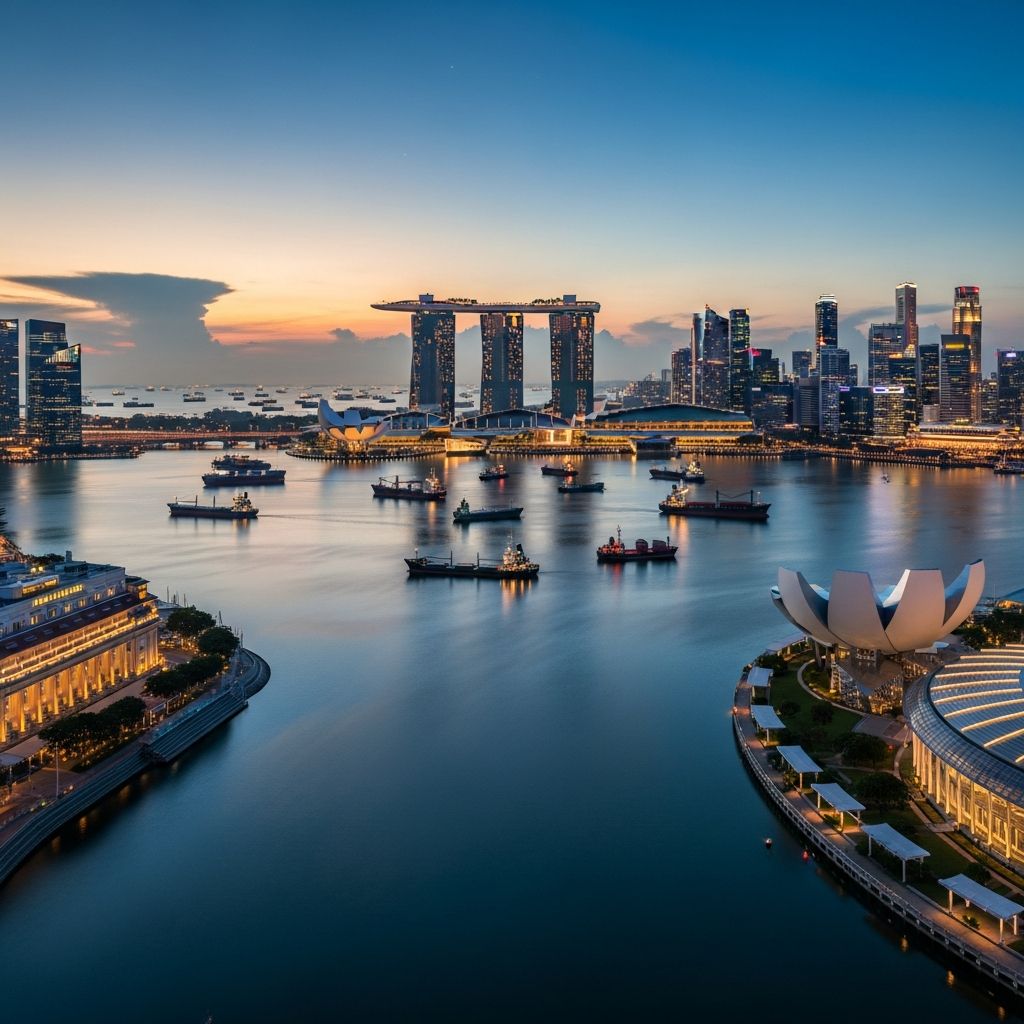
Singapore occupies a prime spot in Southeast Asia as a sovereign city-state, positioned at the southern end of the Malay Peninsula, roughly 137 kilometers north of the Equator. This strategic location between Malaysia and Indonesia has shaped its evolution into one of the world’s most vibrant economic centers.
Geographical Coordinates and Boundaries
Singapore’s central coordinates are approximately 1°17′N 103°50′E, placing it in a pivotal maritime zone. The nation spans a main diamond-shaped island, known as Pulau Ujong, plus over 60 smaller islets, totaling around 728 square kilometers—comparable to slightly more than 3.5 times the size of Washington, D.C.
To the north, the Johor Strait separates it from Peninsular Malaysia, connected by the Johor-Singapore Causeway and the Tuas Second Link bridge. The Singapore Strait lies to the south, bordering Indonesia’s Riau Islands, while the South China Sea touches the east and the Strait of Malacca the west. With no land borders, its 193-kilometer coastline underscores its maritime focus.
Land Composition and Topography
The main island dominates, covering over 90% of the land, measuring about 40 kilometers long and 20 kilometers wide at its broadest. Terrain is mostly low-lying and flat, with elevations rarely exceeding 15 meters, though central areas feature rounded granite hills. Bukit Timah, the highest point at 163.6 meters, exemplifies the modest relief.
- Main island (Pulau Ujong): Hosts the urban core and capital.
- Jurong Island: Industrial hub formed by land reclamation.
- Pulau Ubin and Pulau Tekong: Retained natural, rural character.
- Sentosa Island: Popular for tourism and leisure.
Western and southwestern ridges add subtle elevation, while eastern alluvial plains host streams draining into mangrove-fringed estuaries. Only 1.6% remains arable, highlighting land scarcity amid urban expansion.
Climate and Environmental Features
Proximity to the Equator delivers a tropical rainforest climate: consistently hot (24-32°C), humid (over 80%), with no distinct dry season. Northeast monsoons (November-March) bring heavy rain, while southwest monsoons (June-September) add variability. Annual precipitation exceeds 2,300 mm, supporting lush greenery despite urbanization—over 40% of land is green space.
| Climate Aspect | Details |
|---|---|
| Temperature Range | 24-32°C year-round |
| Humidity | 80-90% |
| Rainy Seasons | Nov-Jan (NE monsoon), May-Sep (SW monsoon) |
| Annual Rainfall | ~2,340 mm |
Challenges include rising sea levels threatening low-lying areas, prompting extensive reclamation (adding ~25% to land area) and coastal defenses.
Strategic Maritime Position and Ports
Singapore’s location at the Strait of Malacca’s eastern end—linking Indian Ocean to South China Sea—makes it indispensable for global shipping. As Southeast Asia’s largest port and world’s second-busiest by cargo tonnage, it handles over 37 million TEUs annually, fueled by deep natural harbors.
Key assets:
- Strait of Malacca: Busiest shipping lane globally.
- Proximity to major routes: India-China-Europe trade.
- Infrastructure: Tuas Mega Port expansion for future growth.
This positioning drives prosperity, with trade exceeding 3x GDP.
Demographics and Urban Landscape
Population nears 6 million (2024 est.), yielding world’s second-highest density after Monaco. Multi-ethnic fabric: 74% Chinese, 13% Malay, 9% Indian, plus expatriates. Official languages—English, Mandarin, Malay, Tamil—reflect diversity; English dominates business.
The city covers much of the main island, blending skyscrapers, Gardens by the Bay, and central nature reserves preserving primary rainforest.
Historical Evolution of Location’s Impact
Modern Singapore traces to 1819 British founding by Stamford Raffles, leveraging the site’s trading potential. Evolving from entrepôt colony to independent republic (1965 post-Malaysia split), its geography enabled rapid industrialization.
Post-independence, land reclamation and vertical growth countered size limits, transforming it into a high-tech hub.
Economic Power from Prime Positioning
Lacking resources, Singapore thrives on location-driven sectors: finance, logistics, biotech, tourism. GDP per capita tops $80,000; it’s Asia’s safest, cleanest city-state. Changi Airport, world’s best, connects 400+ destinations.
| Sector | Contribution to GDP | Location Advantage |
|---|---|---|
| Maritime Trade | 7% | Strait access |
| Finance | 13% | Global hub status |
| Tourism | 4% | Connectivity |
| Manufacturing | 20% | Proximity to markets |
Connectivity and Infrastructure
Two Malaysia links facilitate overland travel; extensive MRT, roads, and airport ensure internal efficiency. Future Tuas Port will double capacity by 2040.
Conservation Amid Density
Despite urbanization, 47% green cover includes Bukit Timah Nature Reserve. Policies mandate greenery in developments, balancing growth with ecology.
Frequently Asked Questions (FAQs)
What is Singapore’s exact location relative to the Equator?
Singapore lies about 137 km (85 miles) north of the Equator, at coordinates 1°17′N 103°50′E.
How many islands make up Singapore?
The country consists of one main island and over 60 smaller islets, with notable ones like Sentosa and Pulau Ubin.
What is the highest point in Singapore?
Bukit Timah reaches 163.6 meters (537 feet), the nation’s peak.
Why is Singapore’s port so important?
Its position at the Strait of Malacca junction makes it a vital link for Asia-Europe-Indian Ocean trade routes.
What climate does Singapore have?
Tropical rainforest: hot, humid year-round with heavy monsoon rains.
Is Singapore connected by land to Malaysia?
Yes, via the Johor-Singapore Causeway and Tuas Second Link.
References
- Singapore | Facts, Geography, History, & Points of Interest — Encyclopædia Britannica. 2024. https://www.britannica.com/place/Singapore
- Singapore Profile – Important Facts, People and History — Day Translations. 2023. https://www.daytranslations.com/blog/guide/singapore/2/
- SINGAPORE BASICS: HISTORY, RELIGION, LANGUAGE … — Facts and Details. 2023. https://factsanddetails.com/southeast-asia/Singapore/sub5_7e/entry-6712.html
- Singapore Country Profile — Greater Cincinnati World Affairs Council. 2024. https://globalcincinnati.org/programs/global-education/country-profiles/singapore/
- Singapore — Wikipedia. 2026-04-04. https://en.wikipedia.org/wiki/Singapore

- Integrated M.A. in Applied Linguistics, University of Hyderabad
- 5+ years in editorial, instructional, SEO, and research-based writing
Sneha is a relationships and lifestyle writer with a strong foundation in applied linguistics and certified training in relationship coaching. She brings over five years of writing experience to theskillvault, crafting thoughtful, research-driven content that empowers readers to build healthier relationships, boost emotional well-being, and embrace holistic living. Her writing and insights reflect the belief that beauty, happiness, and wellness…