
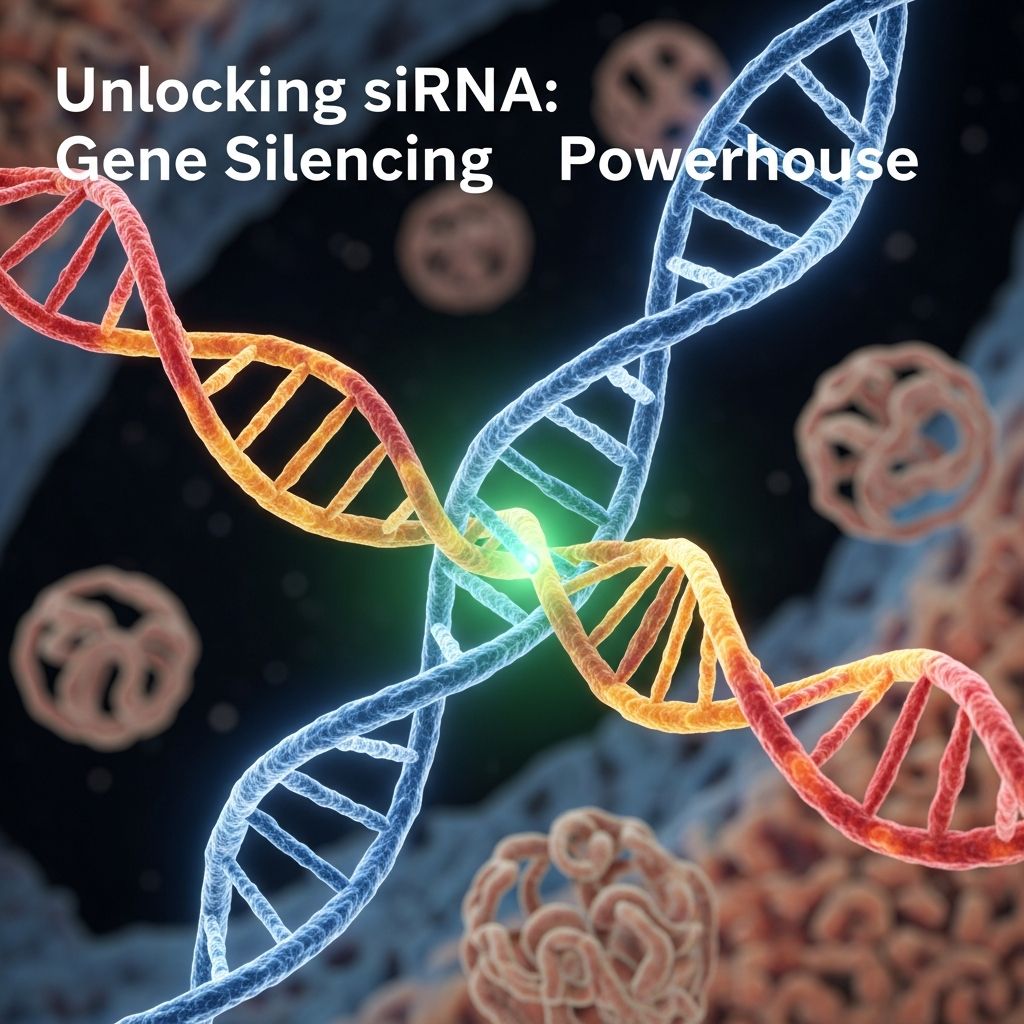
Small interfering RNA, commonly called **siRNA**, represents a breakthrough in molecular biology for its ability to precisely target and suppress specific genes. This double-stranded RNA molecule, typically 20-24 base pairs long, triggers RNA interference (RNAi), a natural cellular process that degrades messenger RNA (mRNA) before it can produce proteins. By halting protein synthesis at the source, siRNA offers researchers and clinicians a tool to study gene functions and combat diseases driven by overactive or mutant genes.
Unlike broader gene-editing technologies like CRISPR, siRNA provides transient, reversible silencing without altering DNA. Its discovery in 1998 by Andrew Fire and Craig Mello earned them the Nobel Prize, highlighting its transformative impact on understanding gene regulation.
Core Mechanism of siRNA Action
The journey of siRNA begins with its entry into the cell, often via synthetic delivery or natural production. Once inside, the enzyme **Dicer** processes longer double-stranded RNA into siRNA duplexes if needed. The siRNA then integrates into the **RNA-induced silencing complex (RISC)**, a multiprotein assembly that unwinds the duplex. The guide strand, with perfect complementarity to the target mRNA, remains bound to RISC, while the passenger strand is discarded.
RISC scans the cellular environment for matching mRNA. Upon binding, it cleaves the target mRNA via the Argonaute protein’s endonuclease activity, rendering it non-functional and preventing translation into protein. This post-transcriptional gene silencing (PTGS) ensures rapid, specific knockdown, lasting days to weeks depending on cell type and delivery method.
- Dicer Cleavage: Converts precursor RNA into mature siRNA duplexes of 20-24 nucleotides.
- RISC Loading: Guide strand directs complex to complementary mRNA.
- mRNA Degradation: Precise cleavage blocks protein production.
- Specificity: Requires 100% base-pair match, minimizing off-target effects compared to microRNAs.
This mechanism also defends against viruses by targeting viral RNA and maintains genome stability by silencing transposons.
Historical Evolution and Discovery
siRNA’s story traces back to observations of RNAi in plants and worms in the mid-1990s. In 1998, Fire and Mello demonstrated that injected double-stranded RNA specifically silenced genes in C. elegans, distinguishing it from single-stranded antisense RNA. This pinpointed dsRNA as the potent trigger for RNAi.
Subsequent research revealed endogenous siRNAs in mammals, expanding from antiviral roles to chromatin regulation. Advances in chemical synthesis allowed custom siRNAs for any gene, propelling its use in labs worldwide. Today, siRNA libraries enable high-throughput screening of thousands of genes.
Key Applications in Research
siRNA dominates functional genomics by enabling **gene knockdown** experiments. Researchers introduce siRNAs via transfection, electroporation, or viral vectors expressing short hairpin RNAs (shRNAs), which cells process into siRNAs. This reveals gene roles in processes like cell division, signaling, and differentiation.
In **high-throughput screens**, siRNA arrays identify pathways in cancer, HIV, and hepatitis. For instance, silencing genes involved in cytokinesis or apoptosis uncovers novel drug targets. Disease modeling uses siRNA to mimic pathologies in cells or animals, testing therapies for neurodegeneration or autoimmunity.
| Research Area | siRNA Role | Example Outcomes |
|---|---|---|
| Functional Genomics | Phenotypic analysis via knockdown | Identifies drug targets in signaling pathways |
| Disease Modeling | Gene reduction in models | Studies cancer pathogenesis |
| Toxicity Testing | Stress gene silencing | Evaluates drug safety on cell viability |
| Virology | Viral gene targeting | Blocks HIV replication |
siRNA’s transient nature suits short-term studies (2-4 days), ideal for transient transfections in hard-to-transfect cells.
Therapeutic Frontiers: From Bench to Bedside
siRNA therapeutics target undruggable proteins by silencing disease-causing genes. Approved drugs like patisiran (for hereditary transthyretin amyloidosis) use lipid nanoparticles for liver delivery, demonstrating clinical success.
In **cancer**, siRNA silences oncogenes like KRAS, halting tumor growth. Antiviral applications target HIV or hepatitis genes, reducing viral loads. For **genetic disorders**, allele-specific siRNAs distinguish mutant from wild-type alleles, crucial for dominant gain-of-function diseases.
Challenges include delivery barriers: siRNAs degrade in blood, trigger immunity, and struggle with off-target tissues. Solutions involve chemical modifications (e.g., 2′-O-methyl), GalNAc conjugates for liver targeting, and nanoparticles.
- Cancer: Inhibits oncogene-driven proliferation.
- Viral Infections: Degrades viral mRNA.
- Genetic Diseases: Suppresses mutant alleles.
- Neurodegeneration: Targets tau in Alzheimer’s models.
Emerging in vivo RNAi in animal models validates targets for cardiovascular and autoimmune conditions.
Comparing siRNA to Other Silencing Tools
| Tool | Duration | Specificity | Delivery | Use Case |
|---|---|---|---|---|
| siRNA | Transient (days-weeks) | High (perfect match) | Transfection, nanoparticles | Research, liver therapeutics |
| shRNA | Stable (long-term) | High | Viral vectors | Stable cell lines |
| miRNA | Endogenous, regulatory | Partial match | Natural | Gene regulation studies |
| ASO | Transient | RNase H cleavage | Injection | Broad exon skipping |
siRNA excels in precision and ease of design but requires optimization for stability.
Challenges and Future Directions
Despite promise, siRNA faces hurdles: immune activation via Toll-like receptors, nuclease degradation, and tissue-specific delivery. Modifications like locked nucleic acids (LNAs) enhance stability and reduce off-targets.
Future innovations include brain-penetrating conjugates for neurodegeneration and universal delivery platforms. Combination therapies with immunotherapy or CRISPR could amplify effects. With over thousands of publications, siRNA’s trajectory points to broader clinical adoption.
Frequently Asked Questions (FAQs)
What exactly is siRNA and how does it differ from mRNA?
siRNA is a short double-stranded non-coding RNA that silences genes by degrading target mRNA, while mRNA carries protein-coding instructions from DNA.
How long does siRNA silencing last in cells?
Typically 2-4 days for transient transfection, extendable via shRNA vectors for weeks.
Can siRNA be used to treat cancer?
Yes, by targeting oncogenes to inhibit tumor growth, with ongoing clinical trials.
What are the main delivery methods for siRNA?
Transfection for research, lipid nanoparticles or GalNAc for therapeutics.
Is siRNA specific enough for allele-specific silencing?
Yes, it can distinguish single-nucleotide differences for dominant genetic diseases.
Advanced Topics: siRNA in Genome Defense
Beyond research, endogenous siRNAs protect against transposons and viruses by transcriptional silencing, maintaining chromatin integrity. In plants and invertebrates, they form heritable defenses.
In mammals, siRNAs contribute to piRNA pathways for germline protection. Synthetic siRNAs mimic this for therapeutic antiviral defense.
Recent advances explore siRNA for epigenetic modulation, activating or repressing genes via chromatin changes, expanding beyond degradation.
Case Studies: Real-World Impact
In HIV research, siRNA screens identified host factors for viral entry, guiding new antivirals. Cancer studies silenced apoptosis regulators, revealing pathway vulnerabilities.
Therapeutically, inclisiran (siRNA for PCSK9) lowers cholesterol via liver silencing, approved for cardiovascular disease.
These examples underscore siRNA’s shift from tool to treatment.
References
- siRNA – Applications — Horizon Discovery. 2023. https://horizondiscovery.com/en/applications/rnai/sirna-applications
- Small Interfering RNA | siRNA Applications — Danaher Life Sciences. 2024. https://lifesciences.danaher.com/us/en/library/sirna.html
- Small interfering RNA (siRNA) — McManus Lab, UCSF. 2023. https://mcmanuslab.ucsf.edu/node/268
- What is SiRNA? — News-Medical.net. 2024-01-15. https://www.news-medical.net/life-sciences/What-is-SiRNA.aspx
- siRNA: From a Powerful Research Tool to Potent Therapeutic Modality — Oligonucleotide Therapeutics Society. 2023. https://oligotherapeutics.org/sirna-from-a-powerful-research-tool-to-potent-therapeutic-modality/
- Small interfering RNA — Wikipedia (primary refs to Fire & Mello, 1998). 2026. https://en.wikipedia.org/wiki/Small_interfering_RNA

Medha Deb is an editor with a master's degree in Applied Linguistics from the University of Hyderabad. She believes that her qualification has helped her develop a deep understanding of language and its application in various contexts. Medha specializes in the areas of beauty, health, sports, and wellness and is committed to ensuring that the content on the website is…