
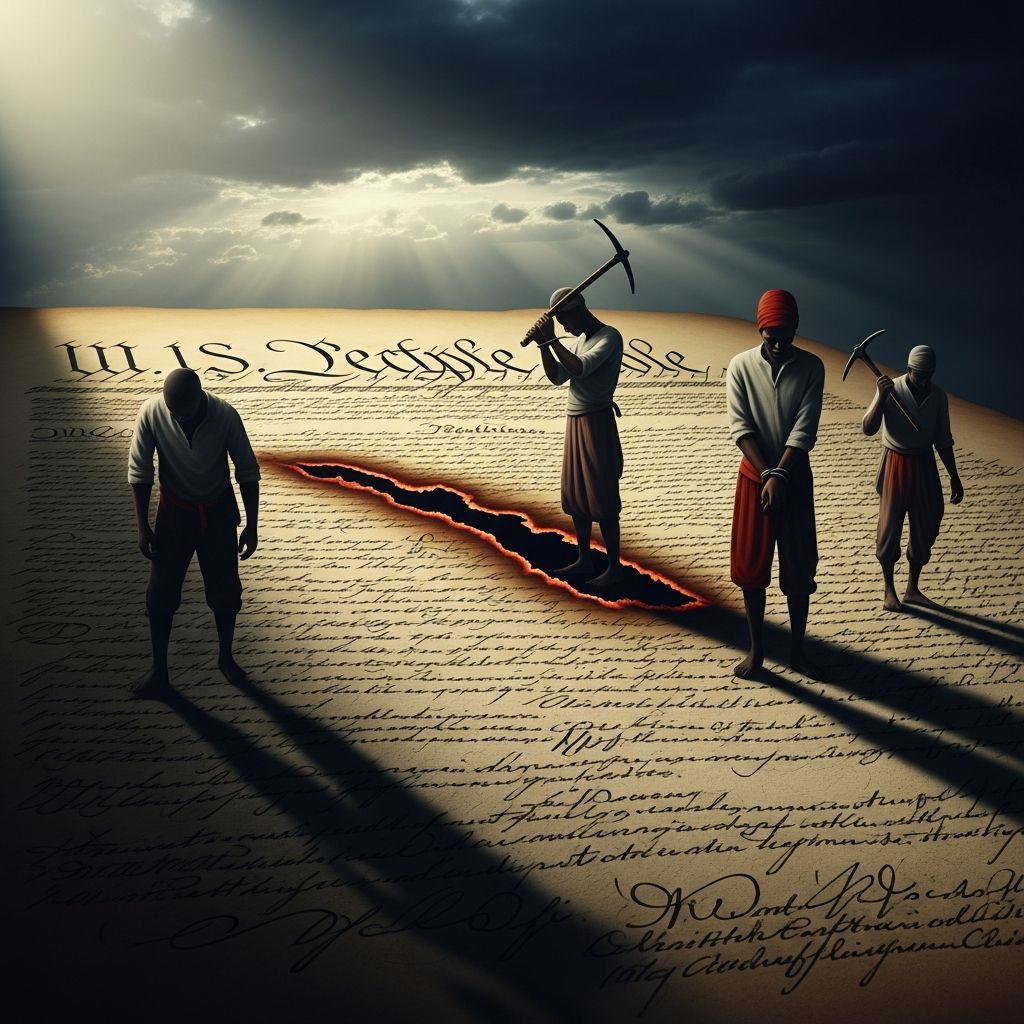
The original U.S. Constitution of 1787 did not explicitly endorse slavery, yet it contained provisions that accommodated the institution to secure ratification by Southern states. These compromises reflected the economic realities of the time, where slave labor underpinned agriculture in the South, while Northern states increasingly viewed it as morally repugnant.
Historical Context of Slavery at the Founding
During the Constitutional Convention in Philadelphia, delegates grappled with slavery amid a nation divided by regional interests. Southern states, reliant on enslaved labor for tobacco, rice, and later cotton, demanded protections. Northern delegates, many of whom had begun phasing out slavery, sought to limit its expansion. The result was a document that avoided the words “slave” or “slavery,” referring instead to “persons” to maintain a veneer of moral neutrality.
Thomas Jefferson, in his initial draft of the Declaration of Independence, had condemned the African slave trade as an “execrable commerce” against human nature. However, such language was removed to appease Southern interests. The Constitution similarly punted on abolition, prioritizing union over immediate moral reckoning.
Key Provisions Accommodating Slavery
Several clauses indirectly supported slavery, balancing representation, trade, and property rights.
The Three-Fifths Compromise
Article I, Section 2, Clause 3 counted enslaved people as three-fifths of a person for representation and direct taxation. This boosted Southern congressional power without granting enslaved individuals voting rights, giving slaveholding states disproportionate influence.
- Increased House seats and Electoral College votes for Southern states.
- Applied to taxation, though direct taxes were rare until the Civil War.
- Critics argue it dehumanized the enslaved; defenders note it was a pragmatic tally for apportionment.
Slave Trade Clause
Article I, Section 9, Clause 1 prohibited Congress from banning the importation of “such persons as any of the states now existing shall think proper to admit” before 1808. This 20-year delay allowed the transatlantic slave trade to continue, importing over 200,000 Africans despite growing abolitionist sentiment.
Congress ended the trade in 1807, effective 1808, but domestic breeding and trading persisted.
Fugitive Slave Clause
Article IV, Section 2, Clause 3 mandated that escaped “person[s] held to service or labor” be returned to their owners, overriding state sanctuary laws. This passed unanimously, underscoring slavery’s entrenchment across state lines.
Implemented via the Fugitive Slave Acts of 1793 and 1850, it fueled tensions leading to the Underground Railroad and Civil War.
Other Indirect Supports
Article I, Section 8 empowered militias to suppress “insurrections,” including slave rebellions like Nat Turner’s 1831 uprising. Article I, Section 9, Clause 5 banned export taxes, protecting Southern goods produced by slave labor.
| Clause | Location | Effect on Slavery |
|---|---|---|
| Three-Fifths | Art. I, Sec. 2, Cl. 3 | Enhanced Southern representation |
| Slave Trade | Art. I, Sec. 9, Cl. 1 | Delayed federal ban until 1808 |
| Fugitive Slave | Art. IV, Sec. 2, Cl. 3 | Required return of escapees |
| Insurrections | Art. I, Sec. 8 | Allowed militia suppression |
Anti-Slavery Elements and Pathways to Extinction
Despite accommodations, the Constitution included mechanisms to curb slavery’s growth. Article IV, Section 3, Clause 2 granted Congress authority over territories, enabling bans on slavery there. Article I, Section 9’s 1808 deadline hinted at future abolition.
James Madison viewed slavery as permissible but not moral—legal yet illegitimate. Framers anticipated its natural decline, empowered by natural rights principles.
Early territorial acts were mixed: from 1798-1822, only half banned slavery, allowing expansion into Missouri and beyond.
The Road to Abolition: Civil War and 13th Amendment
The Compromise of 1850 and Kansas-Nebraska Act intensified conflicts, culminating in the 1861 secession. President Lincoln’s 1863 Emancipation Proclamation freed slaves in rebel states but left border states untouched.
Congress passed the 13th Amendment on January 31, 1865; ratified December 6, 1865. Section 1 declares: “Neither slavery nor involuntary servitude, except as a punishment for crime whereof the party shall have been duly convicted, shall exist within the United States, or any place subject to its jurisdiction.” Section 2 empowers enforcement legislation.
This resolved the Founders’ central contradiction, abolishing chattel slavery nationwide.
Modern Implications and the Punishment Exception
The exception for criminal punishment has enabled prison labor systems, criticized as perpetuating forced work disproportionately affecting Black Americans. Efforts to amend it continue, highlighting ongoing debates.
By 1865, the amendment transformed the Constitution from a document tolerating slavery to one prohibiting it explicitly.
Debating the Constitution’s Stance on Slavery
- Pro-Slavery View: Clauses protected the institution, empowering Southern dominance.
- Anti-Slavery View: Indirect language, territorial powers, and anti-spread mechanisms positioned it for extinction.
- Historians like Allen Guelzo argue its principles were inherently anti-slavery.
Frequently Asked Questions (FAQs)
Did the original Constitution use the word “slavery”?
No, it referred to enslaved people as “other persons,” “persons held to service,” or similar to avoid direct endorsement.
When was the slave trade banned by Congress?
The 1807 Act ended imports effective January 1, 1808, per the Constitution’s allowance.
What did the 13th Amendment change?
It abolished slavery nationwide, except as punishment for crime, overriding state laws.
Was the Constitution pro- or anti-slavery?
Neither purely; it compromised to form the union while embedding tools for abolition.
Why the three-fifths count?
To balance representation and taxation, favoring Southern states without full personhood for slaves.
This exploration reveals a Constitution born of compromise, evolving through amendment to uphold freedom’s promise. Its legacy underscores the tension between unity and justice.
References
- What the Constitution Really Says About Race and Slavery — The Heritage Foundation. 2019-09-17. https://www.heritage.org/the-constitution/commentary/what-the-constitution-really-says-about-race-and-slavery
- 13th Amendment to the U.S. Constitution: Abolition of Slavery (1865) — National Archives. 2023-01-31. https://www.archives.gov/milestone-documents/13th-amendment
- Constitutional Amendments – Amendment 13 — Ronald Reagan Presidential Library. N/A. https://www.reaganlibrary.gov/education/lesson-plans/high-school/constitutional-amendments/constitutional-amendments-amendment-13
- Essay: Slavery and the Constitution — Bill of Rights Institute. N/A. https://billofrightsinstitute.org/essays/slavery-and-the-constitution/
- U.S. Constitution – Thirteenth Amendment — Library of Congress. N/A. https://constitution.congress.gov/constitution/amendment-13/
- Interpretation: The Slave Trade Clause — Constitution Center. N/A. https://constitutioncenter.org/the-constitution/articles/article-i/clauses/761

Medha Deb is an editor with a master's degree in Applied Linguistics from the University of Hyderabad. She believes that her qualification has helped her develop a deep understanding of language and its application in various contexts. Medha specializes in the areas of beauty, health, sports, and wellness and is committed to ensuring that the content on the website is…