
Introduction to Building Emotional Intelligence in Educational Settings
Educational institutions have increasingly recognized that academic achievement alone does not guarantee student success in life. The ability to understand emotions, manage stress, build meaningful relationships, and make responsible decisions form the foundation of personal and professional wellbeing. Social-emotional learning (SEL) represents a comprehensive approach to developing these vital competencies within the school environment. Rather than treating emotional development as secondary to traditional academics, SEL integrates emotional intelligence training directly into the educational framework, creating opportunities for students to develop interpersonal and intrapersonal skills alongside their cognitive abilities.
The growing emphasis on SEL reflects a fundamental shift in educational philosophy. Modern educators understand that students face unprecedented challenges, from managing digital distractions to navigating complex social dynamics. By providing structured opportunities to develop emotional awareness and social skills, schools prepare students not just for standardized tests, but for the multifaceted demands of contemporary life.
The Five Essential Competencies That Drive Personal Growth
The Collaborative for Academic, Social, and Emotional Learning (CASEL) has established a widely recognized framework consisting of five interconnected competencies that form the foundation of effective SEL programming. Understanding each competency provides educators and parents with a roadmap for fostering comprehensive emotional development.
Recognizing Your Own Emotions and Strengths
The first competency, self-awareness, involves developing a clear understanding of one’s own emotional states, strengths, limitations, and values. This foundational skill enables individuals to recognize how emotions influence their thoughts and behaviors. Self-awareness encompasses the ability to identify personal strengths and acknowledge areas for growth, creating a balanced self-perception that is neither inflated nor diminished. When students develop self-awareness, they can recognize their emotional triggers, understand their learning preferences, and articulate their goals with clarity.
Cultivating self-awareness in educational settings involves encouraging reflection and introspection. Teachers might facilitate this through journaling activities, regular check-in conversations, or guided discussions about personal values and aspirations. Students who develop robust self-awareness demonstrate greater confidence and resilience when facing academic and social challenges.
Directing Your Actions and Regulating Your Responses
Self-management refers to the capacity to regulate emotions, control impulses, and maintain focus toward achieving goals. This competency directly impacts academic performance and interpersonal success. Self-management includes stress management techniques, self-discipline, motivation, organizational skills, and the ability to persist through difficulties. Students with strong self-management skills can delay gratification, follow through on commitments, and navigate setbacks without becoming overwhelmed.
Practical self-management strategies for students include goal-setting exercises, time management instruction, and explicit teaching of relaxation techniques. When students learn to manage their emotions constructively, they demonstrate improved attention in class, complete assignments more effectively, and interact more positively with peers and teachers.
Understanding Others’ Perspectives and Experiences
Social awareness encompasses empathy, perspective-taking, and understanding social and cultural norms. This competency develops from recognizing another person’s emotional state and point of view, allowing individuals to respond with compassion and cultural sensitivity. Students with strong social awareness can interpret social cues correctly, understand diverse viewpoints, and appreciate differences across cultural and socioeconomic backgrounds.
Developing social awareness requires creating classroom environments where diverse perspectives are valued and discussed openly. Literature discussions, community service projects, and structured conversations about current events all provide opportunities for students to practice perspective-taking and develop empathy for others’ experiences.
Building and Maintaining Positive Connections
Relationship skills involve the capacity to establish and sustain healthy connections with others, navigate conflict constructively, and collaborate effectively in group settings. These skills encompass communication abilities, teamwork capacity, and conflict resolution strategies. Students with strong relationship skills can express themselves clearly, listen actively to others, and work toward mutually beneficial solutions when disagreements arise.
Educators can strengthen students’ relationship skills through structured collaborative activities, peer mediation programs, and explicit instruction in communication strategies. When students practice these skills regularly, they experience greater social belonging and develop the interpersonal foundation needed for academic group work and future professional environments.
Making Thoughtful Decisions With Consideration of Consequences
Responsible decision-making involves analyzing situations, considering multiple perspectives, and making choices aligned with personal values and ethical principles. This competency requires students to think through the potential consequences of their actions and recognize how their decisions affect themselves and others. Rather than making impulsive choices, students with developed decision-making skills gather information, weigh alternatives, and consider long-term implications.
Teachers can facilitate development of this competency through case study analysis, scenario-based discussions, and guided decision-making processes. When students regularly engage in structured reflection about their choices, they internalize a deliberate approach to decision-making that serves them well beyond the classroom.
Creating the Foundational Elements for Effective Implementation
Successfully implementing SEL requires attention to what researchers call the S.A.F.E. framework, which ensures programs are Sequenced, Active, Focused, and Explicit. Sequenced instruction means that SEL activities build upon one another in a logical progression, allowing students to develop increasingly complex skills. Active learning involves hands-on practice through roleplaying, simulations, and collaborative problem-solving rather than passive instruction. Focused time specifically dedicated to social-emotional skill development signals its importance to students. Finally, explicit instruction clearly identifies which skills are being targeted, helping students understand and internalize the learning objectives.
Establishing a Culture of Psychological Safety
The cornerstone of any successful SEL program is the creation of a classroom environment where students feel emotionally and physically safe. This safe and supportive environment requires teachers to set clear behavioral expectations, listen actively to student concerns, and consistently foster a sense of belonging. When students trust that their classroom is a judgment-free space where their emotions are validated, they become willing to take the social and emotional risks necessary for genuine learning and growth.
Practical strategies for building psychological safety include beginning each day with check-in circles where students share their emotional state, implementing mood tracking activities, and ensuring that all voices are heard and respected in classroom discussions. Teachers who prioritize emotional safety witness improved student engagement, reduced behavioral incidents, and stronger academic performance.
Developing Empathy and Collaborative Problem-Solving
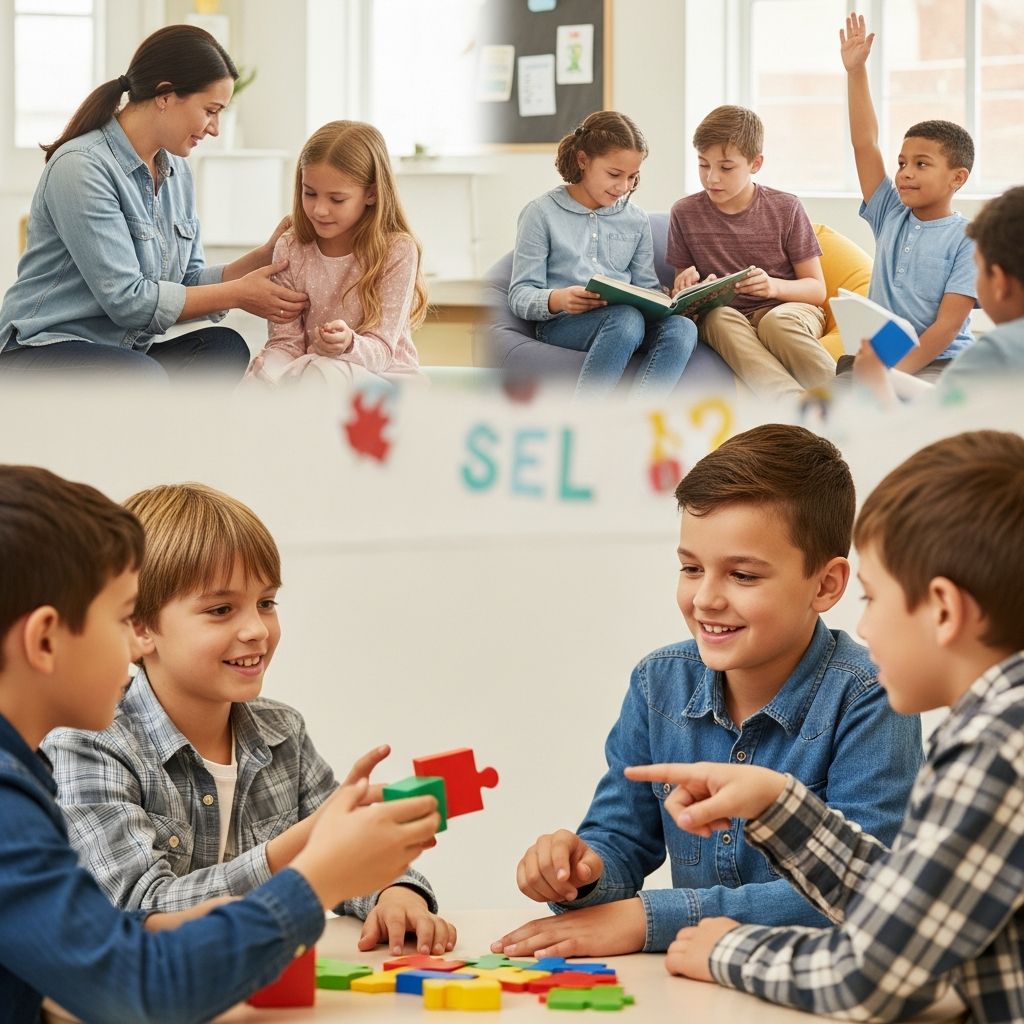
Beyond individual emotional development, SEL emphasizes the importance of fostering empathy and collaborative skills that prepare students to work effectively with diverse peers. Group activities designed to solve problems, resolve conflicts, or complete creative projects build teamwork capacity while developing perspective-taking abilities. When students work together toward shared goals, they naturally develop empathy as they learn to understand and respect different approaches, viewpoints, and strengths.
Collaborative activities might include puzzle-solving challenges, STEM projects requiring joint problem-solving, team-building games, or collective art projects. These experiences teach students that diverse perspectives strengthen group outcomes and that individual differences represent assets rather than obstacles.
Strategic Approaches for Bringing SEL Into Your School Community
Implementing SEL effectively requires a systemic, whole-school approach rather than isolated classroom initiatives. This comprehensive implementation involves developing a shared vision, conducting needs assessments, integrating SEL into all content areas, and building partnerships with families and communities.
Beginning With a Unified Vision and Assessment
Schools implementing SEL should start by developing a shared vision that articulates why SEL matters for their student population and how it aligns with broader educational goals. This process involves gathering input from educators, administrators, families, and students themselves. Following vision development, schools should conduct comprehensive needs and resources assessments to identify current strengths and areas requiring development.
Integrating SEL Throughout the Academic Day
Rather than treating SEL as an add-on program, schools should weave social-emotional competencies throughout content-area instruction. English language arts instruction naturally incorporates perspective-taking through literature analysis. Science projects provide opportunities for collaborative problem-solving. Mathematics instruction involves perseverance and managing frustration when tackling challenging problems. History and social studies classes develop empathy and social awareness through examination of diverse human experiences.
Building Bridges Between School and Families
For SEL initiatives to be maximally effective, schools must establish partnerships with families and communities. This collaboration begins by understanding parental attitudes, knowledge levels, and expectations regarding SEL. Schools might conduct surveys, hold informational meetings, or make home visits to discuss how families define their involvement with social-emotional development. Creating accessible resource banks—whether through online portals or designated school offices—helps families understand SEL fundamentals and provides activities they can reinforce at home.
Selecting Evidence-Based Curriculum
Schools should prioritize adopting evidence-based SEL programs with demonstrated track records of success rather than implementing ad hoc initiatives. Comprehensive curricula often include structured units addressing emotional literacy, social interactions, and personal growth across multiple grade levels. High-quality programs provide detailed lesson plans, teacher training, and ongoing support to ensure consistent, effective implementation.
Adapting SEL for Different Developmental Stages
Effective SEL programming recognizes that emotional and social development unfolds differently across childhood and adolescence. Elementary students benefit from concrete, activity-based learning that develops foundational emotional vocabulary and basic relationship skills. Middle school programs should address the increasing complexity of peer relationships and identity formation. High school SEL can build upon earlier competencies to address abstract reasoning about values, future planning, and civic responsibility.
Reading Instruction Enhanced Through Emotional Learning
One powerful integration point involves combining literacy instruction with social-emotional development. Teaching reading fundamentals while incorporating emotional learning creates multiple entry points for engagement. Strategies might include examining character emotions and motivations in literature, discussing how different perspectives shape interpretation, and reflecting on personal connections to stories. This integrated approach helps struggling readers develop investment in texts while simultaneously building emotional intelligence.
Measuring Progress and Ensuring Continuous Improvement
Schools should establish clear metrics for assessing SEL program effectiveness. This might include tracking changes in student behavior, monitoring academic performance, conducting social-emotional assessments, and gathering qualitative feedback from students, families, and staff. Regular data review enables schools to refine their approaches, address implementation challenges, and celebrate successes with the broader community.
Frequently Asked Questions About Social-Emotional Learning
Q: How does SEL differ from traditional character education programs?
A: While character education focuses on teaching moral values, SEL emphasizes developing the emotional and social competencies students need to understand and live those values. SEL provides specific skill-building instruction and practice opportunities, whereas character education often addresses values more broadly.
Q: Will implementing SEL take time away from academic instruction?
A: When implemented effectively, SEL actually enhances academic outcomes by improving student engagement, reducing behavioral disruptions, and developing the self-management skills necessary for academic success. Integration into existing content areas minimizes additional time demands.
Q: Can SEL benefit students who already have strong social skills?
A: Yes. Even students with naturally strong interpersonal abilities benefit from explicit instruction that deepens their emotional awareness, expands their conflict resolution strategies, and develops their capacity for leading and supporting peers.
Q: How can schools support teachers in delivering SEL programming effectively?
A: Schools should provide comprehensive professional development, create collaborative planning time, offer coaching support, and ensure teachers themselves have opportunities to develop their own social-emotional competencies before facilitating student learning.
Q: What evidence exists that SEL actually improves student outcomes?
A: Research demonstrates that SEL correlates with positive academic outcomes and contributes to student success across multiple dimensions. Students in schools with robust SEL programming show improvements in academic achievement, attendance, behavior, and overall wellbeing.
Q: How can families support SEL development at home?
A: Families can reinforce SEL competencies by modeling emotional regulation, encouraging children to reflect on their feelings and decisions, facilitating family discussions about diverse perspectives, and creating predictable routines that support emotional security.
Moving Forward: The Long-Term Impact of Social-Emotional Learning
As schools navigate increasingly complex educational landscapes, SEL represents a commitment to developing whole students. By intentionally building emotional intelligence, relationship skills, and responsible decision-making capacity, educators prepare students not merely for academic success but for meaningful, connected lives. The investment in social-emotional competencies today yields returns that extend far beyond report cards—into students’ personal relationships, career trajectories, and contributions to their communities.
References
- A Guide to Social Emotional Learning (SEL) — Northstar Academy. Accessed April 2026. https://northstarva.org/newsa-guide-to-social-emotional-learning-sel/
- Best Practices in Social-Emotional Learning — Utah State Office of Education. https://schools.utah.gov/ulead/uleadfiles/reports/bestpractice/Best%20Practices%20in%20Social-Emotional%20Learning.pdf
- A Beginner’s Guide to Social-Emotional Learning for Adults — Positive Action. Accessed April 2026. https://www.positiveaction.net/blog/sel-for-adults
- The Complete Guide To Social-Emotional Learning — Navigate360. Accessed April 2026. https://navigate360.com/the-complete-guide-to-emotional-learning/
- Social Emotional Learning: Recent E-Books — Stanford University Libraries. Accessed April 2026. https://guides.library.stanford.edu/social_emotional_learning/recent_ebooks
- Social-Emotional Learning (SEL) Strategies — Curriculum Associates. Accessed April 2026. https://www.curriculumassociates.com/blog/sel-strategies
- Social Emotional Learning: A Guide to Systemic Whole School Implementation — New York State Education Department. https://www.nysed.gov/sites/default/files/programs/student-support-services/sel-a-guide-to-systemic-whole-school-implementation.pdf
- Fundamentals of SEL — Collaborative for Academic, Social, and Emotional Learning (CASEL). Accessed April 2026. https://casel.org/fundamentals-of-sel/

- Integrated M.A. in Applied Linguistics, University of Hyderabad
- 5+ years in editorial, instructional, SEO, and research-based writing
Sneha is a relationships and lifestyle writer with a strong foundation in applied linguistics and certified training in relationship coaching. She brings over five years of writing experience to theskillvault, crafting thoughtful, research-driven content that empowers readers to build healthier relationships, boost emotional well-being, and embrace holistic living. Her writing and insights reflect the belief that beauty, happiness, and wellness…