
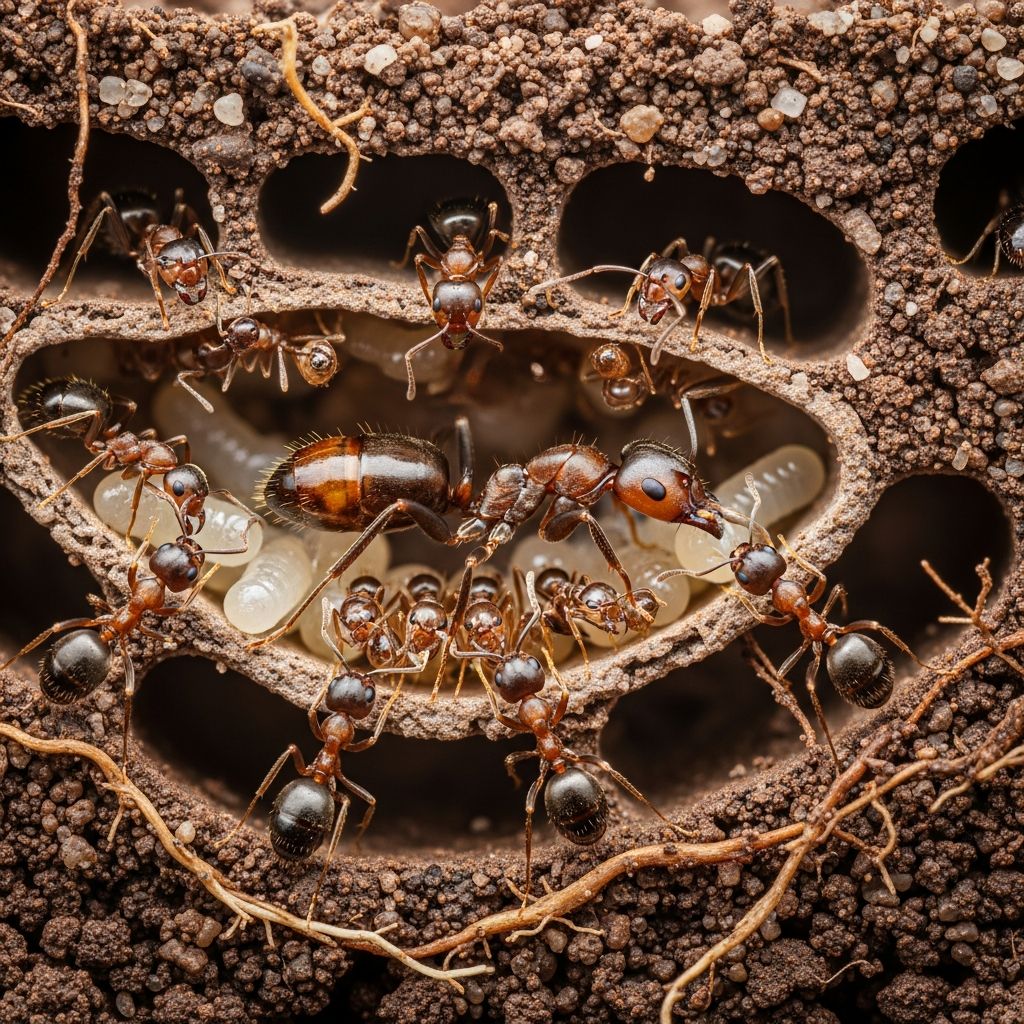
Social insects represent some of the most remarkable examples of cooperation in the animal kingdom, forming complex societies that rival those of vertebrates in sophistication. These creatures, primarily ants, bees, wasps, and termites, live in large colonies where individuals specialize in specific roles, enabling the group to thrive in diverse environments.
Defining True Sociality in Insects
While many insects display group behaviors like shared feeding or nesting, true sociality—known as eusociality—requires specific criteria. Eusocial species exhibit cooperative brood care, where colony members raise young that are not their own; overlapping generations, with adults coexisting with their parents and offspring; and a clear division of labor, including castes like reproductive queens and non-reproductive workers.
Species falling short of these standards are termed presocial, encompassing subsocial insects with parental care and parasocial ones sharing nests without full caste differentiation. This distinction underscores why only certain hymenopterans (ants, bees, wasps) and termites achieve higher social complexity.
Evolutionary Pathways to Eusocial Colonies
The transition to eusociality marks a major evolutionary milestone, transforming individual insects into superorganisms where the colony functions as a single unit. Key drivers include haplodiploidy in hymenopterans, where females develop from fertilized eggs and males from unfertilized ones, promoting kin selection—workers favor raising sisters over their own offspring due to shared genes.
In termites, diploid inheritance necessitates different mechanisms, such as mutual monogamy between kings and queens, fostering high relatedness. Worker sterility solidifies this shift: when workers lose reproductive capacity, individual fitness aligns with colony success, enabling extreme specialization. Genera with sterile workers show greater species richness, highlighting eusociality’s adaptive edge.
Ecological pressures like predation, parasitism, and resource scarcity propel social evolution. Tropical climates favor advanced sociality, with facultatively social bees shifting behaviors based on temperature and habitat. Experimental manipulations confirm environment’s role: solitary queens forced together develop reproductive divisions.
Core Castes and Their Specialized Functions
Eusocial colonies feature distinct castes, each optimized for survival.
- Queens: Sole or primary reproducers, laying thousands of eggs. In advanced species, they achieve extraordinary longevity—decades—overcoming typical fecundity-longevity trade-offs.
- Workers: Sterile females handling foraging, nest maintenance, brood care, and defense. They often forgo reproduction entirely, their ovaries vestigial.
- Soldiers: In some ants and termites, enlarged jaws or chemical defenses protect the colony.
- Males (Drones): Short-lived, focused on mating with new queens.
This division allows colonies to scale massively, with army ant swarms exceeding millions and leafcutter ant nests spanning meters underground.
Communication: The Glue of Insect Societies
Without central leadership, social insects rely on decentralized communication for coordination. Ants use pheromones—volatile chemicals—to mark trails to food, recruit nestmates, and signal alarms. Tandem running, where a forager guides a naive worker, exemplifies teaching behavior.
Bees perform waggle dances, encoding distance and direction to resources via body movements and sounds within the hive. Termites communicate via vibrations and touch, while wasps use visual cues alongside chemicals. These multimodal signals ensure task allocation adjusts dynamically to needs, like ramping up foraging during abundance.
Colony Organization Without a Boss
Social insect colonies operate via self-organization, not top-down control. Workers assess local cues—encounters with nestmates, food availability, or brood hunger—to switch tasks. High interaction rates shift ants from nursing to foraging, creating emergent patterns like trail formation.
This flexibility proves resilient: harvester ant colonies maintain foraging despite worker loss, as survivors recalibrate via interactions. Division of labor enhances efficiency, with age polyethism—young workers inside, older ones outside—minimizing risk.
Ecological Dominance and Ecosystem Services
Social insects punch above their weight ecologically, comprising just 2% of species but 40% of insect biomass in some habitats. Ants aerate soil, disperse seeds, and prey on pests; bees pollinate crops; termites decompose wood, recycling nutrients.
| Insect Group | Key Ecosystem Role | Global Impact |
|---|---|---|
| Ants | Soil turnover, predation | ~20,000 species; dominate biomass |
| Bees | Pollination | Essential for 75% of crops |
| Wasps | Pest control | Parasitize herbivores |
| Termites | Decomposition | Process 10-20% tropical litter |
Yet, invasives like Argentine ants disrupt natives, underscoring social insects’ influence.
Challenges and Conflicts Within Colonies
Harmony isn’t absolute; conflicts arise over reproduction. Queens police workers via pheromones suppressing ovaries, while dominance hierarchies in primitively eusocial wasps determine laying rights. Workers may lay male eggs, prompting policing by nestmates destroying them.
Multiple queens in polygynous colonies spark takeovers, resolved through combat or chemical suppression. These tensions reveal evolutionary arms races shaping social stability.
Origins and Diversity of Sociality
Eusociality evolved multiple times: over 15 in bees, 10 in ants, alongside wasps and termites. Primitively eusocial species, like many sweat bees, flex between solitary and social based on seasons. Advanced eusociality, with morphological castes, dominates ants and honeybees.
Halictid bees illustrate reversals: sociality gained/lost with climate shifts, thriving in warm, sunny sites. This lability highlights sociality’s conditional advantages.
Future Research Directions
Genomics reveals sterility’s genetic basis, while climate models predict social insects’ responses to warming—potentially expanding ranges but stressing pollination. Understanding these superorganisms informs pest management, agriculture, and robotics inspired by swarm intelligence.
Frequently Asked Questions (FAQs)
Are all ants truly social?
Yes, all ~12,000 ant species are eusocial, featuring sterile workers and long-lived queens.
Can social insects survive alone?
Rarely; workers depend on colony support, though queens initiate new nests solitarily.
Why do worker bees die after stinging?
The barbed stinger eviscerates them, a sacrificial defense evolved for colony protection.
Do termites have kings?
Unlike hymenopterans, termite colonies retain paired kings and queens, both reproductive.
How do ants find their way back home?
Pheromone trails, visual landmarks, and polarized light cues guide foragers.
References
- Social Insects – ENT 425 – General Entomology — North Carolina State University. 2023. https://genent.cals.ncsu.edu/bug-bytes/social-insects/
- Major Evolutionary Transitions in Social Insects — Frontiers in Ecology and Evolution. 2021-11-04. https://www.frontiersin.org/journals/ecology-and-evolution/articles/10.3389/fevo.2021.732907/full
- Eusociality — Wikipedia (informed by primary sources). N/A. https://en.wikipedia.org/wiki/Eusociality
- Insect Societies — Encyclopædia Britannica. 2024. https://www.britannica.com/animal/insect/Insect-societies
- The organization of work in social insect colonies — Deborah M. Gordon, UC Davis. 1996. https://csc.ucdavis.edu/~cmg/netdyn/Gordon-1.pdf
- Ecological traits of social insects — British Ecological Society Journals. 2024. https://besjournals.onlinelibrary.wiley.com/doi/full/10.1111/1365-2435.14355

Medha Deb is an editor with a master's degree in Applied Linguistics from the University of Hyderabad. She believes that her qualification has helped her develop a deep understanding of language and its application in various contexts. Medha specializes in the areas of beauty, health, sports, and wellness and is committed to ensuring that the content on the website is…