
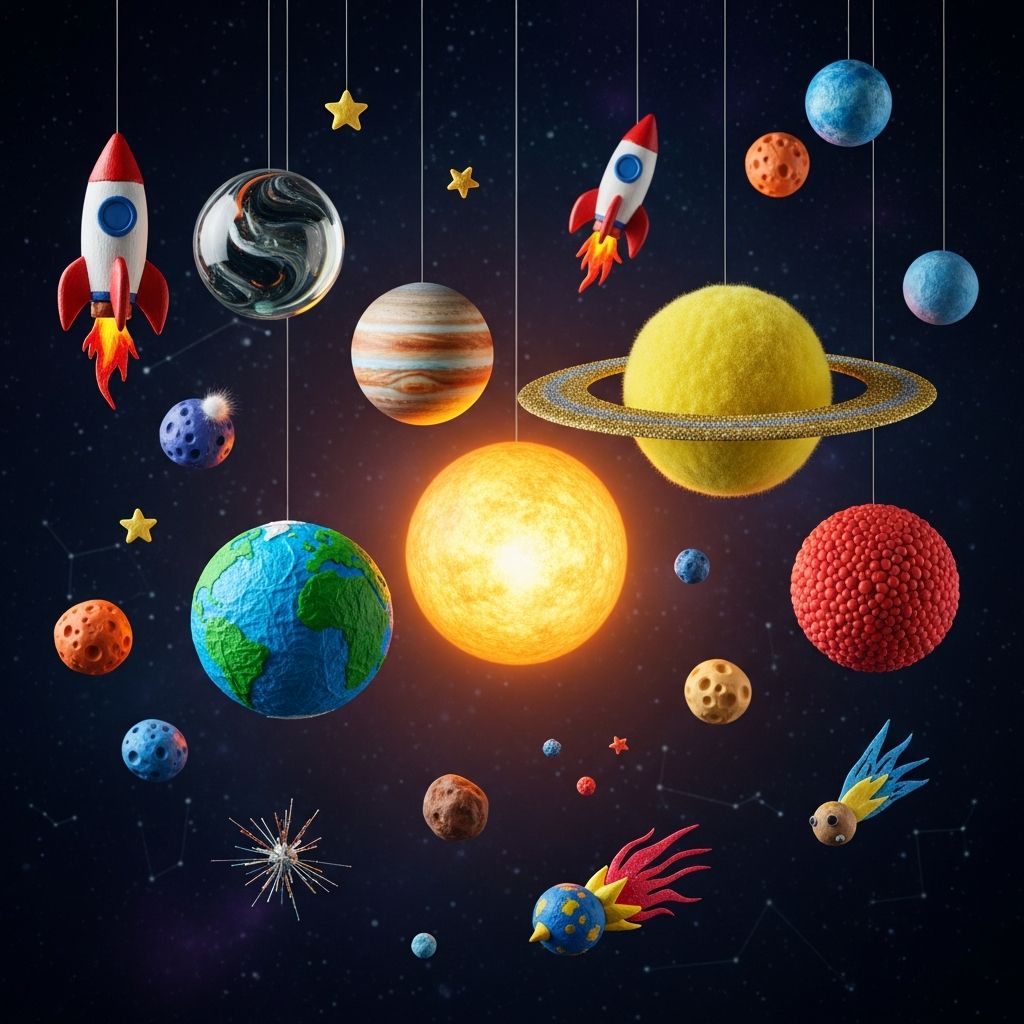
Building models of the solar system offers students a tangible way to grasp the vastness of space, the relative sizes of planets, and their unique features. These projects encourage creativity while reinforcing key astronomical concepts like planetary order, orbits, and characteristics. Suitable for elementary through middle school, they use everyday materials to make learning accessible and exciting.
Why Solar System Projects Matter in Education
Hands-on activities like solar system models help students visualize abstract concepts. According to NASA’s educational resources, interactive models improve retention of facts about planetary distances and compositions by up to 75% compared to lectures alone. They also foster skills in research, design, and presentation, aligning with STEM curricula.
Teachers can adapt projects for different age groups: younger kids focus on colors and shapes, while older students incorporate scale, rotation, and facts. Parents at home can use these to supplement lessons, turning playtime into science exploration.
Essential Materials for Every Project
Most projects require basic supplies found at home or dollar stores:
- Styrofoam balls or foam spheres in varying sizes
- Acrylic paints, markers, or crayons
- Cardboard, poster board, or wooden sticks
- Glue guns, toothpicks, or skewers
- String, yarn, or wire for mobiles
- Optional: LED lights, batteries for glowing effects
Emphasize safety: supervise hot glue use and small parts for young children.
Simple 2D Representations
Start with flat designs for beginners. Draw planets on black poster board using compasses for circles. Paint Mercury closest to a yellow sun, progressing to Neptune farthest out. Label names, distances from the sun, and categories (inner rocky vs. outer gas giants).
For variety, create a sequential strip: cut planet shapes from construction paper, attach to a paper chain in order. Hang it across a wall to demonstrate elliptical orbits. This method suits quick classroom demos and teaches relative positions effectively.
3D Styrofoam Ball Models
A classic choice, these mimic planetary spheres. Select balls by size: small for Mercury, large for Jupiter. Poke skewers through, paint accurately—red for Mars, blue-green for Earth, rings for Saturn using foil or paper. Mount on a cardboard base labeled ‘Our Solar System.’
Enhance with facts: write surface gravity or number of moons on toothpicks. NASA’s planetary fact sheets provide data like Jupiter’s 95 moons. Display on a lazy Susan for spinning orbits.
Interactive Spinning and Rotating Displays
Bring dynamics to models with rotation. Cut cardboard into a large circle for the orbit plane. Attach planets via toothpicks to a central sun dowel, allowing manual spin. For advanced versions, use batteries and small motors from toy kits to automate rotation, simulating a day-night cycle.
A shoebox diorama adds depth: paint the interior black with starry glue-on dots. Suspend planets from the lid with fishing line, positioning to scale (compress distances dramatically for fit). Shine a flashlight as the sun to cast realistic shadows.
Edible and Sensory Crafts
Food-based projects make learning delicious. Use fruits for planets: cherry tomato as Mars, grapefruit as Jupiter, cauliflower florets for the sun. Arrange on a platter with labels. Discuss textures mirroring real surfaces—craters on the moon from cheese balls.
Playdough versions build fine motor skills. Roll colors for layers: Earth with blue oceans over green land, core in red. Flatten into a solar system mat, pressing planets in order. This tactile approach helps kinesthetic learners memorize traits like Venus’s thick atmosphere.
Fiber and Textile Creations
Yarn-wrapped planets develop dexterity. Inflate balloons, dip yarn in glue-water mix, wrap tightly, and pop balloons once dry. Paint the shells: orange for Venus, banded for Jupiter. Suspend as a mobile to show gravitational pull.
Felt cutouts or needle-felted orbs offer soft alternatives. Trace templates for 2D wall hangings or 3D baubles. These portable projects double as ornaments, extending display time.
Recycled and Upcycled Innovations
Promote sustainability with recyclables. Paint ping-pong balls as planets, fit over tea lights for glow. Old CDs make Saturn’s rings, threaded on wire. Cardboard tubes form rocket stands, launching educational narratives.
LEGO enthusiasts build block planets on bases, stacking for volume. Rocks painted as celestial bodies create sturdy, outdoor-friendly models resistant to pets.
Advanced Working Models with Electronics
For science fairs, add mechanics. Wire LEDs into planets—red for Mars, white for polar ice on Europa. Connect to a 9V battery switch for illumination, powered by solar facts: the sun’s energy output is 3.8 × 10^26 watts.
Incorporate gears from hobby kits for orbital paths, demonstrating Kepler’s laws. Document the build process in a report, citing sources like NASA’s Jet Propulsion Laboratory.
| Planet | Relative Diameter | Key Feature | Suggested Material |
|---|---|---|---|
| Mercury | 0.38 Earth | Cratered | Small marble |
| Earth | 1 | Oceans | Tennis ball |
| Jupiter | 11 | Great Red Spot | Basketball |
| Saturn | 9.4 | Rings | Volleyball + foil |
Tips for Accurate and Engaging Presentations
Accuracy elevates projects: use real data for colors (Uranus’s pale cyan) and order (My Very Educated Mother Just Served Us Noodles mnemonic). Practice 2-minute talks covering construction challenges and three facts per planet.
Photograph progress for portfolios. Group projects assign roles: researcher, artist, engineer. Late submissions deduct points; originality trumps store-bought kits.
Frequently Asked Questions (FAQs)
What age groups are these projects best for?
Elementary (K-5) suits simple paints and playdough; middle school (6-8) handles electronics and scales.
How do I teach scale distances?
Compress: place sun in one classroom corner, Pluto in another. Or use a tape measure outdoors.
Are digital tools allowed?
Hybrid: print 3D planet files, but hands-on assembly required for learning benefits.
What if I lack supplies?
Improvise: draw on recyclables, use markers on foil balls.
How to store delicate models?
Use egg cartons for planets; hang mobiles in closets.
Extending Learning Beyond the Model
Follow up with planetariums visits, apps like Solar Walk, or telescope nights. Debate Pluto’s status using IAU definitions. These projects ignite lifelong curiosity in astronomy.
References
- NASA Solar System Exploration — NASA. 2023-10-15. https://science.nasa.gov/solar-system/
- The Sun’s Energy Output — NASA Goddard Space Flight Center. 2024-02-20. https://svs.gsfc.nasa.gov/
- IAU Definition of a Planet — International Astronomical Union. 2006-08-24 (authoritative standard). https://www.iau.org/science/meetings/resolutions/
- Planetary Fact Sheets — NASA Jet Propulsion Laboratory. 2025-01-10. https://nssdc.gsfc.nasa.gov/planetary/factsheet/
- STEM Education Guidelines — U.S. Department of Education. 2024-06-01. https://www.ed.gov/stem

Medha Deb is an editor with a master's degree in Applied Linguistics from the University of Hyderabad. She believes that her qualification has helped her develop a deep understanding of language and its application in various contexts. Medha specializes in the areas of beauty, health, sports, and wellness and is committed to ensuring that the content on the website is…