
Breaking Barriers in Commercial Space Exploration
The private space industry has experienced a seismic shift over the past two decades, fundamentally transforming how humanity accesses and utilizes space. At the forefront of this revolution stands SpaceX, an organization that has systematically dismantled the notion that only government agencies possess the capability to achieve complex spaceflight objectives. Founded with an audacious vision to make space exploration more accessible and economical, SpaceX has evolved from a controversial startup into one of the most consequential aerospace companies in modern history.
The company’s trajectory tells a story of perseverance, technical innovation, and strategic vision. Where skeptics once dismissed private space ventures as unrealistic fantasies, SpaceX has methodically demonstrated capabilities that were previously the exclusive domain of well-funded government programs. This transformation has opened unprecedented opportunities for scientific research, commercial applications, and ultimately, the expansion of human civilization beyond Earth.
From Humble Beginnings to Historic Breakthroughs
The genesis of SpaceX’s operational success required overcoming substantial technical and financial hurdles. The company’s inaugural launch vehicle, the Falcon 1, encountered a series of devastating setbacks that tested organizational resolve and investor confidence. Three consecutive launch failures threatened the viability of the entire enterprise, yet the team persisted with refinements and engineering adjustments. The turning point arrived in September 2008, when the fourth Falcon 1 launch successfully achieved orbital velocity, marking a watershed moment in commercial spaceflight history. This accomplishment held profound significance: the Falcon 1 became the first privately-developed liquid-fueled rocket to reach Earth orbit, validating the feasibility of commercial space launch operations.
Building on this foundation, SpaceX introduced the Dragon spacecraft, a multipurpose vehicle designed for cargo transport and eventually human spaceflight. The Dragon’s inaugural mission in December 2010 demonstrated that private companies could execute complex orbital operations with reliability comparable to established space agencies. When the Dragon spacecraft successfully docked with the International Space Station in May 2012, it became the first commercial vehicle to achieve this milestone, fundamentally reshaping the relationship between private industry and governmental space infrastructure.
Engineering Excellence Through Reusable Technology
The cornerstone of SpaceX’s economic advantage rests upon a technological paradigm shift: the development and deployment of reusable launch systems. Traditional expendable rockets—discarded after a single mission—represented an enormous waste of resources and imposed substantial costs on spaceflight operations. SpaceX rejected this paradigm in favor of designing rockets capable of returning to Earth for refurbishment and reuse, fundamentally altering the economics of space access.
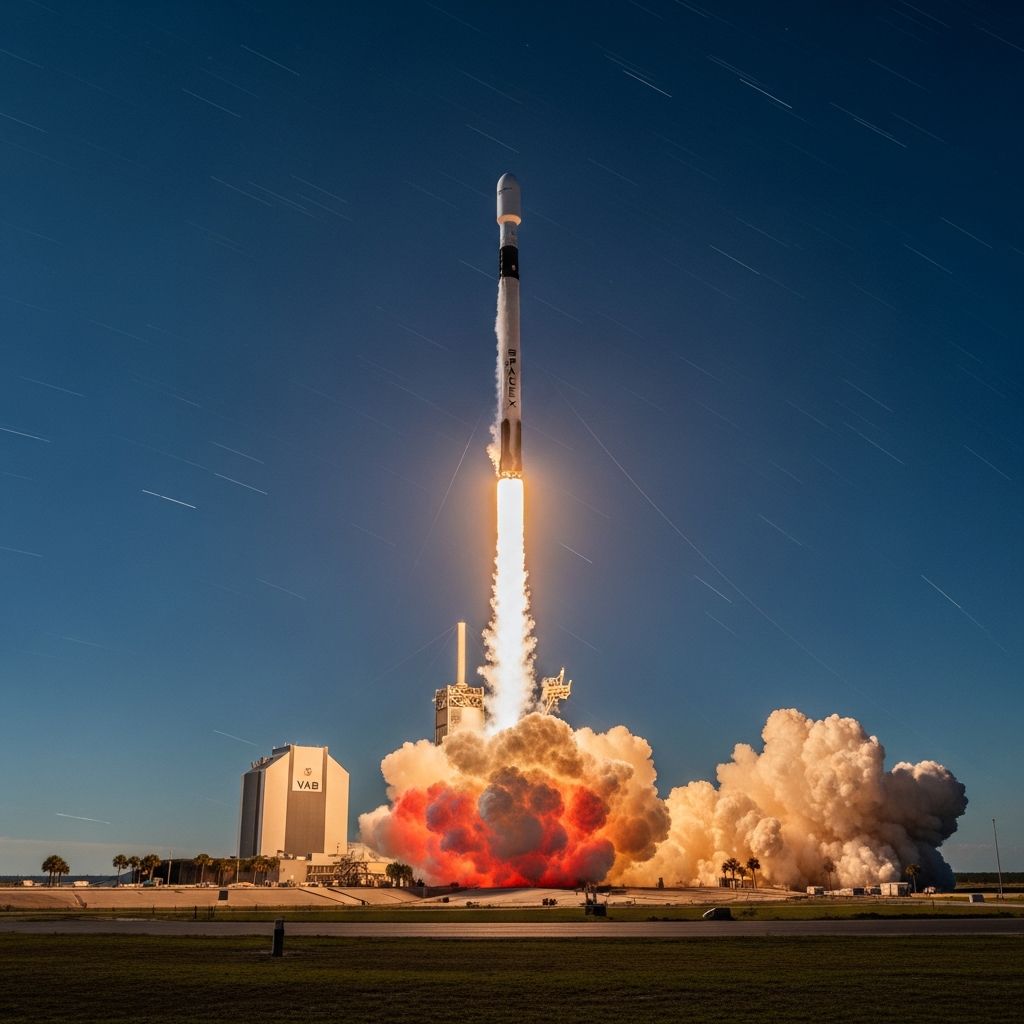
The Falcon 9 represents the most successful embodiment of this reusable rocket philosophy. This medium-lift launch vehicle has become the workhorse of global commercial spaceflight, completing numerous resupply missions to the International Space Station, deploying telecommunications satellites, launching military payloads, and establishing the Starlink global internet constellation. The Falcon 9’s first-stage booster can return to Earth and land vertically, enabling multiple redeployments with minimal refurbishment. This capability has transformed operational economics: missions that previously required years of preparation and hundreds of millions of dollars in development costs now launch with substantially reduced lead times and expenses.
The achievement of perfect operational reliability represents another milestone in SpaceX’s development trajectory. In 2021, the Falcon 9 accomplished an extraordinary feat by completing 101 consecutive orbital launches without experiencing mission failure or partial failure, establishing an unprecedented reliability record for any single rocket type. This accomplishment transcended mere statistical achievement—it demonstrated that commercial launch services could operate with reliability expectations matching or exceeding government-operated systems.
Expanding Capacity with Advanced Heavy-Lift Systems
As SpaceX matured, the company recognized opportunities to expand its launch capabilities beyond the Falcon 9’s payload capacity. The Falcon Heavy emerged as an innovative solution, combining three Falcon 9 first-stage boosters with a specially designed upper stage to create a heavy-lift vehicle capable of deploying massive payloads to orbit. The Falcon Heavy’s spectacular inaugural flight in February 2018 captured global imagination when SpaceX launched a Tesla Roadster toward a trajectory near Mars, complete with a mannequin passenger christened “Starman” by company founder Elon Musk.
By February 2025, the Falcon Heavy had completed 11 successful missions, including both commercial deployments and classified national security launches. This progression established SpaceX as a credible partner for the most demanding space lift requirements, including missions for the U.S. Space Force and other governmental agencies requiring exceptional payload delivery reliability.
Restoring American Human Spaceflight Capability
Perhaps no achievement resonates more profoundly than SpaceX’s restoration of American independent human spaceflight capability. For nearly a decade following the retirement of the Space Shuttle program in 2011, the United States relied exclusively on Russian Soyuz vehicles to transport American astronauts to the International Space Station. This dependency created geopolitical vulnerabilities and financial burdens that prompted NASA to cultivate commercial partners through the Commercial Crew Program.
The Crew Dragon spacecraft, developed through this partnership, underwent extensive validation testing and certification procedures before carrying humans into orbit. On May 30, 2020, SpaceX launched Crew Dragon atop a Falcon 9, carrying NASA astronauts Doug Hurley and Bob Behnken to the International Space Station. This mission transcended routine payload delivery—it represented the restoration of American spaceflight autonomy and validated the commercial spaceflight model for crewed operations. Subsequently, NASA certified the Falcon 9 and Crew Dragon system for operational crew transport, enabling regular astronaut rotations to the space station.
NASA’s strategic investment in SpaceX proved exceptionally valuable, returning substantial capabilities at a fraction of the cost that would have been required for government-operated systems. The 2016 contract worth $2.6 billion allocated to SpaceX for crew transport services established a sustainable model for continued human spaceflight operations. By May 2025, SpaceX had completed 15 commercial crewed missions, with 10 missions sponsored by NASA and others conducted for private space tourism purposes.
Democratizing Access to Space Through Private Missions
The maturation of SpaceX’s crewed capabilities enabled an entirely new category of spaceflight activity: private, non-governmental human space missions. In September 2021, the Inspiration4 mission launched four ordinary citizens aboard a Crew Dragon spacecraft without any professional astronauts aboard. This milestone represented a fundamental transformation in spaceflight accessibility, demonstrating that private citizens could participate directly in space exploration activities. The mission raised over $243 million in charitable donations for St. Jude Children’s Research Hospital, merging commercial spaceflight with philanthropic impact.
The expansion of private space activities continued with increasingly ambitious objectives. On September 12, 2024, the Polaris Dawn mission achieved another historic milestone when two space tourists conducted a spacewalk outside their spacecraft—the first non-governmental extravehicular activity in history. These developments signified the maturation of commercial spaceflight from government-dependent enterprise to genuinely independent industry capable of supporting diverse missions and objectives.
Infrastructure for Global Connectivity
Beyond traditional spaceflight missions, SpaceX has deployed the Starlink satellite constellation, utilizing Falcon 9 launch capacity to establish a global broadband internet network. This application of SpaceX’s launch capabilities demonstrates the multiplier effects of reduced spaceflight costs: the economics of deploying thousands of satellites for continuous global internet coverage became feasible only with the cost reductions enabled by reusable rocket technology. The constellation represents both a commercial venture and an infrastructure development with implications for global connectivity, emergency communications, and technological equity.
Overcoming Setbacks and Continuous Improvement
The progression toward SpaceX’s achievements has not proceeded without significant technical challenges. In June 2015, a Falcon 9 rocket failed during the CRS-7 cargo mission to the International Space Station, exploding two minutes after launch. Investigation revealed that a seemingly minor component—a steel bracket—had contributed to structural failure. Rather than discouraging continued development, this incident prompted comprehensive engineering reviews and reinforced SpaceX’s commitment to systematic safety improvements. The company implemented enhanced quality control procedures and design modifications that contributed to the subsequent reliability achievements.
Strategic Positioning and Future Objectives
SpaceX’s transformation from experimental startup to industry leader occurred within approximately two decades—an extraordinarily compressed timeframe for such fundamental technological advancement. The company’s achievements have attracted partnerships with governmental agencies, commercial enterprises, and international partners, establishing SpaceX as the primary provider of commercial launch services globally.
Looking forward, SpaceX continues development of the Starship vehicle system, designed to enable fully reusable heavy-lift operations and eventual human missions to Mars. Prototype testing at the company’s development facility in Boca Chica, Texas, has progressed through several iterations, with successful landing demonstrations establishing the feasibility of large-scale reusable spacecraft technology. These ongoing development efforts reflect founder Elon Musk’s sustained vision of establishing human settlements beyond Earth, transforming SpaceX’s original ambitions from aspirational goals into engineering projects with defined timelines and technical milestones.
Frequently Asked Questions
Q: What makes SpaceX’s rockets different from traditional government space launch systems?
A: SpaceX emphasizes reusability and cost reduction through innovative design. The Falcon 9’s first-stage booster returns to Earth for refurbishment and redeployment, dramatically reducing the cost per launch compared to expendable rockets used by government agencies. This technological approach has fundamentally transformed spaceflight economics.
Q: How has SpaceX contributed to international space infrastructure?
A: SpaceX has become the primary commercial provider of cargo and crew transport to the International Space Station, supporting both American and international research objectives. The company’s reliable launch capabilities enable numerous scientific missions, satellite deployments, and space station maintenance activities that advance global space exploration programs.
Q: What is Starlink and how does it relate to SpaceX’s core business?
A: Starlink is a global satellite internet constellation deployed using SpaceX’s Falcon 9 rockets. It represents both a commercial application of SpaceX’s launch capabilities and a demonstration of how reduced spaceflight costs enable previously economically unfeasible projects. The constellation provides broadband connectivity to underserved regions worldwide.
Q: What is the significance of SpaceX’s crewed missions?
A: SpaceX’s Crew Dragon missions restored American independent human spaceflight capability after a nine-year gap following Space Shuttle retirement. These missions validate the commercial spaceflight model for transporting astronauts, reduce American dependence on Russian launch services, and enable private citizens to participate in space exploration activities.
Q: How does SpaceX’s Falcon Heavy expand spaceflight capabilities?
A: The Falcon Heavy combines multiple Falcon 9 boosters to create a heavy-lift vehicle capable of deploying massive payloads to orbit, including deep space missions and national security satellites. This expandable architecture provides flexible capacity for demanding mission requirements while maintaining SpaceX’s reusability philosophy.
Q: What are SpaceX’s long-term objectives beyond current operations?
A: SpaceX is developing the Starship vehicle system for fully reusable heavy-lift operations and eventual human missions to Mars. The company’s founder has articulated ambitious goals for establishing human settlements on Mars, positioning SpaceX as a primary vehicle for multi-planetary civilization development.
References
- History and achievements of Elon Musk’s SpaceX — AERONAUT.media. Accessed December 2025. https://aeronaut.media/articles-en/en-spacexs-history-and-achievements/
- 14 big moments in the history of Elon Musk’s SpaceX — Business Insider. December 2022. https://www.businessinsider.com/spacex-history-biggest-moments-elon-musk-2022-12
- 25 significant milestones from the past and future of SpaceX — Interesting Engineering. Accessed December 2025. https://interestingengineering.com/science/destination-mars-15-incredible-spacex-milestones-past-and-future
- Mission — SpaceX Official. Accessed December 2025. https://www.spacex.com/mission

Medha Deb is an editor with a master's degree in Applied Linguistics from the University of Hyderabad. She believes that her qualification has helped her develop a deep understanding of language and its application in various contexts. Medha specializes in the areas of beauty, health, sports, and wellness and is committed to ensuring that the content on the website is…