
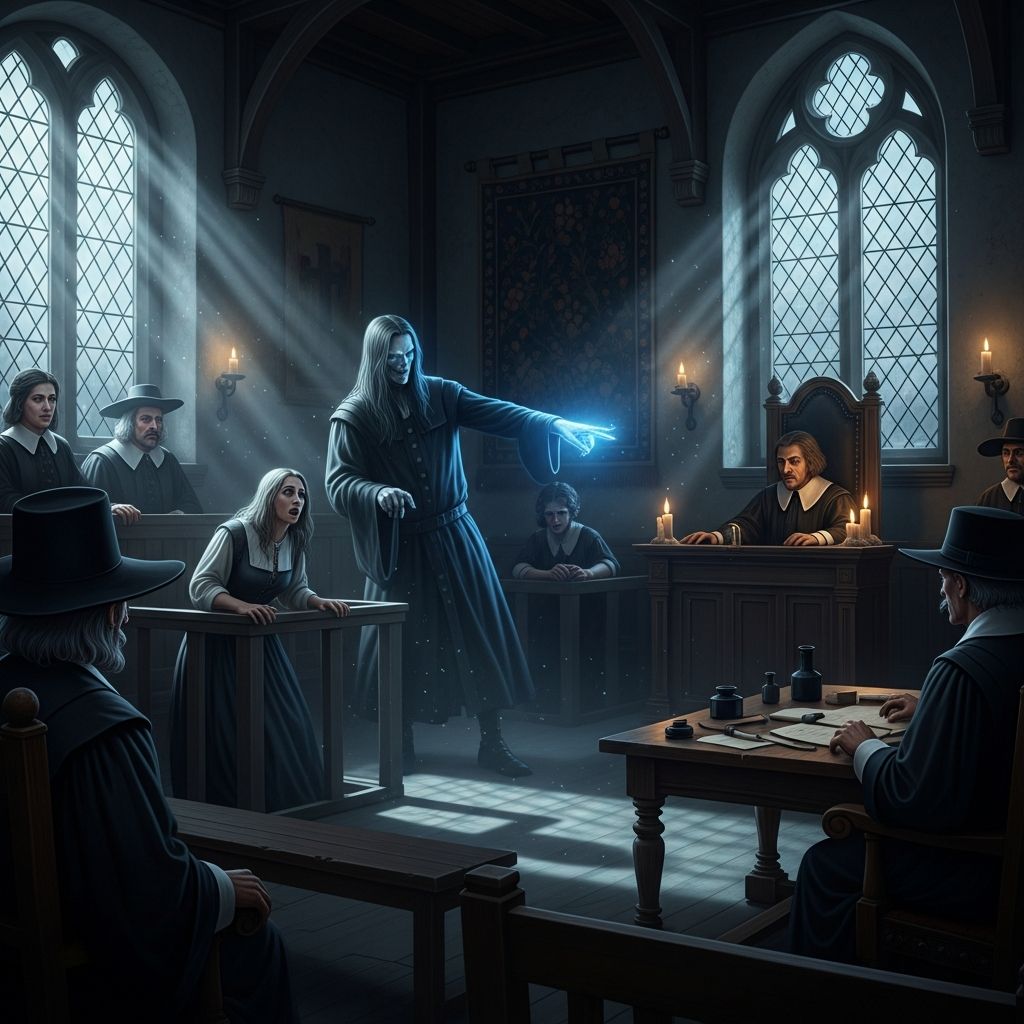
In the shadowed annals of legal history, few concepts evoke as much intrigue and horror as spectral evidence. This ethereal form of testimony relied on witnesses claiming to see the ghostly specter or spirit of an accused individual tormenting them in dreams or visions. Invisible to all but the accuser, it transformed personal nightmares into courtroom fact, propelling some of history’s most infamous witch hunts. Primarily associated with the Salem Witch Trials of 1692, spectral evidence’s acceptance marked a perilous intersection of faith, fear, and jurisprudence, leading to the deaths of innocent people and prompting profound reflections on evidence standards.
Defining Spectral Evidence in Historical Context
Spectral evidence emerged in an era when the boundary between the physical and spiritual worlds seemed perilously thin. It constituted witness accounts where the specter—a ghostly apparition mimicking the likeness of the accused—allegedly inflicted harm. Puritans and other religious communities believed the Devil could assume any shape, including that of the innocent, to sow chaos. Thus, seeing a neighbor’s spirit pinching, choking, or biting in a vision was proffered as proof of witchcraft, as the Devil purportedly needed the witch’s permission to use their form.
Unlike tangible proof like a witch’s mark or a popped doll (poppet), spectral evidence was purely subjective, hinging on the credibility of the tormented individual. Its unverifiable nature made rebuttal nearly impossible; defenders argued the Devil’s deception, but courts often prioritized the accuser’s anguish. This testimony proliferated in 17th-century New England and England amid widespread superstition and social tensions.
English Roots: From Tradition to Legal Precedent
English common law traditionally dismissed spectral evidence as insufficiently concrete. Legal scholars demanded ‘clear and convincing’ proof for crimes like witchcraft, viewing spirit sightings as unreliable fantasies. However, this stance shifted dramatically in 1662 during the Bury St. Edmunds witch trial in Suffolk, England—a case that cast a long shadow over colonial America.
Two women, Rose Cullender and Amy Duny, faced accusations from children exhibiting fits and ailments. Witnesses described spectral visions of the accused tormenting victims invisibly to others. Sir Matthew Hale, a revered judge, presided and admitted this evidence alongside physical signs like witches’ marks and unnatural strength. All twelve jurors convicted the women, who were hanged. Hale’s involvement lent immense credibility; his 1682 book, A Tryal of Witches, detailed the proceedings, influencing future trials.
Prior cases, like those in Northampton (1619) and York (1622), used spectral evidence variably, depending on judicial whim rather than statute. As witchcraft prosecutions waned mid-century, caution grew, but Hale’s precedent endured, especially under King James I’s witch-hunting zeal.
Salem Witch Trials: Spectral Evidence Unleashed
The Massachusetts Bay Colony’s 1692 hysteria epitomized spectral evidence’s destructive power. What began with girls in Salem Village—Betty Parris and Abigail Williams—convulsing and claiming spectral attacks escalated into a colony-wide panic, accusing over 200 people and executing 20.
Key enablers included the 1689 revocation of Massachusetts’ charter during the Glorious Revolution, creating legal uncertainty. Governor William Phips established the Special Court of Oyer and Terminer in May 1692, led by figures like William Stoughton. Influenced by Bury St. Edmunds and Cotton Mather’s writings, the court accepted three evidence types: confessions (often coerced), eyewitness acts of witchcraft, and spectral visions. Supplementary proofs like body marks bolstered cases, but specters dominated—over half the evidence in many trials.
| Evidence Type | Description | Frequency | Impact on Convictions |
|---|---|---|---|
| Confessions | Admissions, sometimes under duress | Low (but spared some lives) | High; led to imprisonment over execution |
| Eyewitness Testimony | Direct observation of witchcraft acts | Moderate | Moderate |
| Spectral Evidence | Ghostly visions tormenting accusers | High (majority in key cases) | Primary conviction driver |
Trials featured dramatic ‘touch tests,’ where an accused’s touch halted fits, interpreted as the specter fleeing its body. Echo-mania—victims mimicking words without sound—added to the spectacle. Hysteria snowballed as accused named others to deflect blame, swelling accusations from three to 165.
Influential Figures and Theological Justifications
Cotton Mather championed spectral evidence in Wonders of the Invisible World (1692), arguing it vital in spiritual warfare against Satan. His father, Increase Mather, countered in Cases of Conscience (1693), cautioning its unreliability unless corroborated, though he conceded it as supplementary.
Judges like Stoughton, swayed by Hale’s precedent, prioritized Puritan theology over English skepticism. The Devil’s ability to impersonate innocents was debated; theologians split, but crisis momentum favored acceptance.
Critiques, Downfall, and Aftermath
Opposition mounted swiftly. Increase Mather’s tract influenced Governor Phips to dissolve the court in October 1692, establishing a Superior Court banning spectral evidence. Phips pardoned many, halting executions.
Critics highlighted its subjectivity: unverifiable, prone to hysteria, and violative of due process. It pitted neighbors against each other, eroding community trust. Post-Salem, spectral evidence faded, symbolizing evidentiary folly.
- Key Criticisms:
- Relied on dreams, not facts—impossible to disprove.
- Fueled mass hysteria, amplifying accusations.
- Contradicted emerging legal standards demanding physical proof.
- Allowed Devil’s deception theory, undermining justice.
Legacy: Lessons for Modern Jurisprudence
Spectral evidence’s saga underscores evidence integrity’s importance. It prefigured debates on eyewitness reliability, coerced confessions, and mass hysteria—echoed in modern wrongful convictions via faulty memory or suggestion.
Salem’s 1697 day of atonement and 1711 reversals of attainders reflected remorse. Today, it warns against unverified testimony in polarized times, from McCarthyism to viral misinformation. Legal systems now mandate corroboration, a direct rebuke to spectral excesses.
Its cultural footprint persists in literature like Arthur Miller’s The Crucible and pop culture, immortalizing 1692’s tragedy as a cautionary tale.
Frequently Asked Questions (FAQs)
Was spectral evidence ever used outside Salem?
Yes, notably in England’s Bury St. Edmunds trial (1662), which inspired Salem judges.
Why was spectral evidence banned after 1692?
Governor Phips intervened amid growing skepticism, prioritizing reliable proof to prevent miscarriages of justice.
Could the Devil impersonate innocents according to Puritan belief?
Theologians debated this; many argued yes, making spectral evidence risky without corroboration.
How many were executed based solely on spectral evidence?
No one exclusively, per Increase Mather, but it was pivotal in most convictions, often with minimal support.
Does spectral evidence have modern parallels?
Yes, in unreliable eyewitness accounts or recovered memory therapies, highlighting subjective testimony dangers.
References
- What is Spectral Evidence? – History of Massachusetts Blog — History of Massachusetts. 2012-10-31. https://historyofmassachusetts.org/spectral-evidence/
- The Devil’s Specter: Spectral Evidence and the Salem Witchcraft Crisis — SUNY Oneonta Academic Research. 2020. https://soar.suny.edu/bitstreams/f65e7e90-e0b1-4bc2-a3f2-088312b8f38e/download
- Spectral Evidence in the Salem Witch Trials | Overview & History — Study.com. 2023-05-15. https://study.com/academy/lesson/spectral-evidence-in-the-salem-witch-trials-definition-lesson-quiz.html
- Spectral evidence – Wikipedia — Wikipedia. 2024-01-12. https://en.wikipedia.org/wiki/Spectral_evidence
- Spectral Evidence – The Salem Witch Museum — Salem Witch Museum. 2013-02-15. https://salemwitchmuseum.com/2013/02/15/spectral-evidence/

Medha Deb is an editor with a master's degree in Applied Linguistics from the University of Hyderabad. She believes that her qualification has helped her develop a deep understanding of language and its application in various contexts. Medha specializes in the areas of beauty, health, sports, and wellness and is committed to ensuring that the content on the website is…