
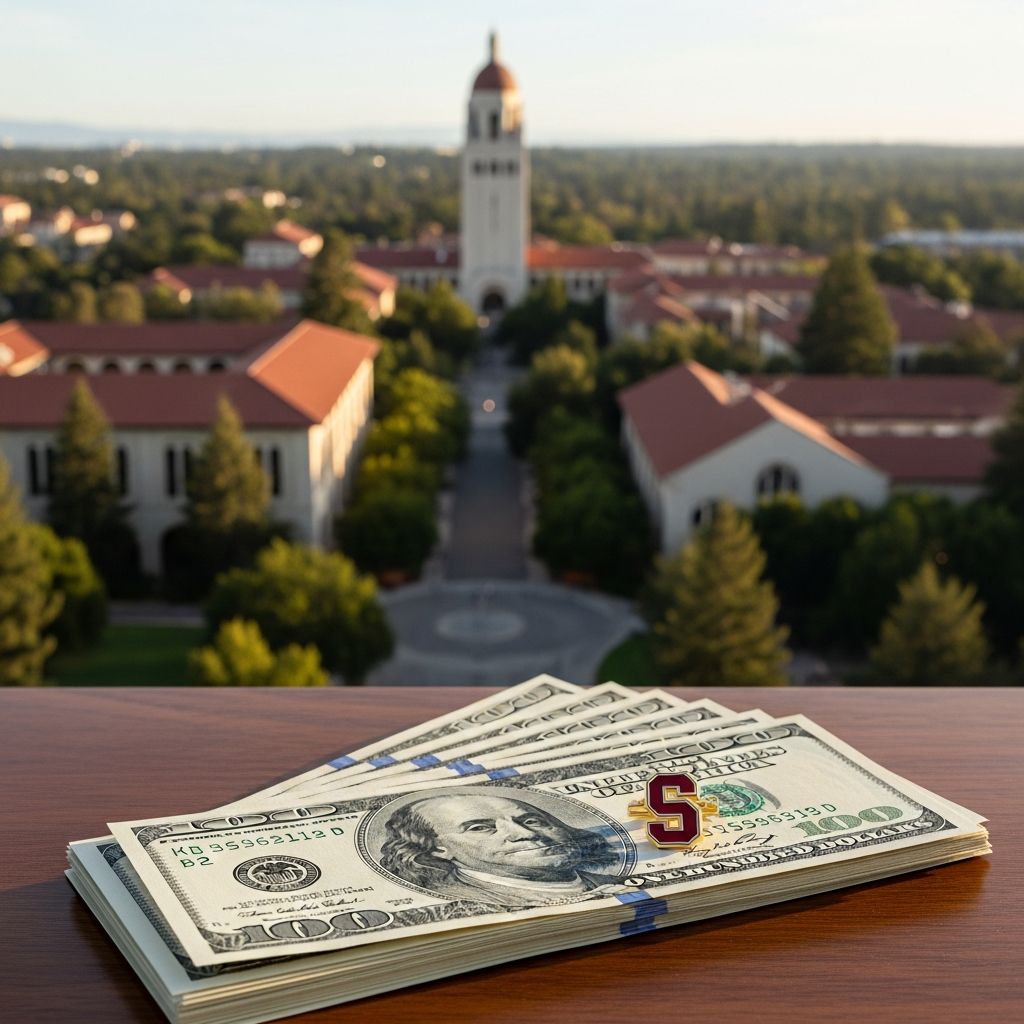
Stanford University is widely seen as a launchpad for spectacular entrepreneurial success, from the founders of Google to the creators of Netflix and Cisco. But for every headline-making billionaire, there are thousands of founders whose outcomes are far more modest. This article uses publicly available data and economic research to explore what the average net worth of Stanford entrepreneurs looks like, how often extreme wealth occurs, and what this means for people considering the startup path.
1. Why Focus on Stanford Entrepreneurs?
Stanford is unusually well suited for examining entrepreneurial outcomes because of its deep and well-documented startup culture.
- Stanford alumni have founded or led tens of thousands of companies worldwide, including Google, Nike, Cisco, Yahoo, Netflix, VMware, and Tesla.
- One major study estimated that companies linked to Stanford alumni created over 5 million jobs and generated trillions of dollars in annual revenue globally.
- External analyses consistently identify Stanford as one of the universities with the highest number of billionaires and ultra-high-net-worth alumni.
Because of this density of entrepreneurial activity, Stanford offers a useful case study for understanding the distribution of outcomes when very talented people pursue startups.
2. What Does “Average Net Worth” Even Mean Here?
When people ask about the average net worth of Stanford entrepreneurs, they often imagine a single number that summarizes how rich a typical founder becomes. That is misleading for at least three reasons:
- Outcomes are extremely skewed. A small number of outliers—billionaires and centimillionaires—dominate the statistics. When distributions are this skewed, the mean (arithmetic average) tells a very different story from the median (the net worth of the person in the middle).
- Timing matters. Net worth varies dramatically over a founder’s life. A student right out of Stanford may have negative net worth due to loans; the same person could become very wealthy decades later, or never at all.
- Illiquid equity is hard to value. Private company shares may appear extremely valuable on paper at one funding round and become nearly worthless if the company later fails or exits at a lower valuation.
Because of all this, any talk of an “average” net worth should be understood as an approximation describing a very uneven landscape.
3. Stanford’s Billionaire and Ultra-Wealthy Alumni
To get a sense of the high end of the distribution, it helps to look at billionaire and ultra-high-net-worth (UHNW) alumni statistics.
- A 2025 analysis of U.S. colleges and billionaires estimated that 94 billionaires attended Stanford, with an average net worth of about $11.76 billion among those billionaire alumni.
- A report based on Wealth-X data found that Stanford’s ultra-high-net-worth alumni (typically defined as individuals with at least $30 million in assets) had the highest average net worth among elite universities, at about $263 million per UHNW alumnus.
- Stanford graduates include founders such as the co-founders of Google and the co-founder of Nike, each with multi-billion-dollar fortunes.
These figures demonstrate that at the very top, Stanford entrepreneurs are extraordinarily wealthy. But they say almost nothing about how well the typical founder does, because these numbers are restricted to the tiny subset who already cleared extremely high wealth thresholds.
4. How Many Stanford Alumni Become Entrepreneurs?
A detailed study of Stanford’s innovation and entrepreneurship ecosystem examined survey data from alumni and faculty over several decades.
- Roughly 29% of surveyed alumni reported that they had founded an organization, either for-profit or non-profit.
- An estimated nearly 40,000 active companies could trace their origins to Stanford alumni or faculty at the time of the study.
- These firms collectively generated millions of jobs and annual revenues in the trillions of dollars, illustrating the large aggregate impact of Stanford entrepreneurship.
This means a sizable share of Stanford graduates try entrepreneurship at some point. But as in the broader startup ecosystem, attempts are common while very large wins are rare.
5. A Heavily Skewed Wealth Distribution
The combination of data on founders, firm revenues, and billionaire alumni all point to one consistent pattern: the wealth of Stanford entrepreneurs follows a power-law–like distribution, where a small number of individuals hold a very large share of total founder wealth.
At a high level, the distribution looks something like this:
- A tiny fraction reach multi-billion-dollar fortunes.
- A somewhat larger group accumulate tens or hundreds of millions through startups, equity grants, and investments.
- A larger minority end up with solid but not extraordinary wealth—say, in the low millions—sometimes through modest exits or well-paid executive roles.
- Many founders do not experience major financial upside from entrepreneurship at all and may end up with roughly similar or only slightly higher lifetime wealth than they would have achieved in conventional high-earning careers.
Because of this skew, the mean net worth of founders can be very high—pulled up by the billionaire tail—while the median founder has quite ordinary wealth relative to other high-skill professionals.
6. Illustrative Wealth Tiers Among Stanford Entrepreneurs
The table below gives an illustrative way to think about wealth tiers among Stanford founders. These are not precise estimates from one dataset, but a conceptual summary informed by the evidence that outcomes are both common and very skewed at Stanford and similar institutions.
| Tier | Approximate Net Worth Range | Rough Prevalence Among Founders | Typical Pathways |
|---|---|---|---|
| Extreme outliers | $1B+ | Tiny fraction | Founders of global tech platforms or breakthrough companies |
| Upper UHNW | $100M–$1B | Very small minority | Multiple successful exits, early employees at major unicorns, or long-term top investors |
| Affluent founders | $5M–$100M | Moderate minority | One or more modest exits, or senior roles in fast-growing firms |
| Comfortable but not extraordinary | $1M–$5M | Substantial share | Small exits, acquihires, or transition to well-paid corporate roles |
| Little financial upside from startups | <$1M (after debts, early career) | Common | Companies that break even, stagnate, or fail; pivot to other careers |
In other words, there is no single “Stanford entrepreneur net worth”; there is a wide range, with the center of gravity much lower than the top stories suggest.
7. Comparing Founders to Other Stanford Graduates
Another useful question is how entrepreneurs compare to their non-founder peers from the same university.
- Stanford alumni who go into finance, consulting, law, or established tech firms often have very high lifetime earnings, even without founding a company.
- Founders take on more variance: their expected financial return might be competitive, but the risk of much lower outcomes is also higher, especially when including the cost of lost salary and failed ventures.
- Research outside Stanford suggests that, on average, entrepreneurs do not universally earn more than similarly skilled employees once risk and failure are accounted for; instead, the benefit is concentrated in a minority of highly successful founders.
For someone already on track for a strong professional career, the entrepreneurial choice is therefore not between “ordinary” and “guaranteed millions”; it is between a relatively predictable high-income path and a high-risk, high-variance path with a long tail of extraordinary winners.
8. Factors That Influence Founder Wealth
Among Stanford entrepreneurs, several factors strongly affect the probability of ending up in the higher wealth tiers:
- Timing and industry choice. Founding companies during major technology waves (e.g., internet search, smartphones, cloud computing, AI) and in industries with strong network effects can magnify upside.
- Co-founder networks. Stanford’s dense network of potential co-founders, early employees, and advisors can significantly improve access to talent, capital, and early customers.
- Access to capital. Proximity to Silicon Valley venture capital, angel investors, and Stanford’s alumni investor network has historically made it easier for Stanford founders to raise early funding.
- Entrepreneurial training. Courses and programs at Stanford that focus on technology entrepreneurship, lean startups, and venture capital correlate with a higher likelihood that alumni become founders and innovators.
- Persistence and multiple attempts. Many successful founders did not succeed on their first startup. Serial entrepreneurship can increase the cumulative chance of a high-upside event, though it also prolongs exposure to risk.
None of these factors guarantees high wealth, but they tilt the odds relative to an average person starting a company without such support.
9. Interpreting the Numbers for Your Own Career
For someone considering founding a startup during or after a degree at a top university, several lessons emerge from the Stanford case:
- Do not anchor on the billionaire examples. They are inspiring but extremely rare. Treat them as proof of possibility, not as a baseline expectation.
- Think in terms of distributions, not single averages. Ask: “What does the full range of outcomes look like, and what is the probability of each?” rather than “What’s the average net worth?”
- Compare against your realistic alternatives. If your alternative is a high-paying role at a leading firm, the incremental financial benefit of founding a startup is uncertain and risky; the main differentiators may be impact, autonomy, and learning.
- Consider impact as well as income. Many Stanford-founded companies have outsized effects on technology, science, and society. For some founders, the main motivation is large-scale impact rather than personal wealth.
In short, starting a company may be most attractive if you value a combination of potential impact, autonomy, and the possibility of large financial upside more than you value security and predictable earnings.
10. Practical Questions to Ask Before You Found
Drawing on what we know about Stanford entrepreneurs, here are some concrete questions prospective founders—at any institution—can reflect on:
- What is my realistic downside? How long can I go without a salary? What happens if my startup fails?
- What are my high-skill alternatives? Could I join an early-stage but already-funded startup, or work in a high-impact role in a larger organization first?
- Am I in a good place to learn fast? Will I have mentors, peers, and advisors who can increase my chances of success, as many Stanford founders do via the alumni network?
- Is my motivation mainly wealth, or also impact and learning? Given the skewed distribution, it is risky to rely on wealth alone as the justification for founding.
- What evidence is there that this problem is worth solving? Stanford’s most successful companies often addressed large, persistent problems with transformative technologies; copying that mindset matters more than copying the institution.
Frequently Asked Questions (FAQs)
Q1: Is the average Stanford entrepreneur a millionaire?
Many Stanford founders who persist in entrepreneurship or join successful startups do end up with net worth in the low millions, but not all. Because of outliers, the mean founder net worth may be several million dollars, while a substantial share of founders fall below that level. The exact figure depends heavily on how you define “entrepreneur” and at what career stage you measure net worth.
Q2: How likely is it for a Stanford graduate to become a billionaire founder?
Even at Stanford, becoming a billionaire is extremely unlikely. Statistics on billionaire alumni show that fewer than a hundred billionaires are associated with Stanford out of hundreds of thousands of alumni and tens of thousands of founders. The probability is therefore a tiny fraction of a percent, even in this unusually favorable environment.
Q3: Do Stanford entrepreneurs generally earn more than graduates who take regular jobs?
Some do, especially those who end up in the top tail of the distribution. However, when you account for the high risk of failure, forgone salary, and the time it takes to build a company, entrepreneurship does not guarantee higher lifetime earnings compared with highly paid professional careers. For many talented graduates, the financial difference may be modest, while the variance in outcomes is much greater.
Q4: How important is the Stanford network for entrepreneurial success?
Research on Stanford’s entrepreneurial ecosystem suggests that alumni networks, entrepreneurship courses, and proximity to Silicon Valley investors play a significant role in helping founders find co-founders, funding, and early hires. However, these advantages amplify a strong idea and capable team; they do not replace them.
Q5: What should I take away from these numbers if I am not at Stanford?
The main lessons are about distributions and expectations, not about Stanford itself. In any strong startup ecosystem, most of the financial rewards go to a small fraction of founders. Being in a supportive environment can raise your odds, but does not change the basic fact that extreme wealth is rare. The decision to found a company is best grounded in your goals, skills, and appetite for risk, rather than in headline net-worth figures.
References
- Stanford University’s Economic Impact via Innovation and Entrepreneurship — Charles E. Eesley. 2016-01-01. https://doi.org/10.1561/0300000074
- 13 rich and famous graduates from Stanford — Study International. 2024-07-19. https://studyinternational.com/news/famous-graduates-from-stanford/
- This U.S. college has created more billionaires than anywhere else — Fortune. 2025-03-04. https://fortune.com/2025/03/04/gen-z-colleges-billionaires-harvard-zuckerberg-mit-stanford-nyu/
- Chart: Where the Wealthiest People Went to College — Business Insider (summary of Wealth-X report). 2017-05-29. https://www.businessinsider.com/chart-where-the-wealthiest-people-went-to-college-2017-5
- Stanford University Notable Alumni: 17 Famous MBAs — BusinessBecause. 2024-06-18. https://www.businessbecause.com/news/notable-alumni/6672/stanford-university-notable-alumni-mba

Medha Deb is an editor with a master's degree in Applied Linguistics from the University of Hyderabad. She believes that her qualification has helped her develop a deep understanding of language and its application in various contexts. Medha specializes in the areas of beauty, health, sports, and wellness and is committed to ensuring that the content on the website is…