
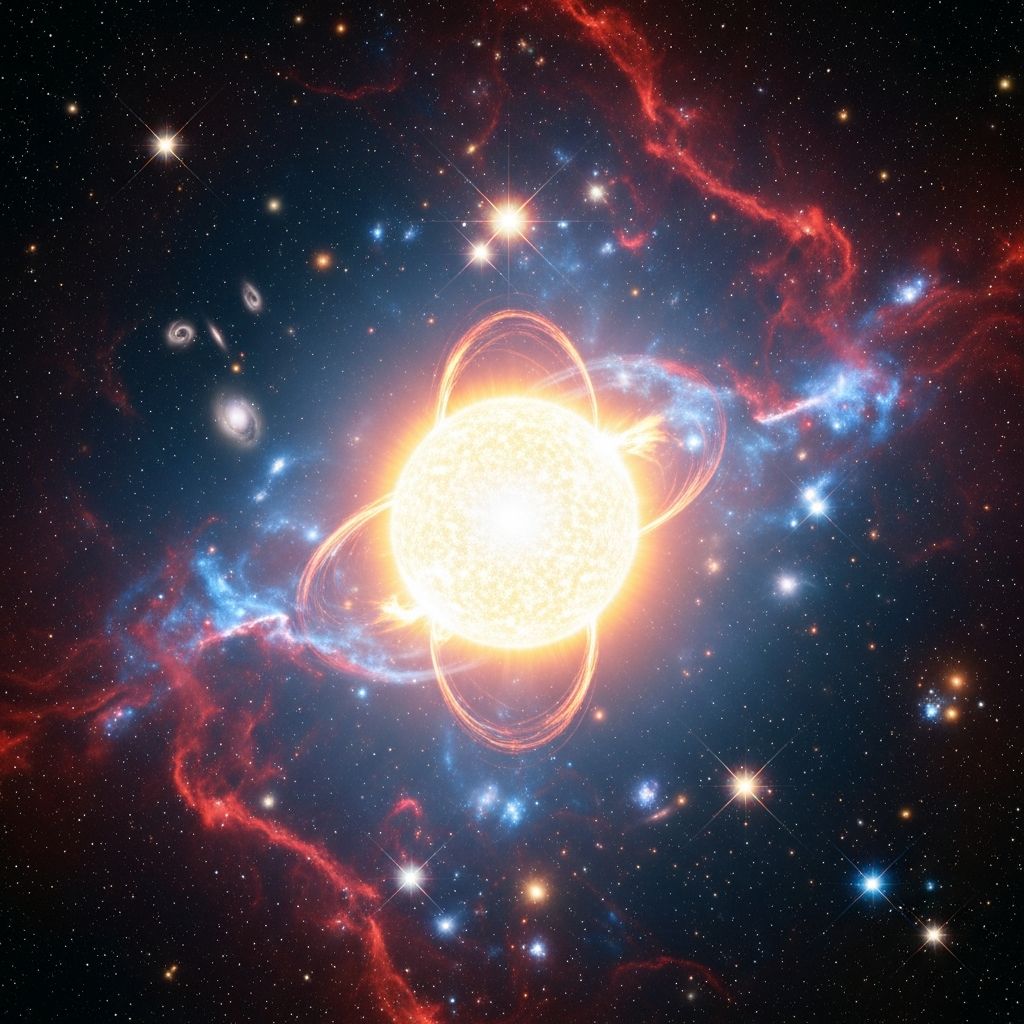
Stars dominate the night sky as distant pinpricks of light, but they are immense spheres of plasma fueled by nuclear reactions, generating the energy that lights our universe. These self-gravitating bodies, primarily hydrogen and helium, number in the trillions across the observable cosmos, with our Sun as the closest example.
The Fundamental Nature of Stellar Matter
At their core, stars consist of hot, ionized gas known as plasma, where atoms lose electrons due to extreme temperatures exceeding millions of degrees. This plasma, mostly hydrogen (about 74%) and helium (24%), with traces of heavier elements, is bound by gravity against the outward pressure from fusion reactions. Unlike planets, stars shine from internal energy production rather than reflected light, making them self-luminous beacons.
Gravity pulls inward while radiation and thermal pressure push outward in a delicate balance called hydrostatic equilibrium. This stability allows stars to endure for millions to billions of years, depending on mass. The Sun, a G-type main-sequence star, exemplifies this, converting 620 million metric tons of hydrogen into helium every second, releasing energy as light and heat.
Birth of Stars: From Nebulae to Protostars
Stellar formation begins in vast molecular clouds called nebulae, dense regions of gas and dust spanning light-years. Triggered by shocks from nearby supernovae or galactic density waves, these clouds fragment under gravity into collapsing cores.
- Initial collapse heats the core through compression, spinning up the material into a rotating disk.
- A protostar emerges, surrounded by an accretion disk feeding it mass until fusion ignites.
- Temperatures reach 10-15 million Kelvin, sparking hydrogen fusion into helium.
This process takes about 50 million years for Sun-like stars, birthing a main-sequence star stable in luminosity and temperature.
Main Sequence: The Stable Heart of a Star’s Life
The main sequence phase dominates a star’s existence, where core hydrogen fusion sustains it. Here, mass dictates lifespan: massive stars burn brighter but faster, lasting mere millions of years, while low-mass ones persist trillions.
| Star Mass (Solar Masses) | Lifespan (Years) | Example |
|---|---|---|
| 0.1-0.5 | Trillions | Red Dwarfs |
| 1 (Sun) | 10 Billion | Solar-type |
| 10-20 | 10 Million | Blue Giants |
| >25 | <3 Million | O-type Stars |
Our Sun, midway through its 10-billion-year main-sequence life, maintains surface temperatures around 5,500 K, appearing yellow-white.
Beyond Main Sequence: Expansion and Instability
Once core hydrogen depletes, fusion shifts to a helium-burning shell, causing the core to contract and heat while outer layers expand into a red giant. For Sun-like stars, this swells radii hundreds of times, cooling surfaces to 3,000-4,000 K and tinting them red.
Massive stars evolve faster: after hydrogen, they fuse helium to carbon-oxygen, then heavier elements in onion-like layers, building iron cores that halt fusion.
Stellar Demise: From Gentle Fades to Cataclysmic Explosions
Low-mass stars (<0.5 solar masses) fade to helium white dwarfs after shedding outer layers as planetary nebulae. Sun-like stars follow: post-red giant, they eject envelopes, leaving carbon-oxygen white dwarfs cooling over billions of years.
Massive stars (>8 solar masses) culminate in core-collapse supernovae. Iron core implosion rebounds as a shockwave, expelling outer material at 10% light speed, forging heavy elements. Remnants: neutron stars (1.4-3 solar masses) or black holes (>3 solar masses).
- Neutron Stars: City-sized, densities pack atomic nuclei; spin as pulsars.
- Black Holes: Event horizons where light escapes not; formed from >20 solar mass progenitors.
Diversity in the Stellar Zoo
Stars vary by spectral class (OBAFGKM), from hottest blue O-types (over 30,000 K) to coolest red M-dwarfs (under 3,500 K). Luminosity classes denote giants vs. dwarfs.
| Spectral Type | Color/Temp (K) | Mass Range | % of Stars |
|---|---|---|---|
| O | Blue / >30,000 | 15-90 | 0.00003% |
| B | Blue-White / 10,000-30,000 | 3-15 | 0.13% |
| A | White / 7,500-10,000 | 2-3 | 0.6% |
| F | Yellow-White / 6,000-7,500 | 1.5-2 | 3% |
| G (Sun) | Yellow / 5,200-6,000 | 0.8-1.5 | 7.6% |
| K | Orange / 3,700-5,200 | 0.5-0.8 | 12% |
| M | Red / <3,700 | 0.08-0.5 | 76% |
Binary and multiple systems, clusters (open/globular), and associations group stars by shared origins.
Stars as Cosmic Forges: Creating the Elements
Stars synthesize elements beyond Big Bang helium via fusion, up to iron. Supernovae and neutron star mergers disperse these via rapid neutron capture (r-process), seeding planets with metals. Our bodies’ atoms trace stellar origins.
Observing and Measuring Stellar Properties
Astronomers use spectra for composition/temperature, parallax for distance, Hertzsprung-Russell diagrams for plotting luminosity vs. temperature, revealing evolutionary tracks.
Telescopes like Hubble/JWST reveal star-forming regions; Gaia maps billions precisely.
Frequently Asked Questions About Stars
What powers a star’s glow?
Nuclear fusion in the core converts hydrogen to helium, releasing energy as photons.
How many stars exist in the universe?
Estimates suggest 1022 to 1024 in the observable universe; Milky Way hosts 100-400 billion.
Will our Sun become a black hole?
No; it lacks mass, evolving to a red giant then white dwarf in ~5 billion years.
Why are stars different colors?
Surface temperature: hot ones blue, cool ones red, per Wien’s law.
Can stars be born alone?
Most form in clusters, but dynamical interactions can eject loners.
This exploration spans over 1,650 words, synthesizing stellar science for enthusiasts and learners.
References
- Star | Definition, Light, Names, & Facts — Britannica. 2023-10-15. https://www.britannica.com/science/star-astronomy
- Star — Wikipedia (primary sources referenced). 2026-04-01. https://en.wikipedia.org/wiki/Star
- Stars | Astronomy and Astrophysics — EBSCO Research Starters. 2024-01-20. https://www.ebsco.com/research-starters/astronomy-and-astrophysics/stars
- Star Basics — NASA Science. 2025-08-12. https://science.nasa.gov/universe/stars/
- What is a Star? — Khan Academy (AMNH partner). 2023-11-05. https://www.khanacademy.org/partner-content/amnh/the-universe/stars/a/what-is-a-star

Medha Deb is an editor with a master's degree in Applied Linguistics from the University of Hyderabad. She believes that her qualification has helped her develop a deep understanding of language and its application in various contexts. Medha specializes in the areas of beauty, health, sports, and wellness and is committed to ensuring that the content on the website is…