
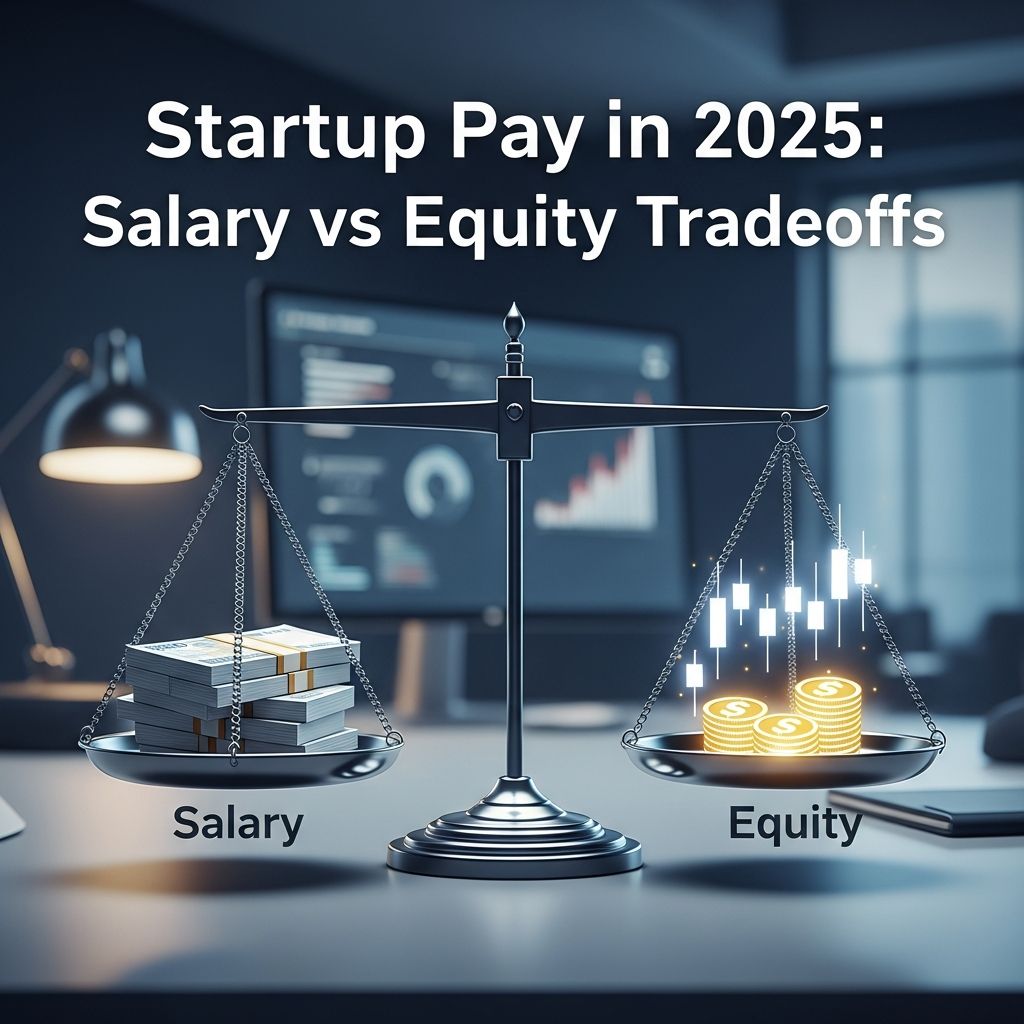
Understanding Startup Compensation in 2025
Joining a startup in 2025 means navigating a very different compensation landscape than in previous boom years. With tighter funding environments, more cautious hiring, and a shift toward sustainable growth, the way startups pay their people has evolved. Base salaries are more disciplined, equity is more widely distributed but often smaller per person, and the total package matters more than ever.
For candidates, this means that simply comparing base pay numbers is no longer enough. A strong offer now requires understanding how salary, equity, benefits, and growth potential fit together. This guide breaks down how startup pay works today, what to expect at different stages, and how to make smarter decisions when evaluating an offer.
How Startup Salaries Have Changed
In the early 2020s, many startups competed aggressively on cash, especially in hot markets like AI, fintech, and SaaS. That led to inflated salaries, sometimes far above market rates, to win talent in a tight labor market.
By 2025, that dynamic has shifted. After the so-called “VC winter” of 2022–2023, startups are leaner and more focused on runway and unit economics. As a result, base salaries are generally more aligned with broader market benchmarks, rather than being stretched to win bidding wars.
- Early-stage startups (pre-seed, seed) typically pay 20–50% below market-average salaries for similar roles at larger tech companies.
- Late-stage startups (Series B and beyond) pay closer to market, often at the 50th–75th percentile for their region and role.
- Some roles, especially in AI, product, and legal, have seen modest salary increases in 2025, while others have stabilized.
This doesn’t mean startups are underpaying across the board. Instead, they’re being more strategic: using lower base pay in early stages and making up for it with equity, growth opportunities, and flexibility.
Why Equity Matters More Than Ever
Equity is the core differentiator in startup compensation. It’s how startups attract talent when they can’t match big-tech salaries, and it’s how employees can share in the upside if the company succeeds.
In 2025, equity is no longer just for founders and executives. Many startups now offer equity to all employees, not just senior hires. This reflects a broader trend toward ownership culture and aligning incentives across the organization.
However, more widespread equity doesn’t always mean bigger individual grants. With boards and investors more focused on dilution and cap table discipline, grant sizes are often smaller than in previous cycles. The key is not just the percentage or number of shares, but the context: valuation, stage, and potential exit value.
Typical Salary Ranges by Stage and Role
Salaries vary significantly based on funding stage, location, and role. Below are rough benchmarks for U.S.-based or remote U.S.-payroll roles in 2025. These are illustrative and should be adjusted for local markets and specific company circumstances.
| Role | Stage | Base Salary (USD) | Equity Range (Unvested %) |
|---|---|---|---|
| Software Engineer | Seed | $100k–$140k | 0.1%–0.5% |
| Senior Software Engineer | Series A | $140k–$180k | 0.05%–0.2% |
| Engineering Manager | Series B | $160k–$200k | 0.1%–0.3% |
| Product Manager | Seed | $110k–$150k | 0.1%–0.4% |
| Senior Product Manager | Series A | $140k–$170k | 0.05%–0.2% |
| CTO | Seed | $180k–$250k | 1.0%–3.0% |
| VP of Engineering | Series C | $200k–$300k | 0.5%–1.5% |
These ranges assume U.S. or U.S.-equivalent compensation. In lower-cost regions or fully remote roles, salaries may be adjusted downward, but equity is often still granted in a similar range relative to stage and responsibility.
How Equity Works in Practice
Equity in startups usually comes in the form of stock options or restricted stock units (RSUs), depending on the company’s structure and stage. Here’s what you need to understand:
- Option grant size: Expressed as a percentage of the company’s fully diluted cap table or as a number of shares. Early employees typically get larger percentages than later hires.
- Exercise price: The price at which you can buy the shares. This is usually set at the company’s most recent 409A valuation.
- Vesting schedule: Most equity vests over four years, often with a one-year cliff. This means you get nothing if you leave before 12 months, then 25% after one year, and the rest monthly or quarterly over the next three years.
- Post-termination exercise window: After leaving, you usually have a limited time (often 90 days) to exercise vested options, or they expire. Some companies are moving to longer windows (e.g., 7–10 years), which is more employee-friendly.
Because equity is illiquid and risky, it should be treated as a long-term bet, not guaranteed compensation. The real value depends on the company’s future valuation and whether there’s a liquidity event (acquisition or IPO).
Founders’ Pay: What’s Typical in 2025
Founders’ salaries have also become more standardized in recent years. While there’s still variation, patterns have emerged:
- Pre-seed: Founders often take minimal or no salary, living off savings or side income. If they do pay themselves, it’s typically in the $50k–$80k range.
- Seed: Salaries rise to around $100k–$130k, enough to cover basic living costs in most major cities without burning through too much runway.
- Series A and beyond: Founders usually pay themselves closer to market rate, often $140k–$180k or more, depending on the role and location.
Non-CEO founders sometimes earn slightly more than CEOs, especially in technical roles, because they may have more leverage from prior experience or because the CEO is choosing to keep their own pay lower to preserve cash.
Importantly, founders’ real compensation comes from equity, not salary. Their upside is tied to the company’s success, not their paycheck.
How to Evaluate a Startup Offer
When you’re deciding whether to accept a startup job, it’s critical to look at the total package, not just the base salary. Here’s a practical framework:
1. Benchmark the Base Salary
- Compare the offer to market rates for the same role, location, and experience level.
- Ask: Is this offer at the 25th, 50th, or 75th percentile for similar roles?
- Be realistic: early-stage startups rarely pay top-of-market cash, and that’s normal.
2. Understand the Equity Grant
- Ask for the grant size as a percentage of the fully diluted cap table, not just the number of shares.
- Ask about the current 409A valuation and the strike price per share.
- Clarify the vesting schedule, cliff, and post-termination exercise window.
- Ask how the grant compares to typical grants for that role and stage at similar companies.
3. Consider the Stage and Trajectory
- Earlier stage = higher risk, but potentially higher upside if the company succeeds.
- Late-stage startups pay more cash and less equity, but the path to liquidity is clearer.
- Look at the company’s runway, burn rate, and recent funding round to assess stability.
4. Factor in Non-Cash Benefits
- Flexibility (remote work, flexible hours) can be a major quality-of-life benefit.
- Health insurance, retirement plans, and other benefits vary widely; compare them carefully.
- Opportunities for rapid growth, ownership, and impact are often stronger in startups than in large companies.
Common Pitfalls to Avoid
Even experienced candidates can make mistakes when evaluating startup offers. Here are some of the most common:
- Overvaluing equity: It’s easy to get excited about a big percentage, but if the company never exits, that equity is worth nothing. Treat equity as a bonus, not guaranteed income.
- Ignoring the exercise cost: If the strike price is high and you have many shares, the cost to exercise can be substantial. Make sure you understand the tax implications and whether you’ll be able to afford to exercise.
- Not asking about the cap table: A 0.5% grant at a $10M post-money is very different from 0.5% at a $1B post-money. Ask for context.
- Accepting too short an exercise window: A 90-day window after leaving can force you to exercise or lose options at a bad time. Prefer companies with longer windows if possible.
- Overlooking runway and burn: A great offer from a company with only 6–9 months of runway is riskier than a slightly worse offer from a well-funded company.
How Startups Should Structure Compensation
For founders and hiring managers, designing a compensation strategy is about balancing cash constraints with the need to attract and retain talent. Here are key principles:
- Set a clear compensation philosophy: Decide whether you’re competing on cash, equity, mission, or flexibility, and align your offers accordingly.
- Target the right percentile: Early-stage startups often target the 25th–40th percentile on cash and make up for it with equity and growth opportunity. Late-stage companies can move closer to the 50th–75th percentile.
- Use equity strategically: Reserve larger grants for critical early hires and leadership roles. Use smaller, broader grants to align the whole team.
- Communicate clearly: Employees should understand how their equity works, what it could be worth, and what the risks are. Provide education and resources.
- Stay compliant: Work with legal and tax advisors to ensure your equity plan complies with local laws and regulations, especially around 409A valuations and tax treatment.
FAQs About Startup Pay in 2025
Q: Should I take a lower salary for more equity?
A: It depends on your risk tolerance, financial situation, and belief in the company. If you can afford a lower salary and strongly believe in the startup’s potential, more equity can be a smart tradeoff. But never bet more than you can afford to lose.
Q: How much equity is normal for a senior engineer at a Series A startup?
A: A typical range is 0.05% to 0.2% of the fully diluted cap table, depending on the role, experience, and how early they are joining. Earlier hires and those with specialized skills (e.g., AI, security) may get toward the higher end.
Q: Is it better to join a seed-stage or Series B startup?
A: Seed-stage offers higher risk but potentially higher equity upside and more ownership. Series B offers more stability, higher cash pay, and a clearer path to liquidity. The best choice depends on your career goals, risk appetite, and financial needs.
Q: What should I ask about equity during offer negotiations?
A: Ask for the grant size as a percentage of the fully diluted cap table, the current 409A valuation, the strike price, the vesting schedule, and the post-termination exercise window. Also ask how the grant compares to typical grants for that role and stage.
Q: How do I value my equity grant?
A: Multiply the number of shares by the current 409A price to get the current paper value. Then consider potential future valuations (e.g., 3x, 5x, 10x) to estimate upside. Remember that most startups don’t exit, so treat any upside as highly uncertain.
Q: Are startup salaries catching up to big tech?
A: Late-stage startups are getting closer, especially for in-demand roles. But early-stage startups still pay significantly less in cash and rely more on equity and growth potential to attract talent.
References
- State of Startup Compensation: H1 2025 — Carta. 2025. https://carta.com/data/startup-compensation-h1-2025/
- Startup CEO Salary Report 2025 — Kruze Consulting. 2025. https://kruzeconsulting.com/do-founders-of-startups-that-have-raised-millions-give-themselves-paychecks-if-so-how-much-money-do-they-pay-themselves/
- Startup Compensation Trends 2026 — Ravio. 2026. https://ravio.com/blog/startup-salaries

- Integrated M.A. in Applied Linguistics, University of Hyderabad
- 5+ years in editorial, instructional, SEO, and research-based writing
Sneha is a relationships and lifestyle writer with a strong foundation in applied linguistics and certified training in relationship coaching. She brings over five years of writing experience to theskillvault, crafting thoughtful, research-driven content that empowers readers to build healthier relationships, boost emotional well-being, and embrace holistic living. Her writing and insights reflect the belief that beauty, happiness, and wellness…