
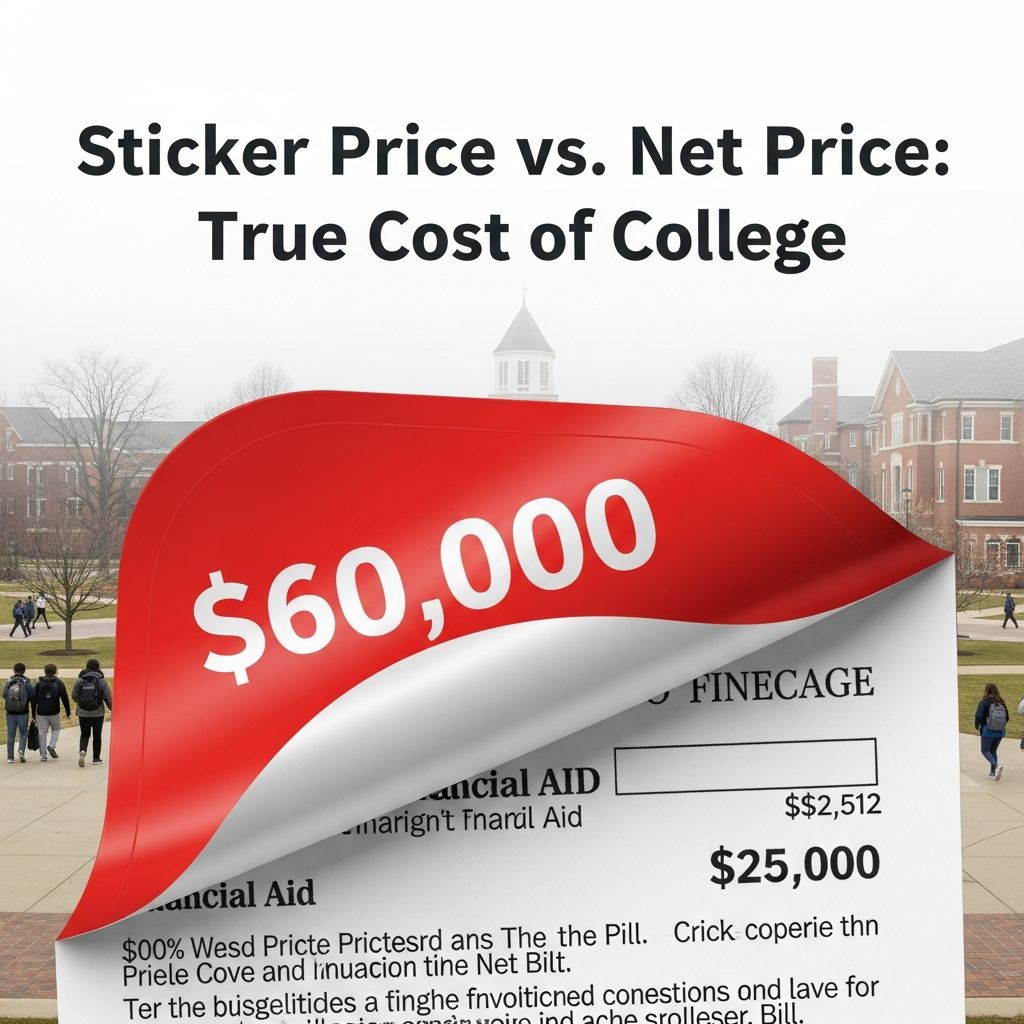
The published tuition rates you see on college websites represent the **sticker price**, but the amount most students actually pay is the **net price** after financial aid. This distinction is crucial for making informed decisions about higher education affordability.
Defining the Sticker Price of Higher Education
The sticker price, also known as the Cost of Attendance (COA), is the full published estimate of what it costs to attend a college for one academic year before any discounts or aid. It serves as the baseline figure that institutions advertise, often causing initial sticker shock for families.
This total encompasses both direct and indirect expenses. Direct costs are billed straight to the student by the school, while indirect costs are personal estimates that vary by lifestyle.
| Cost Type | Description | Typical Annual Range (2024-25) |
|---|---|---|
| Direct Costs | Tuition & Fees | $10,000 – $60,000 |
| Room & Board (on-campus) | $10,000 – $18,000 | |
| Indirect Costs | Books & Supplies | $1,000 – $2,000 |
| Transportation | $1,500 – $3,000 | |
| Personal Expenses | $2,000 – $4,000 |
For instance, public four-year colleges average around $33,000 in sticker price, while private nonprofits reach $55,000 or more. Very few—often less than 10%—pay this full amount.
Understanding Net Price: What You Really Pay
**Net price** is the sticker price minus all grant and scholarship aid that doesn’t require repayment. It reflects the out-of-pocket cost after institutional generosity, federal programs, and state support are applied.
In 2024-25, average net tuition and fees at public four-year schools stood at $2,480 for first-time students, compared to $16,510 at private nonprofits—showing how aid bridges the gap. Nationally, full-time students at public four-year colleges paid an average net price of $19,490 versus $33,220 sticker, while private nonprofit students paid $26,820 against $54,880.
- Net price varies by family income, student merit, and institutional endowment size.
- Lower-income families often see the largest reductions, sometimes approaching zero out-of-pocket.
- Middle-income students may still face higher nets due to limited need-based aid.
Key Components Breaking Down College Expenses
Tuition and Mandatory Fees
Tuition covers instruction, while fees fund services like technology or athletics. Public in-state tuition averages $11,260; out-of-state jumps to $29,150; privates hit $41,540. These form the largest chunk of sticker price.
Housing and Meals: On-Campus Living Costs
Room and board typically adds $12,000-$15,000. Off-campus options can lower this but shift it to indirect costs, requiring budgeting for rent and groceries.
Hidden Expenses: Books, Travel, and Lifestyle
Indirect costs like textbooks ($1,250 average), commuting, and personal needs add up quickly. Families can mitigate by buying used books, carpooling, or choosing frugal lifestyles.
How Financial Aid Transforms Sticker to Net Price
The bridge between these figures is financial aid, primarily grants and scholarships. Over 75% of students receive some aid, slashing costs dramatically.
- Grants: Need-based (Pell, institutional) or merit-based; non-repayable.
- Scholarships: Awarded for academics, athletics, or demographics.
- Work-Study: Part-time jobs earning aid dollars.
- Loans: Not subtracted from net price, as they must be repaid.
Elite privates with large endowments (e.g., Ivy League) offer the most aid, reducing net prices for 99% of students. Publics provide less flexibility, especially for out-of-state or middle-class applicants.
Institutional Factors Affecting Aid Availability
Endowments play a huge role: Wealthier schools subsidize more students. Public institutions rely on state funding, which fluctuates, while privates use tuition revenue and donations.
Recent trends show sticker prices rising 2-3% annually, but net prices stabilizing or declining due to increased grant aid. The Free Application for Federal Student Aid (FAFSA) determines eligibility via the Student Aid Index (SAI).
Tools and Strategies to Calculate Your Net Price
Every college must provide a **Net Price Calculator** on its site, mandated by federal law. Input family income, assets, and student info for a personalized estimate.
- Complete FAFSA early (opens October 1).
- Use calculators on 5-10 schools’ websites.
- Compare net prices across similar institutions.
- Appeal aid offers with competing packages.
Average net prices: Public 4-year ($19,490), Private 4-year ($26,820). Focus here over sticker for smart choices.
Real-World Examples: Sticker vs Net Price Comparisons
| Institution Type | Avg Sticker Price (2020-21) | Avg Net Price | Aid Reduction |
|---|---|---|---|
| Public 4-Year | $33,220 | $19,490 | 41% |
| Private Nonprofit 4-Year | $54,880 | $26,820 | 51% |
At a flagship state university, a $30,000 sticker might net $15,000 for middle-income families. A private college’s $70,000 could drop to $25,000 with merit aid.
Common Pitfalls When Evaluating College Costs
- Ignoring Net Price: Obsessing over low sticker publics may overlook generous privates.
- Overlooking Indirect Costs: Budget realistically for living expenses.
- Not Filing FAFSA: Misses federal and institutional aid.
- Forgetting Multi-Year Costs: Aid packages change annually.
Planning Ahead: Minimizing Your True College Costs
Strategies include merit scholarship hunts, community college transfers, and employer tuition aid. Recent FAFSA simplifications improve access.
Project total 4-year costs using net estimates, then build savings plans like 529s.
Frequently Asked Questions (FAQs)
What percentage of students pay full sticker price?
Less than 10% at most privates; even fewer at elites. Publics see higher full-payers among non-aided students.
How accurate are net price calculators?
Very reliable for estimates; actual awards come post-admission via financial aid letters.
Does net price include loans?
No—net price subtracts only free aid (grants/scholarships), excluding loans and work-study.
Can international students get net price reductions?
Limited; most pay closer to sticker as federal aid is unavailable.
Has net price been rising or falling?
Stable or declining recently for many, despite sticker increases, thanks to grant growth.
References
- Sticker Price vs Net Price: What College Really Costs — Appily. 2023. https://www.appily.com/guidance/articles/applying-to-college/the-difference-between-college-sticker-price-and-net-price
- What Is The Difference Between Sticker Price And Net Price? — College Raptor. 2023. https://www.collegeraptor.com/find-colleges/articles/affordability-college-cost/the-difference-between-a-schools-sticker-price-and-net-price-and-how-to-estimate-it/
- Sticker Price vs. Net Price: A Guide to College Costs — College Aid Pro. 2023. https://collegeaidpro.com/sticker-price-vs-net-price/
- Sticker vs. Net Price: Understanding the Real Cost of College — Collegiate Parent. 2023. https://collegiateparent.com/finances/sticker-vs-net-price-the-real-cost-of-college/
- Navigating the Cost of College: Understanding Sticker Price vs Net Price — A Box Edu. 2023. https://www.aboxedu.com/post/navigating-the-cost-of-college-understanding-sticker-price-vs-net-price-and-how-to-save-on-tuition
- Understanding Costs — College Ready AZ. 2023. https://collegereadyaz.com/understanding-costs/
- Sticker v. Net Price in 2024-25: The College Board Breaks Down What Students Actually Pay — NASFAA (citing College Board). 2024-10-15. https://www.nasfaa.org/news-item/34985/Sticker_v_Net_Price_in_2024-25_The_College_Board_Breaks_Down_What_Students_Actually_Pay_to_Attend_College
- Focus on Net Price, Not Sticker Price — BigFuture College Board. 2023. https://bigfuture.collegeboard.org/pay-for-college/get-started/focus-on-net-price-not-sticker-price
- Ignore the sticker price: How have college prices really changed? — Brookings Institution. 2023. https://www.brookings.edu/articles/ignore-the-sticker-price-how-have-college-prices-really-changed/

- Integrated M.A. in Applied Linguistics, University of Hyderabad
- 5+ years in editorial, instructional, SEO, and research-based writing
Sneha is a relationships and lifestyle writer with a strong foundation in applied linguistics and certified training in relationship coaching. She brings over five years of writing experience to theskillvault, crafting thoughtful, research-driven content that empowers readers to build healthier relationships, boost emotional well-being, and embrace holistic living. Her writing and insights reflect the belief that beauty, happiness, and wellness…