
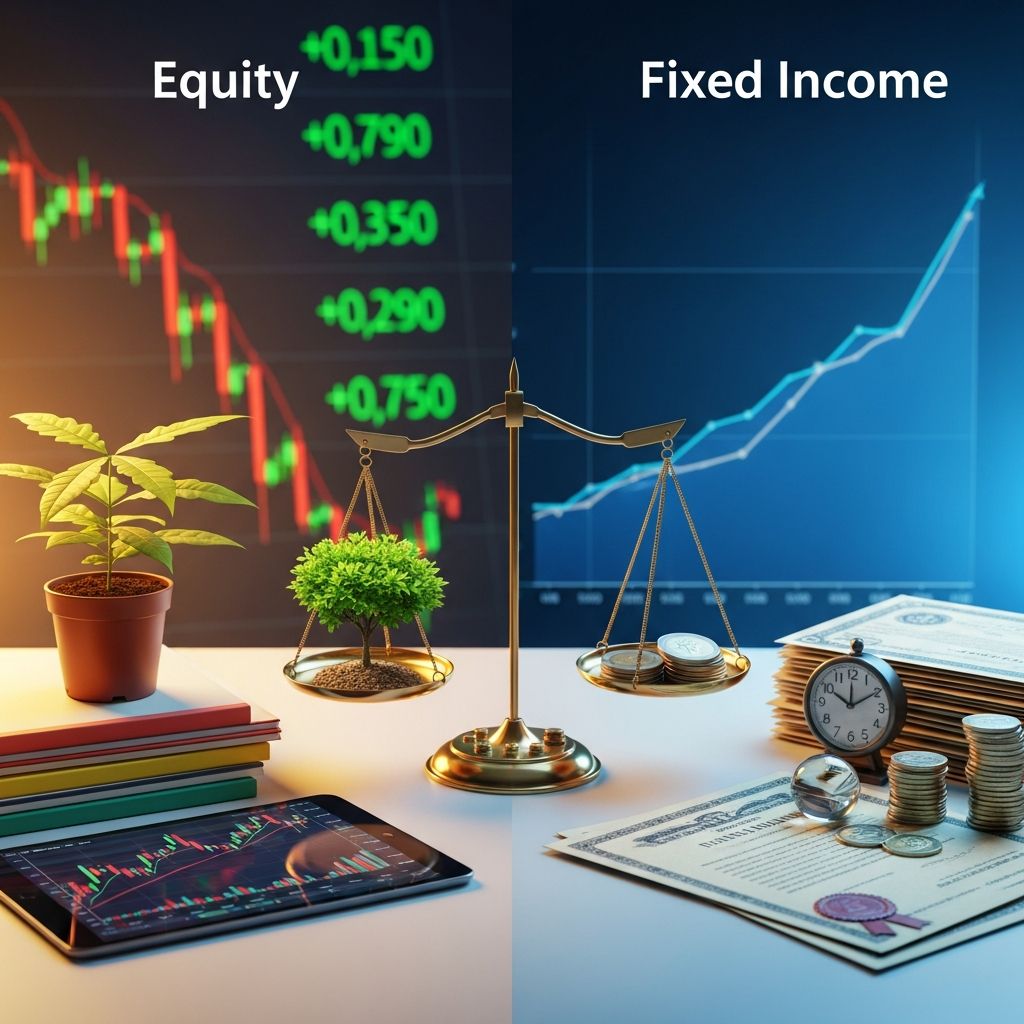
Understanding the Fundamental Distinction Between Equities and Debt Securities
When entering the world of investing, two asset classes consistently emerge as the foundational building blocks of a diversified portfolio: equities (stocks) and fixed-income securities (bonds). While both serve as vehicles for growing wealth and generating income, they operate according to fundamentally different mechanics. Understanding how each functions, their respective advantages, and their limitations is essential for anyone seeking to make informed financial decisions.
At their core, stocks represent fractional ownership in a corporation. When you purchase shares of a company, you become a part-owner with a claim on the company’s future earnings and assets. Conversely, bonds function as debt instruments—essentially formalizing a loan relationship where you lend capital to an entity (typically a government or corporation) in exchange for predetermined interest payments and the return of your principal at a specified maturity date.
The Nature of Ownership Versus Lending
The distinction between ownership and lending creates vastly different investor experiences. As a stockholder, you participate directly in the company’s success. If the business grows, innovates, and becomes more profitable, your ownership stake becomes more valuable. However, this upside participation comes paired with downside risk—if the company struggles or fails, your investment can decline significantly or become worthless. Unlike creditors (bondholders), stockholders have no guaranteed claim on assets and occupy the lowest position in the capital structure during bankruptcy proceedings.
Bondholders, by contrast, occupy a contractual position outlined in the bond indenture—a legally binding agreement specifying payment schedules, interest rates, and other terms. This formalized arrangement provides predictability. You know exactly when interest payments will arrive and when your principal will be returned. If a company encounters financial difficulties, bondholders must be paid before stockholders receive anything. This seniority in the capital structure translates into lower risk compared to equity ownership.
Income Generation Mechanisms
The paths through which stocks and bonds generate returns differ markedly. Stocks produce income through two mechanisms: capital appreciation and dividends. Capital appreciation occurs when share prices rise above your purchase price, allowing you to sell for a profit. Some corporations distribute portions of their earnings to shareholders as dividends—regular cash payments that provide income regardless of stock price movements. However, neither capital gains nor dividends are guaranteed. A stock may stagnate or decline indefinitely, and companies can reduce or eliminate dividends during difficult periods.
Bonds generate returns primarily through coupon payments—regularly scheduled interest payments made according to a predetermined rate. These payments are contractually obligated and do not depend on company profitability or investor sentiment. Treasury bonds pay every six months, corporate bonds may pay monthly, quarterly, or semiannually, and Treasury bills pay exclusively at maturity. This reliable income stream appeals particularly to investors prioritizing cash flow stability over growth potential.
Risk Profiles and Volatility Considerations
Risk tolerance fundamentally shapes investment strategy, and stocks and bonds present distinctly different risk profiles. Equity investments exhibit substantial price volatility driven by numerous factors: company earnings announcements, management changes, industry disruption, macroeconomic conditions, and investor sentiment. A stock can double in value or lose half its worth within months based on market dynamics. This volatility creates opportunity for significant gains but equally threatens substantial losses.
Bond prices also fluctuate, particularly when interest rates change or credit quality concerns emerge. However, this volatility typically remains more muted than equity volatility. Crucially, if you hold a bond to maturity, price fluctuations become irrelevant—you receive your full principal investment as promised. This maturity feature provides a built-in protection mechanism unavailable with stocks, which lack predetermined termination dates or guaranteed redemption values.
Credit risk—the possibility that an issuer cannot meet its obligations—represents another critical consideration. Government bonds, particularly U.S. Treasuries backed by the federal government’s taxing authority, carry minimal default risk. Corporate bonds introduce credit risk proportional to the issuing company’s financial stability. Bonds from struggling companies offer higher interest rates to compensate for elevated default risk, while financially robust companies can issue bonds at lower rates. Stocks, having no fixed obligation to pay anything, technically carry maximum credit risk—companies owe shareholders nothing regardless of profitability.
Return Potential and Historical Performance
Historical data consistently demonstrates that stocks outperform bonds over extended time horizons. This relationship reflects the principle that higher risk demands higher potential reward. An investor who purchased diversified stock index funds decades ago and held through multiple market downturns would have accumulated substantially more wealth than someone investing exclusively in bonds. However, this historical outperformance comes with important caveats. Past performance does not guarantee future results, and individual stock selection carries unique risks not present with diversified bond investing.
Bonds appeal to investors prioritizing stability and predictable income over maximum growth. A retiree drawing income from investments may find bond interest payments more suitable than relying on stock dividends and sales. Younger investors with decades until retirement can typically tolerate stock volatility and benefit from long-term equity appreciation.
Inverse Relationship and Portfolio Dynamics
An intriguing characteristic of stocks and bonds involves their tendency toward inverse price movement. When economic confidence increases and investors aggressively pursue growth, stock prices typically rise while bond prices fall—investors reduce lower-returning fixed-income holdings to pursue equities. Conversely, economic uncertainty sends investors fleeing toward bonds’ safety, causing bond prices to rise and stock prices to decline. This inverse dynamic makes stocks and bonds natural portfolio complements. A portfolio containing both tends to experience less dramatic value swings than one concentrated in either asset class alone.
During the 2008 financial crisis, stocks collapsed while Treasury bond prices surged as panicked investors sought safety. This inverse movement provided portfolio balance—bond gains partially offset stock losses for diversified investors. Similarly, during strong economic expansions, stock gains often offset bond declines, maintaining overall portfolio stability.
Categories and Varieties Within Each Asset Class
Stock Classifications
Stocks themselves encompass diverse categories with varying risk and return characteristics. Growth stocks represent companies expected to expand revenues and earnings faster than typical businesses. These companies reinvest profits into expansion rather than paying dividends, offering potential for substantial long-term gains but experiencing higher price volatility. Value stocks, conversely, represent companies trading below their intrinsic worth based on earnings, dividends, or book value. These typically mature, stable businesses offer more modest growth but potentially attractive valuations for patient investors.
Bond Categories and Credit Quality
Bond diversity includes distinctions based on issuer and credit quality. Treasury securities issued by the U.S. government represent the safest category, backed by the government’s full faith and credit. Corporate bonds vary dramatically in safety depending on issuer financial strength. Investment-grade corporate bonds come from financially stable companies with strong credit ratings, offering modest returns with manageable risk. High-yield (junk) bonds from financially weaker companies pay substantially higher interest to compensate for elevated default risk. Municipal bonds, issued by state and local governments, often offer tax-advantaged returns for higher-income investors.
Time Horizon and Investment Strategy Implications
Investment time horizon significantly influences the stock-versus-bond decision. Investors with decades until retirement can afford to weather stock market downturns and benefit from long-term equity growth. Those needing capital within a few years should weight portfolios toward bonds to minimize the risk of selling stocks during a downturn. Mid-career investors typically benefit from balanced allocations combining growth potential from stocks with stability from bonds.
Asset allocation—the percentage of your portfolio invested in stocks versus bonds—should reflect your specific circumstances: age, income needs, risk tolerance, and financial goals. Financial advisors commonly recommend younger investors maintain higher stock percentages, gradually shifting toward bonds as retirement approaches. However, individual circumstances vary, and personal preferences matter. Some conservative investors prefer bond-heavy portfolios despite their age, while adventurous retirees maintain significant stock exposure if they have sufficient income outside their portfolio.
Tax Considerations and Account Types
Tax treatment differs between stocks and bonds in ways that influence investment decisions. Long-term capital gains from stocks enjoy preferential tax rates compared to ordinary income, while dividend income receives similar treatment. Bond interest payments, however, face taxation as ordinary income at your marginal tax rate. Municipal bonds often provide tax-exempt interest income for federal tax purposes, making them particularly valuable for high-income investors in high-tax states.
Account type also matters significantly. Tax-advantaged retirement accounts like 401(k)s and IRAs allow stocks and bonds to grow without annual tax consequences, making them ideal vehicles for bonds’ interest income. Taxable brokerage accounts favor growth stocks since gains are only taxed when shares sell, allowing years of tax-deferred growth.
Building Your Strategic Allocation
Rather than choosing exclusively between stocks and bonds, sophisticated investors recognize their complementary roles. A diversified portfolio typically includes both, with the specific allocation reflecting individual circumstances. The mathematical principle of portfolio diversification demonstrates that combining assets with different risk profiles and return characteristics produces superior risk-adjusted returns compared to concentrated portfolios.
Consider a simple balanced portfolio containing 60% stocks and 40% bonds. During stock market rallies, the equity portion drives significant gains. During corrections, bond stability reduces overall losses. The investor benefits from equity upside participation while experiencing less dramatic swings than an all-stock portfolio.
Frequently Asked Questions
Q: Can bonds lose value before maturity?
A: Yes, bond prices fluctuate before maturity based on interest rate changes and credit quality concerns. If you hold to maturity, you receive full principal regardless of price movements. However, selling before maturity could result in losses if prices have fallen.
Q: Are stocks appropriate for retirees?
A: Many retirees maintain stock portfolios alongside bonds, depending on retirement income needs and risk tolerance. Those with substantial income outside their portfolio can afford stock exposure for growth. Those relying primarily on portfolio withdrawals typically maintain lower stock percentages.
Q: What percentage should I allocate to stocks versus bonds?
A: Appropriate allocation depends on age, income needs, risk tolerance, and goals. A common guideline suggests stock percentage equal to 110 minus your age, with the remainder in bonds. However, personal circumstances vary, and consultation with financial advisors provides personalized recommendations.
Q: Do I need both stocks and bonds in my portfolio?
A: Most investors benefit from both asset classes. Stocks provide growth potential while bonds offer stability and income. Combining them typically produces better risk-adjusted returns than either alone, though individual situations vary.
Q: How do I purchase stocks and bonds?
A: Individual stocks and bonds can be purchased through brokerage accounts, though many investors prefer mutual funds or exchange-traded funds (ETFs) providing diversification across numerous securities with single purchases.
References
- Stocks vs. Bonds: Key Differences and Strategies Explained — Synchrony Bank. 2025. https://www.synchrony.com/blog/bank/stocks-vs-bonds
- What’s the Difference Between Stocks & Bonds? — John Hancock Financial Services. 2025. https://www.johnhancock.com/ideas-insights/understanding-stocks-vs-bonds.html
- Stocks are ownership shares in a company, while bonds are a kind of loan — TD Bank. 2025. https://www.td.com/ca/en/investing/direct-investing/learn-to-invest/stocks-vs-bonds
- Bonds vs. Stocks: A Beginner’s Guide — NerdWallet Investing. 2025. https://www.nerdwallet.com/investing/learn/stocks-vs-bonds
- Bonds vs. Stocks: What’s the Difference? — Association for Financial Professionals. 2025. https://www.financialprofessionals.org/training-resources/resources/articles/Details/bonds-vs.-stocks-what-s-the-difference
- Stock vs. Bonds: What’s the Difference? — Origin Bank. 2025. https://www.origin.bank/blog/stock-vs-bonds-whats-difference/
- The difference between stocks and bonds explained — Fidelity Singapore. 2025. https://www.fidelity.com.sg/beginners/bond-investing-made-simple/difference-between-stocks-and-bonds

- Integrated M.A. in Applied Linguistics, University of Hyderabad
- 5+ years in editorial, instructional, SEO, and research-based writing
Sneha is a relationships and lifestyle writer with a strong foundation in applied linguistics and certified training in relationship coaching. She brings over five years of writing experience to theskillvault, crafting thoughtful, research-driven content that empowers readers to build healthier relationships, boost emotional well-being, and embrace holistic living. Her writing and insights reflect the belief that beauty, happiness, and wellness…