
The Strategic Advantage of Accessible Writing Tools
In an increasingly digital world, the humble pen and paper remain one of the most powerful tools for enhancing productivity and cognitive performance. However, their effectiveness depends not just on using them, but on having them readily accessible in the moments when you need them most. The placement of writing instruments throughout your environment can significantly impact your ability to capture fleeting ideas, maintain focus, and organize your thoughts effectively.
Research demonstrates that handwriting activates deeper cognitive processes than digital note-taking. When you write by hand, your brain engages in more elaborate neural activity, creating stronger connections between concepts and improving information retention. Yet this benefit only materializes when you have the tools at hand when inspiration strikes. Strategic placement of pen and paper ensures you never miss a moment of clarity or a valuable insight.
Understanding the Psychology of Accessibility
The principle underlying strategic pen and paper placement stems from behavioral psychology: the easier it is to perform a desired action, the more likely you are to perform it. When writing implements are within arm’s reach, you’re significantly more inclined to capture thoughts immediately rather than attempting to remember them later. This immediate capture is crucial because ideas lose their vividness and detail as time passes.
Dr. Gail Matthews, a psychology professor, found that people are 42 percent more likely to achieve goals they write down. However, this benefit only extends to those who actually take the time to write. By positioning pen and paper strategically throughout your life, you reduce friction and increase the likelihood of converting mental commitments into written records.
Furthermore, having visible writing surfaces serves as a cognitive reminder. Seeing a notebook prompts your brain to organize thoughts more intentionally. This visual cue activates the same neural pathways involved in goal-setting and planning, creating a continuous loop of productivity enhancement.
Primary Workspace Organization
Your primary workspace—whether that’s an office desk, home study area, or kitchen table—deserves the most prominent pen and paper setup. This is where you spend significant time focused on important tasks, making it the logical hub for your writing tools.
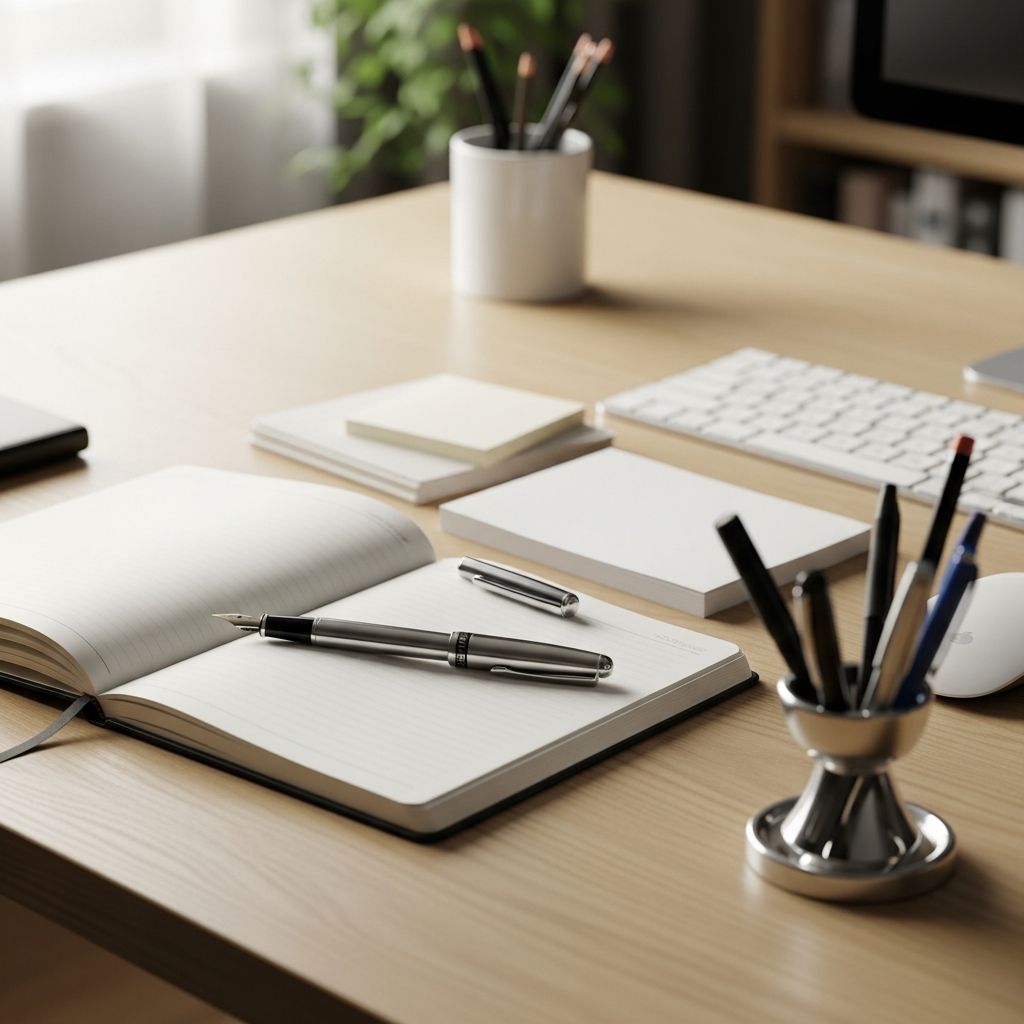
Position a dedicated notepad directly on your desk surface, not in a drawer where it becomes invisible. The visibility serves multiple functions: it reminds you of your planning intentions, it catches your eye when new thoughts emerge, and it eliminates the barrier between impulse and action. Keep several pens nearby in a holder or cup, ensuring you never face the frustration of searching for a working writing instrument.
Consider creating a tiered system with your workspace tools. Have a primary notepad for daily tasks and project work, alongside a secondary pad for capturing creative ideas or unexpected insights. This separation helps organize your thinking while ensuring you always have an appropriate surface for whatever thought needs recording.
Bedside Placement for Nocturnal Inspiration
Many of humanity’s greatest ideas arrive at inconvenient moments—particularly during the transition between sleep and wakefulness. The mind’s relaxed state in bed often produces novel associations and creative solutions that seem to disappear upon full awakening. Keeping pen and paper on your nightstand captures these fleeting insights before they evaporate.
A bedside notebook serves additional functions beyond idea capture. Writing down racing thoughts before sleep can help clear your mind for better rest. If worries or tomorrow’s tasks are occupying your mental space, externalizing them onto paper reduces cognitive burden and promotes more restful sleep. Morning pages—writing immediately upon waking—benefit enormously from this setup, allowing you to capture dreams, insights, or early-morning clarity before the day’s distractions begin.
Position the notepad and pen within reach of your bed, perhaps on a nightstand or small table. Ensure adequate lighting with a small lamp so you can write comfortably without disturbing your sleep environment significantly.
Mobile Solutions for Active Environments
Your life extends far beyond fixed workspaces. Commuting, meetings, waiting rooms, and travel demand portable writing solutions. A compact notebook that fits in your bag, jacket pocket, or vehicle ensures writing capability wherever you are.
The advantage of portable pen and paper becomes apparent during meetings, commutes, and social interactions. Rather than typing on your phone—which appears rude and isolating—taking handwritten notes maintains engagement while producing superior memory retention. Handwriting in these contexts also slows your thinking, encouraging more deliberate note-taking that captures essential information rather than transcribing everything verbatim.
For vehicle use, keep a small notepad secured near your steering wheel or in a convenient cup holder. This captures brilliant ideas that arrive during drives without requiring you to distract yourself with phone devices. Many professionals and creative thinkers report that driving triggers problem-solving breakthroughs—having writing capability in your vehicle ensures these insights get recorded.
Meeting and Conversation Spaces
Strategic placement in conference rooms, meeting spaces, and conversational areas acknowledges a critical truth: important information emerges during dialogue. Phone calls, face-to-face meetings, and collaborative discussions generate insights that must be captured immediately.
Keep writing pads near your phone for call notes. Position them in spaces where you conduct video conferences so you can reference and jot notes during remote meetings. This practice serves multiple purposes: it keeps you engaged and focused during conversations, it creates a record of decisions and action items, and it demonstrates attention and professionalism to others.
In shared spaces like conference rooms, ensuring adequate supplies of paper and multiple pens means no one must sacrifice the ability to record important information. This seemingly small detail removes a barrier to note-taking during collaborative work.
Kitchen and Common Living Areas
Life’s practical necessities often collide with creative inspiration in kitchens and living spaces. A recipe adjustment, a grocery list, a sudden brilliant idea while cooking—these moments demand immediate capture. Keeping a dedicated notepad in your kitchen ensures cooking inspiration, meal planning ideas, and shopping lists don’t vanish.
The common living area—your lounge or family room—is where relaxation can paradoxically trigger creative thinking. The brain’s default mode network, activated during rest, produces novel associations and problem-solving breakthroughs. Having writing tools accessible in these spaces ensures your most relaxed insights get captured before fading.
A shared family notepad in high-traffic areas also serves organizational functions beyond personal productivity. It becomes a central hub for household coordination, appointment reminders, and shared messages—demonstrating how strategic pen and paper placement benefits entire households.
Transition Spaces and Waiting Areas
Hallways, entryways, and waiting areas represent overlooked opportunities for strategic placement. These in-between spaces are where thoughts often crystallize as you move from one context to another. The brief pause at a doorway or the moment before leaving for an appointment can produce sudden clarity about something you need to remember.
An entryway notepad captures last-minute reminders before leaving home. A hallway pad catches thoughts as you move between rooms. These small gestures acknowledge that productivity and memory aren’t confined to designated workspaces—they emerge throughout your daily environment.
The bathroom, often overlooked, deserves consideration as a thought-capture station. Many people report their best ideas arriving during showers or bathroom visits. A waterproof notepad or a protected pad within arm’s reach captures these insights without requiring a digital device.
Comparison: Strategic Placement Benefits
| Location | Primary Benefit | Secondary Function | Ideal Setup |
|---|---|---|---|
| Primary Workspace | Task organization and project planning | Ongoing reference during work | Large pad with multiple pens in holder |
| Bedside | Nocturnal idea capture and sleep improvement | Morning pages and dream recording | Small pad with reliable pen and reading light |
| Mobile/Portable | Capture insights during active time | Professional note-taking in meetings | Pocket-sized notebook with pen clip |
| Meeting Spaces | Discussion documentation | Decision recording and action items | Pads at each seating position with pens |
| Kitchen | Recipe and meal planning ideas | Grocery and household lists | Water-resistant pad near preparation area |
| Common Living Areas | Relaxation-triggered creative thinking | Shared household coordination | Accessible pad in family gathering space |
Reducing Cognitive Load Through Strategic Placement
One of handwriting’s most significant advantages is its ability to reduce cognitive overload. Your brain can only hold so much information in working memory simultaneously. By externalizing tasks and ideas onto paper, you free mental resources for higher-order thinking.
Strategic placement multiplies this benefit. When writing tools are everywhere you spend time, you externalize thoughts more frequently and completely. This creates a continuous loop of cognitive relief: thoughts emerge, you capture them immediately, your mind releases them, and you free mental capacity for the next challenge.
This distributed system of capture points ensures nothing occupies your mental space unnecessarily. Instead of trying to remember ideas for later, you record them immediately. Instead of holding task lists in your head, you externalze them to paper. This systematic reduction of cognitive burden compounds over days and weeks, resulting in measurably improved focus and productivity.
Creating Consistency and Habit Formation
Strategic placement supports habit formation through environmental design. Rather than relying on motivation or discipline to remember writing things down, you create an environment where the behavior becomes automatic. Seeing a notepad prompts note-taking. Having a pen accessible makes capture effortless.
This approach aligns with behavioral psychology principles. B.J. Fogg’s research on habit formation demonstrates that pairing behaviors with environmental cues creates stronger habits than relying on willpower alone. By placing writing tools throughout your environment, you create consistent contextual cues that trigger the productive behavior of capturing thoughts.
Over time, this becomes self-reinforcing. As you experience the benefits of having ideas recorded and tasks documented, you develop greater appreciation for the practice. The positive outcomes create motivation to continue the behavior, supported by the convenient placement that makes it effortless to maintain.
Customizing Your Personal System
While these placement strategies provide a framework, your specific system should reflect your unique patterns and needs. Pay attention to where you naturally generate ideas. If your best thinking happens during walks, ensure you have portable writing capability. If inspiration strikes primarily during professional work, emphasize your workspace setup.
Consider your communication patterns. If you take frequent phone calls, position pads near phones. If meetings dominate your calendar, ensure every meeting space has supplies. If your work involves travel, invest in quality portable solutions that won’t deteriorate in a bag.
Evaluate the tools themselves. Some people prefer lined notebooks that provide structure; others need blank pages for sketching and non-linear thinking. Some favor compact pads that fit anywhere; others want spacious surfaces that encourage extensive notes. The “right” setup is whichever one you’ll actually use consistently.
Sustainability and Maintenance
Strategic placement only benefits you if the systems remain maintained. Regularly check that pens still write reliably. Replace pads before they become completely filled, creating resistance to use. Periodically review your placement strategy as your work environment and habits evolve.
This maintenance transforms pen and paper placement from a one-time setup into an ongoing practice that adapts with your life. As projects change, as you spend time in new locations, or as your work patterns shift, your writing tool placement should evolve accordingly.
Frequently Asked Questions
Q: Why is handwritten note-taking better than typing for productivity?
A: Handwriting activates deeper cognitive processing and creates stronger memory retention compared to typing. Research shows that handwritten notes engage more brain regions associated with learning and memory, resulting in better information recall and understanding. Additionally, handwriting forces slower, more deliberate thinking, which reduces multitasking and improves focus.
Q: How does strategic pen and paper placement improve idea capture?
A: When writing tools are immediately accessible, you’re more likely to capture thoughts the moment they emerge. Immediate capture preserves the detail and vividness of ideas before they fade from memory. Strategic placement removes friction between impulse and action, increasing the likelihood you’ll actually record insights rather than losing them.
Q: Can strategic placement help with achieving goals?
A: Yes significantly. Research shows people are 42 percent more likely to achieve goals they write down. Strategic placement increases the frequency and ease of writing down goals, creating multiple touchpoints where you commit intentions to paper. This repeated engagement with written goals strengthens commitment and accountability.
Q: What’s the best type of notebook for different locations?
A: Different locations benefit from different formats. Your primary workspace might use a large desk pad or bound notebook. Bedside areas work well with small, quick-reference pads. Mobile situations require pocket-sized notebooks. Kitchens benefit from water-resistant or laminated pads. Choose based on the space constraints and primary function of each location.
Q: How often should I review and update my placement strategy?
A: Review your system monthly initially, then quarterly once established. As your work patterns change, as projects conclude, or as you move to new spaces, reassess whether your current placement strategy still serves you effectively. The goal is maintaining an adaptive system that evolves with your life.
References
- The Science Behind Writing Things Down: Why Paper Planning Boosts Productivity — Jane’s Agenda. 2024. https://janesagenda.com/blogs/planning-101/the-science-behind-writing-things-down-why-paper-planning-boosts-productivity
- 4 Reasons to Keep Writing with a Pen and Paper — Zebra Pen. 2024. https://www.zebrapen.com/blogs/enlightened-writing/4-reasons-to-keep-writing-with-a-pen-and-paper
- Why Pen and Paper Beat Digital Notes Every Time — Jesse Wisnewski. 2024. https://www.jessewisnewski.co/article/pen-and-paper
- Pen & Productivity – How Handwriting by Hand Can Boost Creativity and Focus — A.T. Cross. 2024. https://cross.com/blogs/news/pen-productivity-how-handwriting-by-hand-can-boost-creativity-and-focus

- Integrated M.A. in Applied Linguistics, University of Hyderabad
- 5+ years in editorial, instructional, SEO, and research-based writing
Sneha is a relationships and lifestyle writer with a strong foundation in applied linguistics and certified training in relationship coaching. She brings over five years of writing experience to theskillvault, crafting thoughtful, research-driven content that empowers readers to build healthier relationships, boost emotional well-being, and embrace holistic living. Her writing and insights reflect the belief that beauty, happiness, and wellness…