
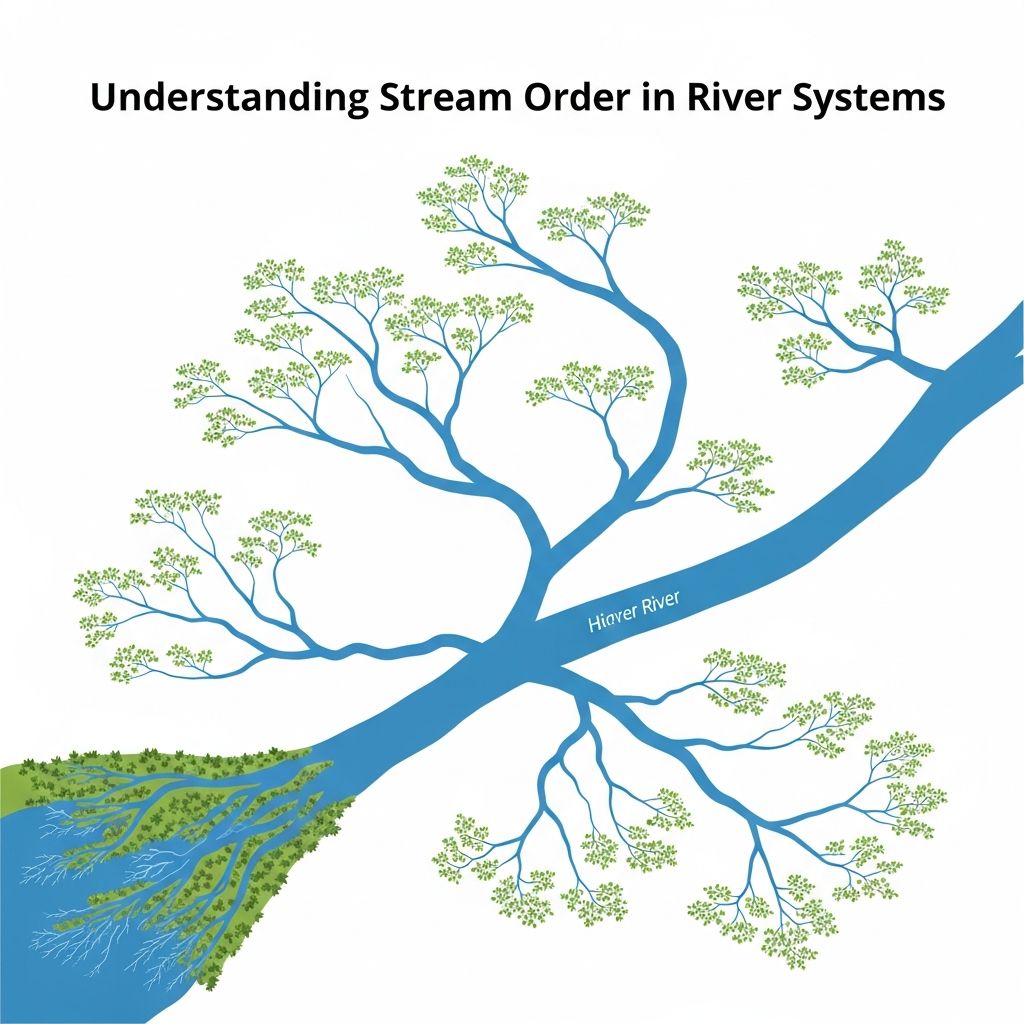
River networks form complex branching patterns across landscapes, and **stream order** provides a systematic way to quantify this hierarchy. This classification method assigns numerical values to streams based on their position and confluence patterns, offering insights into watershed structure, flow dynamics, and ecological zones.
Foundations of Stream Classification
Stream order emerged as a fundamental concept in geomorphology and hydrology to describe the topological organization of drainage basins. It treats rivers not as linear paths but as tree-like structures where smaller tributaries feed into larger channels. The smallest streams, often headwaters with no tributaries, receive the lowest order number, while confluences build higher orders downstream.
This approach simplifies complex networks into quantifiable hierarchies. Early hydrologists recognized that stream size correlates with order, influencing everything from sediment transport to habitat diversity. By mapping orders, scientists predict channel morphology and biological communities without extensive fieldwork.
Dominant Stream Order Systems
Several schemes exist, but two prevail: the Strahler (top-down) and Hack’s (bottom-up) methods. Each suits different analytical needs, from basin-wide comparisons to detailed network tracing.
Strahler Stream Order: A Top-Down Approach
In the Strahler system, first-order streams are the outermost, unbranched tributaries originating from springs or seeps. When two first-order streams merge, they form a second-order stream. The rule is straightforward: equal-order streams combining yield the next higher order; unequal mergers retain the higher order.
For instance, two second-order streams unite to create a third-order, but a second-order joining a third-order keeps it third-order. This method, refined by Arthur Strahler in 1957, excels in characterizing branching complexity across diverse watersheds.
- First-order: Headwater channels, no tributaries.
- Second-order: Formed by two first-orders merging.
- Higher orders: Build via equal-order confluences.
Hack’s or Gravelius Order: Bottom-Up Hierarchy
Contrasting Strahler, Hack’s scheme starts from the outlet. The main river to the sea or lake is order 1. Tributaries feeding it become order 2, their tributaries order 3, and so forth. This ‘bottom-up’ view emphasizes discharge position relative to the basin mouth.
Hack’s suits studies focusing on downstream dominance, like sediment budgets or flood propagation. It inverts Strahler, assigning highest numbers to headwaters, which can complicate cross-study comparisons.
Applying Stream Order in Practice
Stream order transcends theory, guiding real-world applications in water management, ecology, and engineering. It standardizes watershed assessments globally.
| Stream Order | Typical Characteristics | Examples |
|---|---|---|
| 1st-3rd | Headwaters; narrow, steep, perennial but low flow; high biodiversity in riffles. | Mountain tributaries. |
| 4th-6th | Medium streams; wider channels, moderate gradients; transitional habitats. | Valley rivers. |
| 7th+ | Rivers; broad, meandering, high discharge; major navigation routes. | Amazon (12th order). |
Hydrologists use order to estimate basin attributes. Higher-order streams generally carry more water and sediment, correlating with increased width and depth.
Insights from Stream Order Analysis
Quantitative metrics derived from orders reveal basin health. Mean stream order indicates average hierarchy; bifurcation ratio (number of streams of order n to n+1) measures branching density, often around 3-5 for natural basins.
These ratios help model erosion patterns and predict flood risks. Deviations signal human impacts like channelization, which flattens hierarchies by reducing tributaries.
Ecological Significance Across Orders
Stream order delineates distinct habitats. First-order streams host sensitive macroinvertebrates, intolerant of pollution. As orders increase, fish assemblages shift from trout in cold headwaters to bass in warmer rivers.
Conservation leverages this: protecting high-order mainstems preserves corridors, while restoring low-order tributaries boosts overall biodiversity. Agencies like the EPA use orders to prioritize stream reaches for rehabilitation.
Stream Order in Watershed Management
From urban planning to dam siting, order informs decisions. Low-order streams demand riparian buffers to prevent erosion; high-order ones require flood control. GIS tools automate ordering from digital elevation models, enabling rapid assessments.
In restoration, matching pre-impact orders guides channel redesign. For example, reconnecting oxbows in fourth-order reaches enhances fish passage.
Global Scale and Major Rivers
The Nile ranks as an 11th-order system, the Mississippi 10th, underscoring how order scales with basin size. Tropical rivers like the Amazon achieve 12th order due to dense branching.
Comparative studies show bifurcation ratios vary by geology: uniform bedrock yields lower ratios than fractured terrains.
Frequently Asked Questions (FAQs)
What defines a first-order stream?
A first-order stream is an unbranched headwater channel with no permanent tributaries feeding it, typically perennial and originating from springs.
How does Strahler differ from Shreve order?
Strahler uses topological rules for hierarchy; Shreve sums magnitudes at confluences, treating all tributaries equally in flow accumulation.
Why is stream order useful for ecologists?
It predicts community structure: low orders support riffle-dwelling insects; high orders favor pool-adapted fish and pollution-tolerant species.
Can stream order change over time?
Yes, via erosion, deposition, or human alterations like dams, which can create artificial tributaries or truncate networks.
What tools compute stream order?
GIS software like ArcGIS or SuperMap uses flow direction rasters to assign orders automatically from DEMs.
Advanced Applications and Future Directions
Modern research integrates stream order with remote sensing and AI for dynamic modeling. Climate change alters orders by headward erosion in drying basins or piracy where one stream captures another’s flow.
In forestry, order-based logging buffers protect low-order streams from sedimentation. Fisheries management zones stocking by order, ensuring species match habitats.
Ultimately, stream order bridges scales, from microhabitats to continental hydrology, fostering sustainable water use. Its simplicity belies profound utility in unraveling nature’s plumbing.
References
- Stream order – Wikipedia — Wikimedia Foundation. 2023-10-15. https://en.wikipedia.org/wiki/Stream_order
- Fun with Geomorphology: What Is Stream Order? — Ausable River Association. 2022-05-12. https://www.ausableriver.org/blog/fun-geomorphology-what-stream-order
- STREAM ORDER — West Virginia Conservation Agency. 2024-01-08. https://www.wvca.us/envirothon/a7.cfm
- Stream Order — SuperMap Software. 2023-11-20. https://help.supermap.com/iDesktopX/en/tutorial/Hydrology/StreamOrder.html
- Whatzzzzup-Stream — U.S. Environmental Protection Agency. 2016-01-01. https://www.epa.gov/sites/default/files/2016-01/documents/whatzzzzzup_article.pdf

- Integrated M.A. in Applied Linguistics, University of Hyderabad
- 5+ years in editorial, instructional, SEO, and research-based writing
Sneha is a relationships and lifestyle writer with a strong foundation in applied linguistics and certified training in relationship coaching. She brings over five years of writing experience to theskillvault, crafting thoughtful, research-driven content that empowers readers to build healthier relationships, boost emotional well-being, and embrace holistic living. Her writing and insights reflect the belief that beauty, happiness, and wellness…