
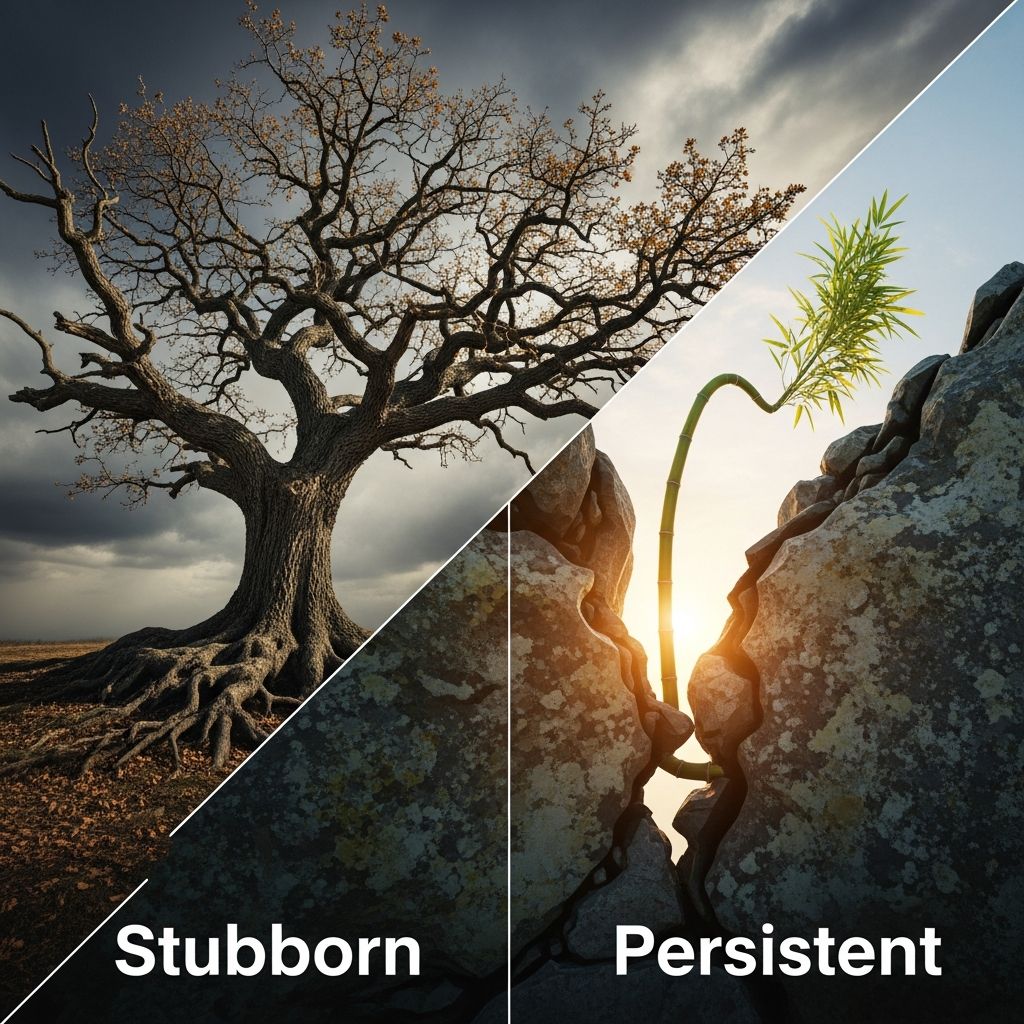
People are often described as either stubborn or persistent. The two can look very similar from the outside, yet one tends to damage relationships and decision-making, while the other supports resilience, achievement, and well-being. Personality differences shape how each of us walks this fine line.
This article explores how stubbornness and persistence differ, how personality patterns can influence both, and what you can do to keep your determination from turning into self-defeating rigidity.
Stubbornness vs. Persistence: What’s the Real Difference?
Stubbornness and persistence both involve staying with something over time, but the motives, flexibility, and outcomes are very different.
Defining the Two Traits
| Aspect | Stubbornness | Persistence |
|---|---|---|
| Core focus | Protecting ego or being right | Reaching a meaningful goal |
| Flexibility | Rigid, resists new information | Adaptable, learns and adjusts |
| Response to evidence | Ignores or dismisses | Re-evaluates and refines strategy |
| Impact on others | Often creates conflict | Can inspire and motivate |
| Psychological driver | Fear of being wrong, threat to self-image | Commitment, hope, and realistic optimism |
Research on personality traits describes stubbornness as a blend of rigidity, resistance to change, and inflexibility that makes it hard to compromise or respond to feedback. Persistence, by contrast, overlaps more with conscientiousness and grit in personality literature, involving sustained effort toward long-term goals when change of strategy is still possible and welcomed.
How Stubbornness Can Masquerade as Strength
Stubborn attitudes often show up as:
- Insisting on doing things one way, even when better options exist
- Refusing to admit mistakes or reconsider decisions
- Dismissive reactions to feedback or alternative viewpoints
- Equating backing down with being weak or losing face
These patterns may be justified internally as “staying true to myself” or “not letting people push me around.” In reality, they often reflect an attempt to protect self-esteem and avoid the discomfort of being wrong.
The Psychology Behind Stubbornness
Stubbornness is more than a quirk of personality; it is tied to how the brain makes predictions and how the ego protects our sense of self.
Predictive Brains and Mental Inflexibility
Neuroscientific models propose that the brain constantly predicts what will happen and updates those predictions when they are wrong. This process, often called predictive coding, helps us act efficiently in a complex world. When prediction errors fail to update our expectations, we can become mentally rigid and keep acting as if our prior beliefs are correct, even when reality says otherwise.
In day-to-day life, this might look like:
- Clinging to a long-held belief despite repeated evidence to the contrary
- Filtering new information so it always seems to support your existing view
- Reinterpreting feedback as an attack instead of useful data
This rigidity can contribute not only to interpersonal stubbornness, but also to patterns seen in mood problems, where people interpret events in ways that confirm negative expectations.
Ego, Shame, and the Fear of Being Wrong
On the emotional side, stubbornness is often rooted in the need to protect self-worth. When backing down feels like humiliation or defeat, people may dig in harder even when they secretly doubt their own position.
Common ego-based drivers include:
- Equating “I made a mistake” with “I am a failure”
- Believing that strong people never change their minds
- Growing up in environments where apologizing was punished or mocked
- Feeling that control is the only way to feel safe
In this sense, stubbornness can be seen as a defensive strategy rather than a pure character flaw. Recognizing that can make it easier to change.
Personality Styles and How They Express Stubbornness
Different personality patterns lean toward different forms of rigidity. While formal personality models use various dimensions (such as Big Five traits or type-based systems), the underlying question is similar: how do you naturally react to disagreement, change, and uncertainty?
Four Broad Styles of Sticking to Your Guns
The following descriptions are stylized snapshots, not fixed boxes. Many people blend several patterns.
1. The Principle-Driven Idealist
These individuals care deeply about values, ethics, and meaning. Their determination tends to focus on causes and beliefs.
- Healthy persistence: Advocates for fairness, stands up for marginalized people, stays loyal to personal values even under pressure.
- Unhealthy stubbornness: Treats every disagreement as a moral failing in others, struggles to compromise even on minor issues, assumes alternative views must be unethical.
- Growth edge: Learning to separate core values (non-negotiable) from personal preferences (negotiable) can release some rigidity.
2. The Results-Oriented Strategist
These personalities focus on efficiency, outcomes, and plans. They often take charge and like clear goals.
- Healthy persistence: Maintains focus on long-term targets, takes calculated risks, pushes through setbacks.
- Unhealthy stubbornness: Refuses to pivot even when data shows a plan is failing, dismisses emotional concerns as irrelevant, views compromise as inefficiency.
- Growth edge: Practicing active listening and data-driven flexibility—updating decisions when the evidence changes—keeps drive from turning to dominance.
3. The Relationship-Focused Supporter
These individuals prioritize harmony, belonging, and loyalty. Their stubbornness often hides behind warmth.
- Healthy persistence: Stays committed to relationships, continues to care even through conflict, protects others from being treated unfairly.
- Unhealthy stubbornness: Quietly refuses to talk about problems, says “it’s fine” but holds grudges, resists change that might disrupt the group.
- Growth edge: Learning to express disagreement directly, rather than through passive resistance, turns emotional loyalty into effective collaboration.
4. The Independent Innovator
These personalities prize autonomy, creativity, and freedom. They resist being controlled.
- Healthy persistence: Pursues original ideas despite skepticism, experiments with new approaches, stays curious.
- Unhealthy stubbornness: Rejects advice just because it comes from authority, abandons ideas that require routine or structure, equates cooperation with losing independence.
- Growth edge: Recognizing that selectively accepting structure can protect freedom rather than threaten it helps transform defiance into effective self-direction.
When Stubbornness Becomes Harmful
Some degree of determination is essential for success. The risk arises when rigidity starts to interfere with functioning and relationships.
Warning Signs Your Stubbornness Is Working Against You
- Repeated conflicts about the same issues because you “won’t budge” even on small points
- Difficulty collaborating at work due to resistance to shared decision-making
- Frequent defensiveness when others offer feedback or ask for change
- Missed opportunities because you refuse to try new strategies or tools
- Feeling stuck but blaming others rather than considering your own role
Articles on stubbornness note that refusing to listen, staying rigid in beliefs, and insisting on “my way or nothing” are common markers that the trait has tipped into the unhelpful zone.
Connections with Other Difficulties
In some cases, strong stubbornness may appear alongside other issues such as impulsivity, aggression, or developmental conditions where rigidity is part of the picture. Persistent inflexibility in many areas of life—work, home, social settings—may be a signal to seek professional input to explore underlying factors and supportive strategies.
The Upside of Stubbornness: How It Becomes Persistence
Viewed through another lens, stubborn people often possess raw materials for positive traits:
- Strong convictions: Clarity about what they believe and value
- Resilience: Capacity to keep going despite setbacks
- Focus: Ability to concentrate deeply on a goal or problem
- Leadership potential: Determination that can inspire others when paired with empathy
Psychological writing on stubbornness emphasizes that the same tenacity that causes conflict can also support innovation, boundary-setting, and self-respect, provided it is balanced with openness and flexibility.
Practical Strategies to Transform Stubbornness into Healthy Determination
You do not need to change your basic personality to soften stubbornness. Instead, you can learn to direct your natural resolve more skillfully.
1. Clarify What You Are Protecting
When you feel the familiar internal “lock up,” pause and ask:
- “Am I defending a value, an opinion, or my ego?”
- “If I changed my mind, what would I fear it says about me?”
Often, you will find that you are not defending a deep principle, but the discomfort of seeming wrong or out of control. Simply naming that can loosen the grip.
2. Separate Goal from Method
Persistence focuses on the goal; stubbornness clings to a specific method. To shift toward persistence:
- State the shared objective out loud: “We both want this project to succeed.”
- Brainstorm at least two alternative paths to the same outcome.
- Evaluate options using data, not pride: “Which is more likely to work, given what we know?”
This approach is consistent with evidence-based problem-solving strategies that emphasize flexibility in adapting to new information.
3. Practice Evidence-Based Flexibility
Because stubbornness is often linked to how our brains protect existing beliefs, it helps to build a habit of actively seeking disconfirming evidence.
- Ask someone you trust to explain why your view might be incomplete.
- Summarize their point back to them to ensure you truly understood.
- Identify at least one piece of information that, if proven true, would make you reconsider your stance.
This mirrors scientific thinking: hypotheses are tested and revised rather than guarded at all costs.
4. Use “Partial Agreement” Statements
Rather than shifting from “I’m right” to “You’re right,” practice finding areas of overlap:
- “I still care a lot about my concern, and I can see why that part of your suggestion makes sense.”
- “I agree with you on the goal; I’m unsure about the timeline. Let’s work on that piece.”
This lets you remain engaged without feeling like you are surrendering your entire position.
5. Check the Cost-Benefit Balance
Some hills are not worth dying on. Before digging in, ask yourself:
- “What am I realistically going to gain by holding this line?”
- “What might I lose—trust, time, opportunities, goodwill?”
- “If we look back in a year, will this still matter?”
Many conflicts driven by stubbornness involve low-stakes issues that quietly erode relationships over time.
6. Build Emotional Safety Around Mistakes
Stubbornness softens when it is emotionally safe to be wrong. You can foster that safety by:
- Speaking kindly to yourself after errors instead of using harsh self-criticism.
- Modeling apologies in your relationships (“I see now I dug in too hard there.”).
- Choosing environments—teams, friends, partners—where learning is valued more than always being right.
Over time, this reduces the ego threat that often underlies inflexible behavior.
Everyday Examples of Healthy vs. Unhealthy Sticking Power
The contrast between persistence and stubbornness becomes clearer in concrete situations:
- Work project: A persistent teammate adapts the plan when new data emerges; a stubborn teammate insists the original plan must work, even as deadlines and quality suffer.
- Family decision: A persistent parent holds a firm boundary about a child’s bedtime but is flexible about which book they read; a stubborn parent refuses any negotiation and interprets every question as defiance.
- Personal goal: A persistent learner changes study methods when grades stagnate; a stubborn learner keeps the same approach and blames the exam or teacher.
Frequently Asked Questions (FAQs)
Q: Is being stubborn always a bad thing?
No. The same qualities that look like stubbornness—strong convictions, tenacity, refusal to be easily swayed—can support resilience, leadership, and innovation when combined with openness to evidence and respect for others.
Q: How can I tell if I’m being persistent or just stubborn?
Ask yourself whether you are willing to adjust your methods in light of new information, whether you can acknowledge valid points from other people, and whether your stance is serving a meaningful goal or simply protecting your pride. Flexibility in approach is a sign of persistence; inflexibility regardless of consequences points to stubbornness.
Q: Do some personality types tend to be more stubborn?
People differ in traits like openness to experience, conscientiousness, and agreeableness, which influence how readily they adapt and compromise. Those who are more rigid, highly self-protective, or uncomfortable with uncertainty may appear more stubborn, but context, learning history, and stress levels all matter as well.
Q: Can chronic stubbornness be changed?
Yes. While you may always have a strong will, you can learn skills such as perspective-taking, evidence-based decision-making, and emotional regulation that help direct your determination more constructively. In some cases, counseling or therapy can provide tools for reducing rigidity, especially when it is linked to deeper issues or co-occurring conditions.
Q: When should I seek professional help about my stubbornness?
Consider professional support if your inflexibility is causing repeated relationship breakdowns, significant problems at work, or severe distress, or if others consistently describe you as impossible to reason with. A mental health professional can help tease apart personality style from underlying conditions and suggest evidence-based strategies.
References
- How to Identify a Stubborn Person — Solh Wellness. 2023-05-10. https://www.solhapp.com/blog/how-to-identify-a-stubborn-person
- Turning Stubbornness Into Positive Personality Traits — BetterHelp Editorial Team. 2023-08-15. https://www.betterhelp.com/advice/general/turning-bad-mad-and-stubborn-into-positive-personality-traits/
- Why Some People Are So Stubborn — Susan Krauss Whitbourne, Psychology Today. 2024-07-19. https://www.psychologytoday.com/us/blog/fulfillment-at-any-age/202407/is-stubbornness-hardwired-into-the-brain
- Stubbornness: The Guts to Fight Reality — WhyWeSuffer.com. 2018-04-02. https://whywesuffer.com/stubbornness-the-guts-to-fight-reality/

Medha Deb is an editor with a master's degree in Applied Linguistics from the University of Hyderabad. She believes that her qualification has helped her develop a deep understanding of language and its application in various contexts. Medha specializes in the areas of beauty, health, sports, and wellness and is committed to ensuring that the content on the website is…