
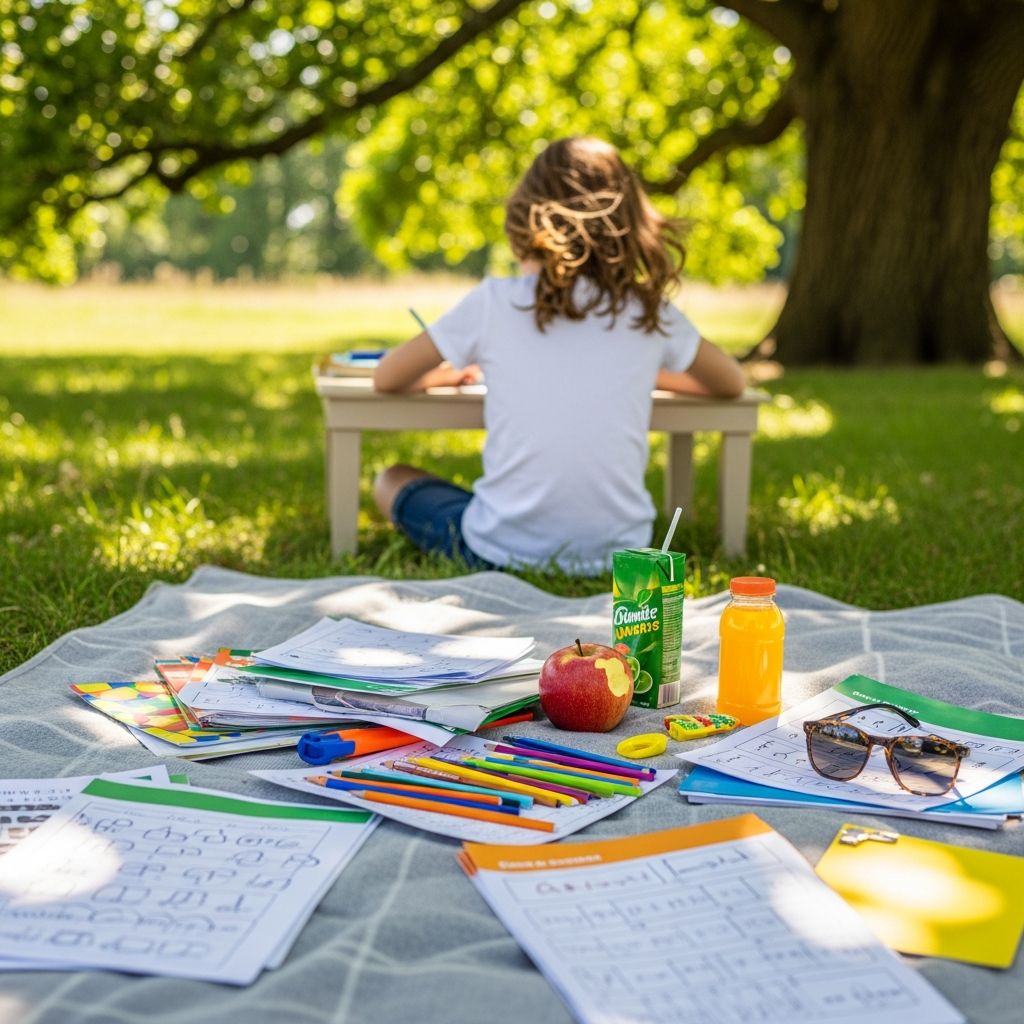
Keeping children academically engaged during summer vacation is essential to counter the ‘summer slide,’ where students can lose up to 2.6 months of math skills and fall behind in reading by the end of grade 6. Fun, targeted worksheets provide a structured yet enjoyable way to maintain progress in key subjects, fostering confidence and readiness for the new school year. This article outlines original worksheet concepts across multiple disciplines, designed for home use with minimal preparation.
Why Prioritize Summer Academic Activities
Summer breaks offer freedom but often lead to skill regression, particularly for low-income students who learn less over vacations compared to peers. Structured activities like worksheets prevent this by reinforcing prior knowledge and introducing new concepts playfully. Research from voluntary district programs shows gains in academic, behavioral, and social-emotional outcomes. Parents can integrate 20-30 minutes daily, blending education with play to build lifelong habits.
Benefits extend beyond grades: enhanced critical thinking, reduced back-to-school anxiety, and stronger executive functions like time management. High-quality programs even yield measurable math and reading improvements. For students with learning differences, consistent practice eases the transition back to routines.
Math Mastery Through Playful Challenges
Math sees the steepest summer losses, but interactive worksheets turn drills into adventures. Focus on problem-solving to develop logical reasoning and conceptual depth.
- Daily Number Puzzles: Create grids where kids fill patterns using summer themes, like beach ball counts or ice cream cone fractions. This reinforces operations without rote memorization.
- Geometry Scavenger Hunts: Printable sheets with shapes to spot in photos or drawings, calculating areas of picnic blankets or pool perimeters.
- Budgeting Games: Simulate vacation spending with mock allowances, teaching addition, subtraction, and decimals through shopping lists.
Assign balanced homework post-worksheet, around 30 minutes, with step-by-step solutions to build independence. Track progress to celebrate gains, mirroring guided programs that boost exam readiness.
Reading Adventures to Spark Imagination
Reading slips significantly over summer, but story-based worksheets reignite passion. Encourage comprehension and vocabulary through themed narratives.
- Book Journal Prompts: Sheets for summarizing chapters with drawing spaces, questioning ‘what if’ plot twists to deepen analysis.
- Word Treasure Maps: Hunt synonyms and antonyms hidden in maze-like layouts inspired by treasure islands.
- Character Interviews: Questionnaires where kids role-play as book heroes, practicing inference skills.
Combine with family read-alouds for bonding and retention. Studies confirm consistent practice minimizes review needs in fall.
Writing Workouts for Expressive Skills
Journaling counters writing stagnation, promoting creativity and grammar. Varied prompts keep it fresh.
- Summer Memory Logs: Daily entries with photo prompts, focusing on descriptive language.
- Postcard Stories: Design cards to ‘send’ fictional friends, emphasizing structure and persuasion.
- Comic Strip Creators: Blank panels for sequential storytelling, integrating dialogue and sequencing.
Feedback loops, like parent highlights of strengths, mirror effective programs. This builds confidence for school essays.
Science Experiments on Paper and Practice
Hands-on science worksheets bridge theory and application, vital for retention.
- Weather Trackers: Charts to log daily forecasts, predict patterns, and hypothesize causes.
- Plant Growth Journals: Observation grids for home gardens, measuring variables like sunlight effects.
- Magnetism Mazes: Predict paths of objects through illustrated fields, explaining attractions.
Pair with simple experiments; even paper versions reinforce inquiry skills.
History Quests to Uncover the Past
Timeline worksheets contextualize events, combating factual fade.
- Era Match-Ups: Pair inventions with inventors via drag-and-drop style printables.
- Timeline Vacations: Plot historical sites on personal travel maps.
- Artifact Decoders: Riddles decoding ancient symbols’ meanings.
This fosters critical connections to modern life.
Artistic Expressions for Creative Growth
Art integrates subjects, enhancing fine motor and innovation.
- Perspective Drawings: Guides for summer scenes from varied angles.
- Collage Math: Shape compositions calculating totals.
- Emotion Palettes: Color-mood charts tied to stories.
Display work to boost pride.
Language Explorations for Global Minds
Basic foreign language sheets build fluency foundations.
- Phrase Bingo: Grids with vacation words in target languages.
- Cultural Recipe Cards: Translate ingredients, practice pronunciation.
- Flag Puzzles: Assemble and label country symbols.
Apps supplement for interactivity.
Implementing a Balanced Summer Plan
Structure prevents burnout: rotate subjects weekly, 3-4 days on, rest playful. Use tables for scheduling:
| Day | Subject | Activity Type | Duration |
|---|---|---|---|
| Monday | Math | Puzzle | 25 min |
| Tuesday | Reading | Journal | 30 min |
| Wednesday | Science | Experiment | 20 min |
| Thursday | Writing | Prompt | 25 min |
| Friday | Art/History | Project | 30 min |
Digital options ensure access. Incentives like stickers motivate.
Measuring Progress and Adjusting
Pre/post quizzes gauge retention; apps track digitally. Parental involvement closes gaps. Voluntary programs prove long-term gains.
Frequently Asked Questions
How much time daily for summer worksheets?
20-30 minutes suffices to prevent loss without overwhelming.
Are digital worksheets effective?
Yes, they match physical for engagement if interactive.
What if my child resists?
Gamify with themes and rewards; start short.
Do these help advanced learners?
Yes, add challenges for growth.
Can they replace programs?
They supplement well, mimicking benefits.
References
- The Ultimate Guide to Summer Learning — Oxford Learning. Accessed 2026. https://oxfordlearning.com/the-ultimate-guide-to-summer-learning/
- Make Summer Homework Work: 5 Proven Steps for Better Habits — Think Academy. Accessed 2026. https://www.thethinkacademy.com/blog/make-summer-homework-work-5-proven-steps-for-better-habits/
- Should You Create Summer Learning Packets for Your Students? — School Specialty Blog. Accessed 2026. https://blog.schoolspecialty.com/should-you-create-summer-learning-packets-for-your-students/
- Unlock the Full Potential of Summer Learning — Springer Learning Differences. 2026-01-22. https://www.springer-ld.org/2026/01/22/unlock-the-full-potential-of-summer-learning/
- Summer Learning Enhances Student Success — Parents for Public Schools. Accessed 2026. https://parents4publicschools.org/summer-learning-enhances-student-success/
- Learning from Summer: Effects of Voluntary Summer Learning Programs — Wallace Foundation. 2023-09. https://wallacefoundation.org/sites/default/files/2023-09/Learning-from-Summer-Effects-of-Voluntary-Summer-Learning-Programs.pdf
- School’s Out… Now What? Creating a Summer Learning Plan That Works — Scholars Education. Accessed 2026. https://www.scholarsed.com/schools-out-now-what-creating-a-summer-learning-plan-that-works/

- Integrated M.A. in Applied Linguistics, University of Hyderabad
- 5+ years in editorial, instructional, SEO, and research-based writing
Sneha is a relationships and lifestyle writer with a strong foundation in applied linguistics and certified training in relationship coaching. She brings over five years of writing experience to theskillvault, crafting thoughtful, research-driven content that empowers readers to build healthier relationships, boost emotional well-being, and embrace holistic living. Her writing and insights reflect the belief that beauty, happiness, and wellness…