
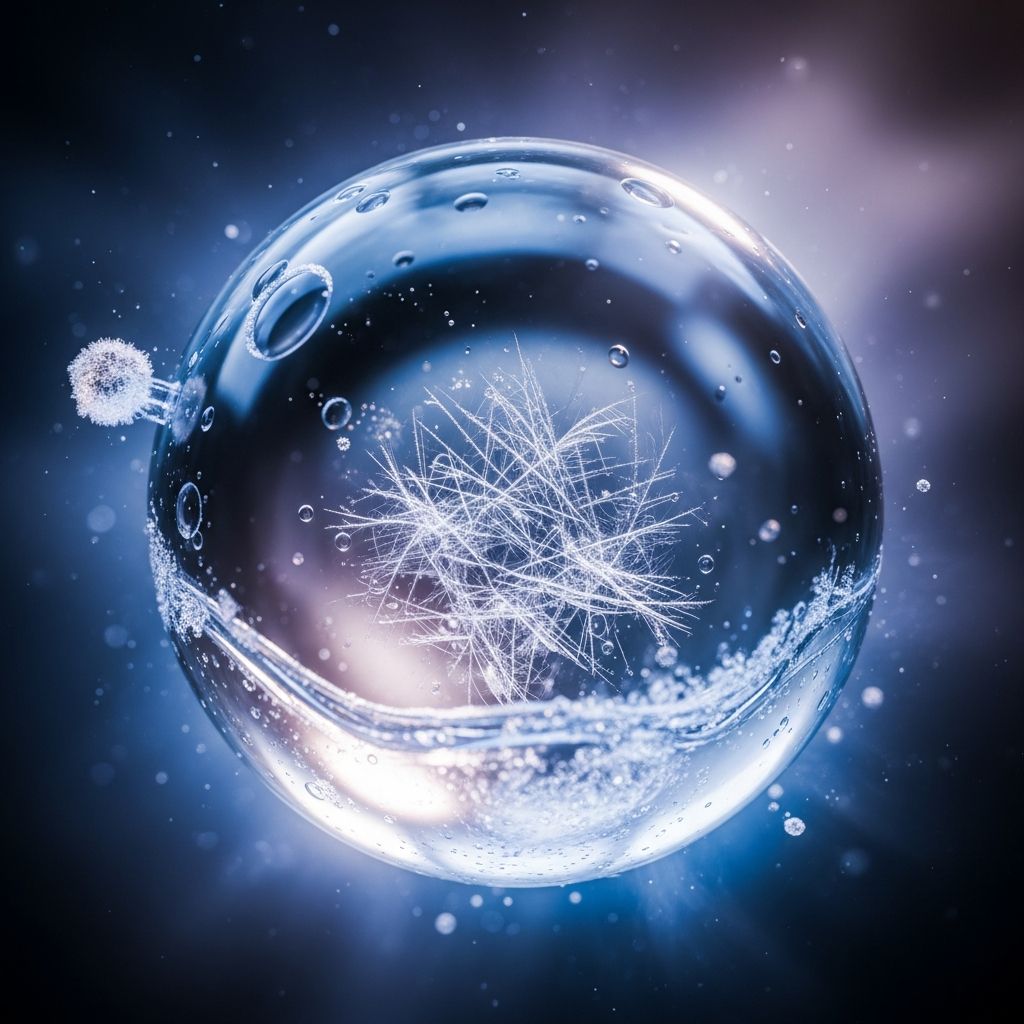
Water, the most familiar substance on Earth, harbors secrets that defy everyday expectations. Supercooling occurs when liquid water is chilled below its standard freezing point of 0°C (32°F) without turning solid, remaining fluid until triggered to crystallize rapidly. This phenomenon reveals the delicate balance of molecular arrangements and external influences on phase changes.
The Molecular Dance Behind Supercooling
At its core, supercooling hinges on water’s molecular structure. In liquid form, H2O molecules move freely, sliding past each other. Cooling slows this motion, but freezing requires molecules to align into a rigid crystal lattice. Impurities, container scratches, or even dust act as nucleation sites—tiny anchors where ice crystals begin forming. Pure water lacks these sites, allowing it to persist as a liquid far below 0°C.
Homogeneous nucleation, the natural limit without external triggers, occurs around -48.3°C (-55°F) for ultra-pure water under standard pressure. This threshold marks where molecular collisions inevitably form ice seeds spontaneously. Achieving supercooling demands purity via methods like reverse osmosis or distillation, preventing premature solidification.
- Purity is key: Minerals or particles in tap water promote instant freezing.
- Cooling rate matters: Rapid chilling bypasses nucleation up to extreme lows.
- Disturbance triggers change: Shaking or adding ice initiates explosive crystallization.
Everyday Methods to Supercool Water at Home
Replicating supercooling requires minimal equipment but precise conditions. Two reliable approaches stand out: freezer-based bottle supercooling and ice-salt bath glass cooling. Both prioritize purified water to maximize success rates.
Freezer Bottle Technique
This method leverages a household freezer’s consistent chill. Select a smooth plastic bottle to minimize surface nucleation points.
- Fill a clean plastic bottle with 250-500ml of distilled or purified water, leaving minimal headspace.
- Seal tightly and place undisturbed in the freezer for 2-3 hours. Check periodically—water should be ice-cold but fully liquid. If slushy, reduce time and retry.
- Gently remove. Tap the bottle on a countertop or shake vigorously. Watch as ice forms instantly from the bottom up, like a wave.
Pro tip: Brands like Fiji work well due to low mineral content. For visuals, pour supercooled water over frozen grapes or ice cubes to grow instant ‘icicles’.
Ice-Salt Glass Method
A quicker alternative uses an ice-salt mixture to drop temperatures below 0°C rapidly.
- Pour 30-50ml purified water into a spotless glass.
- Nestle the glass in a deeper bowl packed with ice cubes.
- Sprinkle rock salt over ice (avoid water contamination) to depress the melt point, chilling faster.
- Wait 15-20 minutes until water feels intensely cold.
- Trigger by dropping an ice cube in or pouring onto ice—the liquid flash-freezes.
| Method | Time | Equipment Needed | Success Rate |
|---|---|---|---|
| Freezer Bottle | 2-3 hours | Bottle, purified water, freezer | High (80-90% with pure water) |
| Ice-Salt Glass | 15-20 min | Glass, bowl, ice, salt | Medium-High |
Safety first: Wear gloves to handle super-cold items; supervise children closely to avoid spills or breakage.
Why Supercooling Feels Like Magic—But Isn’t
The dramatic freeze captures attention, but it’s rooted in thermodynamics. Supercooled water holds excess energy, metastable until disturbed. Nucleation releases latent heat, warming the forming ice slightly and accelerating the chain reaction across the liquid.
Experiment variations amplify the wow factor:
- Fruit freeze: Dip frozen grapes into supercooled water for crystalline coatings.
- Chain reaction: Pour from one bottle to another, propagating ice instantly.
- Scale up: Use larger volumes for slower, more visible propagation.
Failures? Common culprits include impure water, vibrations during cooling, or over-chilling. Patience refines technique.
Nature’s Supercooling Spectacles
Beyond labs, supercooling shapes our world. In clouds, supercooled droplets persist until dust or collision triggers rain or hail, vital for weather patterns. Plants endure frosts via natural antifreeze proteins inhibiting nucleation; some fish thrive in icy waters using similar biochemistry.
Atmospheric supercooling enables glaze ice on aircraft wings, posing aviation risks. Understanding it informs de-icing strategies.
Industrial and Scientific Frontiers
Supercooling drives innovation. In cryopreservation, it enables vitrification—freezing biological tissues glass-like without damaging crystals, advancing organ storage and fertility tech. Rapid cooling to glassy states (below -123°C) forms amorphous ice, stable up to extreme reheating.
Materials science exploits it for metallic glasses with superior strength. Food processing uses supercooling for texture preservation in frozen goods. Even climate modeling relies on accurate nucleation predictions for precipitation forecasts.
Advanced Experiments for Curious Minds
Elevate demos with precision:
- Temperature logging: Use a probe to track supercooling depth (aim for -5°C to -10°C home limits).
- Pressure effects: Note supercooling deepens under pressure, though home setups ignore this.
- Microscope view: Observe dendrite (branching) ice growth post-nucleation.
Quantify: Latent heat release raises temperature by ~0.5-1°C during freezing, measurable with thermometers.
Frequently Asked Questions (FAQs)
What is the deepest supercooling possible for water?
Under lab conditions with ultra-pure water, down to -48.3°C before homogeneous nucleation forces freezing.
Why does shaking trigger freezing?
It generates shear forces creating nucleation sites, sparking the crystal lattice chain reaction.
Is supercooled water safe to touch or drink?
It’s potable if from safe sources, but the rapid freeze can startle. Avoid ingestion mid-experiment due to speed.
Can I supercool other liquids?
Yes—many pure liquids supercool, but water’s hydrogen bonding makes it exceptionally prone.
Why does salt help in the glass method?
Salt lowers ice’s melting point, creating sub-zero brine that chills water faster without direct contact.
Troubleshooting Common Pitfalls
Not every attempt succeeds on the first try. Here’s a diagnostic guide:
| Issue | Cause | Solution |
|---|---|---|
| Freezes too soon | Impurities or rough surfaces | Use distilled water, smooth plastic |
| No reaction on trigger | Not cold enough | Extend cooling time slightly |
| Partial slush | Overcooled or disturbed | Shorten time, insulate bottle |
Practice builds mastery—record attempts to optimize.
The Broader Physics of Phase Transitions
Supercooling exemplifies metastability: systems lingering in higher-energy states until perturbed. Parallels exist in diamonds (metastable carbon), overcooled alloys, and even financial ‘bubbles’. It underscores chaos theory’s sensitivity to initial conditions.
Quantum insights reveal water’s anomalies—higher density at 4°C, expanding on freeze—stem from tetrahedral bonding. Supercooling amplifies these quirks, making H2O uniquely study-worthy.
Educators love it for engaging students tactilely with abstract concepts like entropy and Gibbs free energy. ΔG = ΔH – TΔS dictates phase stability; supercooling tips the balance artificially.
Future Horizons in Supercooling Research
Ongoing studies probe limits: Can we supercool beyond -48°C with confinement or fields? Nanoscale droplets push boundaries, informing exoplanet ocean models. Climate change alters atmospheric supercooling, potentially shifting rainfall patterns.
Biotech dreams of room-temperature supercooling for vaccines. While home demos thrill, they gateway profound discoveries.
References
- The Science Behind Supercooled Water — Aqua Water. 2023. https://www.aquawater.com/news/science-behind-supercooled-water
- A Supercool Experiment — MEL Science. Accessed 2026. https://melscience.com/US-en/articles/supercool-experiment/
- Supercooling — Wikipedia (drawing from primary physics sources incl. Fahrenheit 1724). Last edited 2026. https://en.wikipedia.org/wiki/Supercooling

Medha Deb is an editor with a master's degree in Applied Linguistics from the University of Hyderabad. She believes that her qualification has helped her develop a deep understanding of language and its application in various contexts. Medha specializes in the areas of beauty, health, sports, and wellness and is committed to ensuring that the content on the website is…