
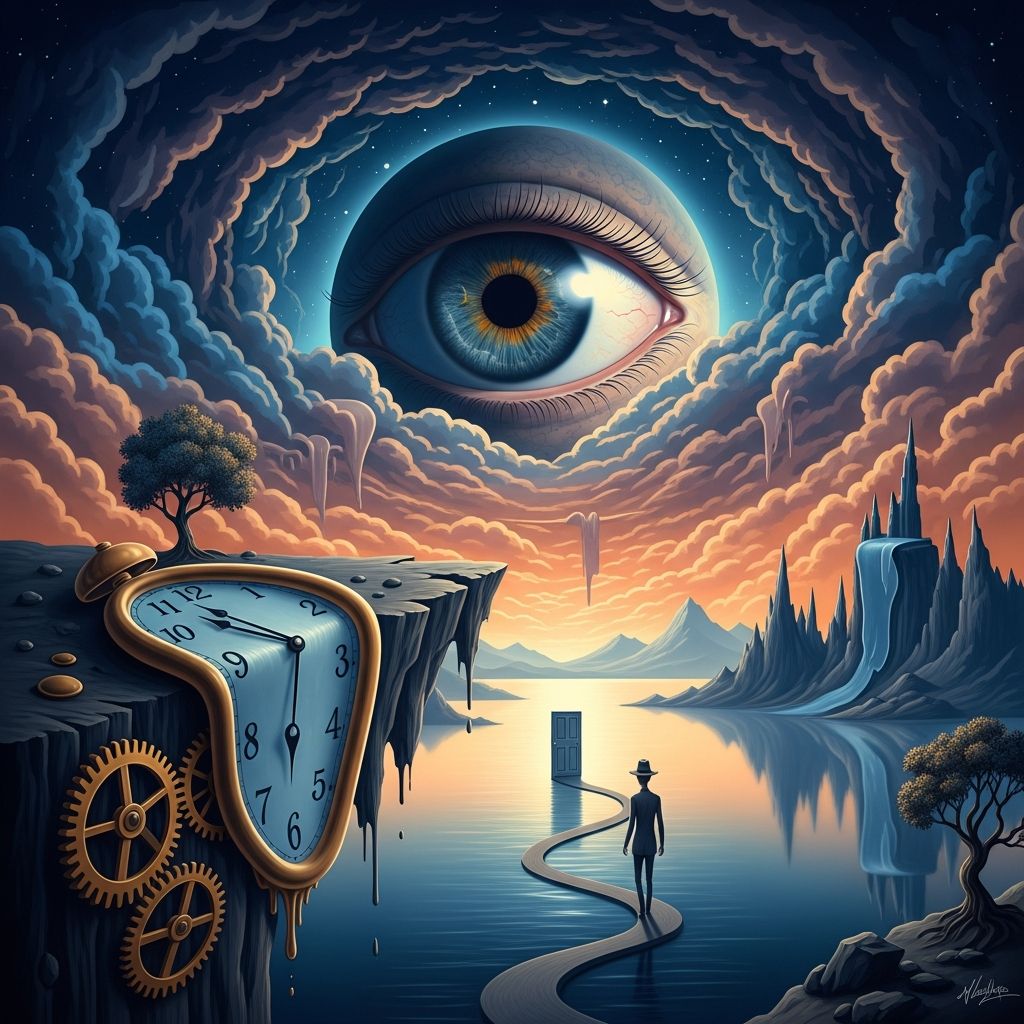
Surrealism emerged as a transformative force in the early 20th century, blending the rational with the irrational to unlock the depths of the human psyche. This movement sought to transcend everyday reality by harnessing dreams, fantasies, and subconscious impulses, creating works that provoke, unsettle, and inspire.
Birth of a Revolutionary Vision
The roots of Surrealism trace back to the devastation of World War I, a catastrophe that shattered faith in logic, reason, and societal norms. Artists and writers, reeling from the war’s horrors, rejected the rationalism they blamed for such destruction. Influenced by the chaotic Dada movement, they pursued a new path that elevated the irrational and the dreamlike.
In 1924, French poet and critic André Breton crystallized this ethos in his groundbreaking Surrealist Manifesto. Breton defined Surrealism as “pure psychic automatism,” a method to express thought free from rational control, aesthetic rules, or moral constraints. His vision aimed to fuse dream and reality into a ‘super-reality’ or surreality, revolutionizing human experience by asserting the power of the unconscious.
Breton’s call resonated across Europe, drawing poets, painters, sculptors, and filmmakers into a vibrant international network centered in Paris. The movement quickly spread, challenging conventional art and igniting debates on creativity, psychology, and freedom.
Psychological Foundations and Core Influences
At Surrealism’s heart lies Sigmund Freud’s theory of the unconscious mind, where repressed desires and primal instincts reside. Surrealists adopted Freudian ideas like free association and dream analysis to access hidden mental realms, viewing the subconscious as a boundless source of inspiration.
Figures like Carl Jung also contributed, with concepts of the collective unconscious enriching the movement’s exploration of archetypes and universal symbols. Marxism influenced some Surrealists, who saw art as a tool for social revolution, blending psychological liberation with political critique.
The term ‘surreal’ originated with poet Guillaume Apollinaire in 1917, describing a play that merged reality with the extraordinary. Breton seized this idea, transforming it into a manifesto for artistic rebellion against post-war disillusionment.
Defining Characteristics of Surrealist Expression
Surrealist works defy logic, featuring bizarre juxtapositions, dreamlike scenarios, and uncanny transformations. Common traits include:
- Dreamlike landscapes: Floating objects, impossible architectures, and melting forms evoke the fluidity of sleep.
- Unexpected combinations: Apples replacing human heads or clocks draped over branches challenge perceptions.
- Erotic and grotesque elements: Bodies morph into animals or machines, revealing subconscious tensions.
- Human yet alien figures: Distorted anatomies blur the line between familiar and otherworldly.
These elements create a sense of wonder and disorientation, inviting viewers to question reality itself.
Techniques That Unleashed the Subconscious
Surrealists pioneered methods to bypass conscious interference, prioritizing spontaneity over deliberation. Key techniques include:
- Automatism: Automatic drawing or writing captures unfiltered thoughts, producing abstract, organic forms. Artists like Joan Miró used this for raw, biomorphic imagery.
- Exquisite Corpse: Collaborative game where participants add to a folded drawing blindly, yielding surreal composites.
- Frottage and Decalcomania: Rubbing textures or pressing wet paint for accidental patterns, as in Max Ernst’s innovations.
- Veristic rendering: Hyper-realistic depiction of impossible scenes, mastered by Salvador Dalí.
These approaches democratized art, emphasizing process over product and making the unconscious accessible to all.
Two Branches: Automatism vs. Verism
| Aspect | Automatism (Abstract Surrealism) | Veristic Surrealism |
|---|---|---|
| Approach | Spontaneous, unplanned marks from subconscious flow | Precise, detailed realism for dream scenarios |
| Key Artists | Joan Miró, André Masson | Salvador Dalí, René Magritte |
| Visual Style | Abstract, fluid, organic shapes | Photorealistic yet impossible compositions |
| Goal | Direct unconscious expression | Illusion of reality to provoke interpretation |
This duality enriched Surrealism, accommodating diverse paths to the psyche.
Iconic Artists and Their Masterpieces
Salvador Dalí: The Spanish virtuoso of veristic Surrealism painted melting clocks in The Persistence of Memory (1931), symbolizing time’s fluidity. His paranoid-critical method induced hallucinations for bizarre precision.
René Magritte: Belgian painter famed for philosophical paradoxes, like The Treachery of Images (1929), declaring ‘This is not a pipe’ beneath a pipe image, questioning representation.
Joan Miró: Catalan artist blended automatism with playful symbols in works like The Tilled Field (1923-1924), evoking dreamlike narratives.
Max Ernst: German pioneer of frottage, created frothy forests and hybrid creatures in collages and paintings.
Women like Dorothea Tanning and Leonora Carrington brought feminist perspectives, exploring domestic surrealism and mythology.
Surrealism’s Reach Beyond Canvas
Though rooted in painting, Surrealism permeated literature, film, theater, photography, and fashion. Breton’s group produced journals and exhibitions blending media. Filmmakers like Luis Buñuel shocked with Un Chien Andalou (1929), featuring surreal eye-slicing sequences.
Photography by Man Ray distorted forms via solarization, while sculptors like Alberto Giacometti crafted elongated figures. Surrealism’s influence endures in advertising, music videos, and contemporary art[10].
Legacy and Modern Echoes
Surrealism waned post-WWII amid political shifts and Abstract Expressionism’s rise, but its impact persists. It paved the way for Pop Art, psychedelia, and digital surrealism. Today, artists use AI and VR to revisit subconscious frontiers.
The movement’s emphasis on liberation inspires ongoing challenges to norms, proving art’s power to reshape consciousness.
Frequently Asked Questions
What sparked the Surrealism movement?
World War I’s trauma and Dada’s anti-rationalism fueled Surrealism, formalized by André Breton’s 1924 manifesto.
How did Freud influence Surrealists?
Freud’s unconscious theories provided tools like dream interpretation to access repressed thoughts.
Who are the most famous Surrealist artists?
Salvador Dalí, René Magritte, Joan Miró, and Max Ernst lead, each pioneering unique subconscious expressions.
Is Surrealism still relevant today?
Yes, its techniques inform film, design, and digital art, continuing to explore human depths[10].
What distinguishes Surrealism from Dadaism?
Dadaism destroyed norms chaotically; Surrealism constructively harnessed the unconscious for new realities.
References
- What is Surrealism Art? Definition, Artists, & Examples — Sparks Gallery. 2023. https://sparksgallery.com/blogs/art-education/what-is-surrealism-art-definition-artists-examples
- Surrealism — Wikipedia. 2024-04-01. https://en.wikipedia.org/wiki/Surrealism
- What is Surrealism? Definition and Examples for Filmmakers — StudioBinder. 2023. https://www.studiobinder.com/blog/what-is-surrealism-definition/
- Surrealism | Definition, Painting, Artists, Artworks, & Facts — Britannica. 2024-03-15. https://www.britannica.com/art/Surrealism
- Surrealism — Tate. 2023. https://www.tate.org.uk/art/art-terms/s/surrealism
- What Is Surrealism? How Art Illustrates the Unconscious — Park West Gallery. 2024. https://www.parkwestgallery.com/blog/what-is-surrealism-art/
- Surrealism — The Metropolitan Museum of Art. 2023. https://www.metmuseum.org/essays/surrealism

Medha Deb is an editor with a master's degree in Applied Linguistics from the University of Hyderabad. She believes that her qualification has helped her develop a deep understanding of language and its application in various contexts. Medha specializes in the areas of beauty, health, sports, and wellness and is committed to ensuring that the content on the website is…