
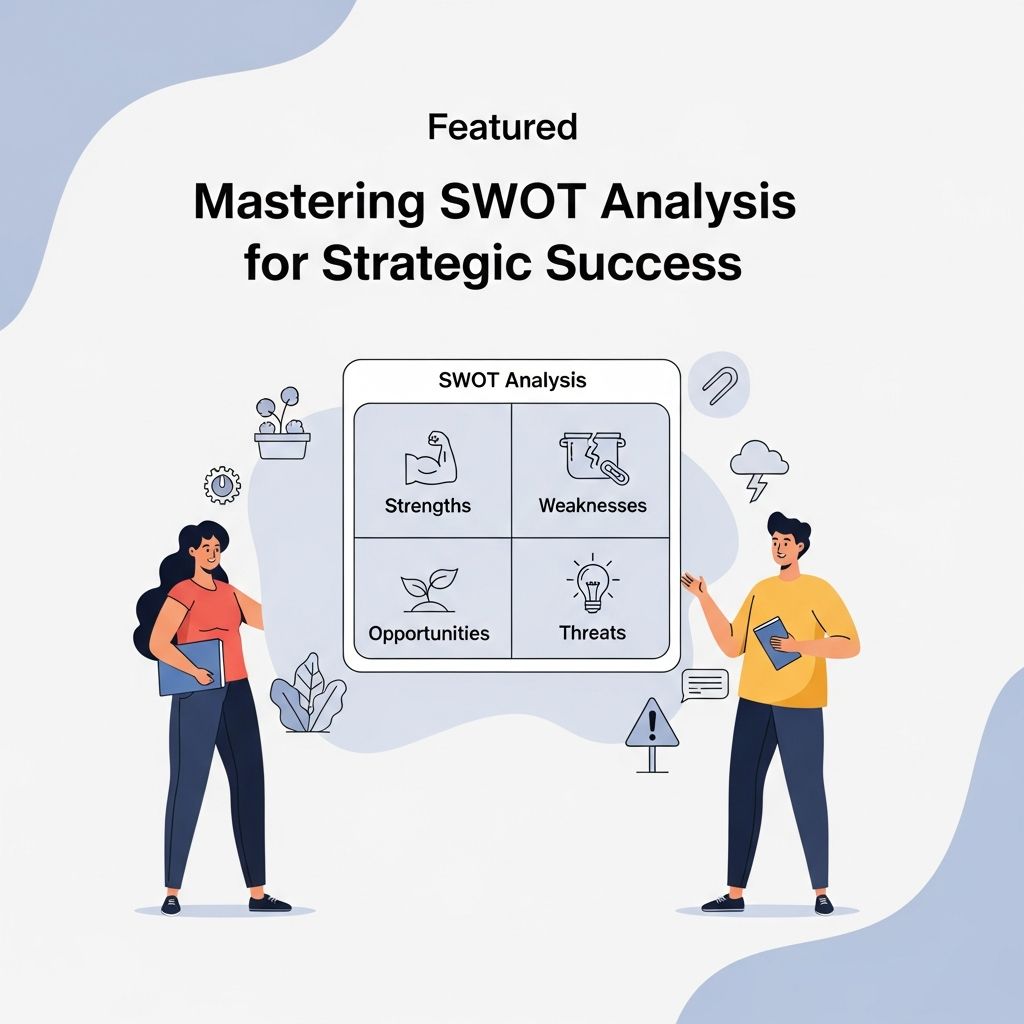
SWOT analysis serves as a foundational tool in strategic planning, enabling organizations to systematically evaluate their position by examining internal strengths and weaknesses alongside external opportunities and threats. This framework, often visualized in a simple matrix, empowers leaders to make data-driven decisions that align resources with market realities.
Understanding the Core Framework of SWOT
The acronym SWOT represents four distinct categories that provide a holistic view of any business, project, or personal endeavor. Strengths and weaknesses focus on controllable internal elements, while opportunities and threats address uncontrollable external dynamics. By categorizing these factors, teams gain clarity on their competitive standing and potential pathways forward.
This approach originated in the 1960s from research at Stanford Research Institute and has evolved into a staple for corporations worldwide, from startups to Fortune 500 companies. Its simplicity belies its power: a single grid can reveal actionable insights that shape multi-year strategies.
Breaking Down the Four Pillars of SWOT
Internal Strengths: Building on What Works
Strengths highlight the unique advantages an organization possesses, such as superior technology, talented teams, or established market share. These are assets that set you apart from rivals and can be leveraged for growth. For instance, a company with patented innovations holds a defensible edge in competitive markets.
- Robust brand loyalty from satisfied customers
- Skilled workforce with specialized expertise
- Efficient supply chain reducing costs
- Prime geographic locations enhancing accessibility
- Strong financial reserves for investment
Identifying strengths requires honest self-assessment, often through customer feedback, performance metrics, and competitor benchmarking.
Internal Weaknesses: Confronting Limitations
Weaknesses are internal shortcomings that undermine performance, like outdated infrastructure or skill gaps in the team. Acknowledging these vulnerabilities is crucial for targeted improvements and risk mitigation.
- High employee turnover impacting continuity
- Dependence on a single supplier
- Limited digital marketing presence
- Outdated software slowing operations
- Inadequate R&D budget for innovation
Weaknesses demand proactive fixes; ignoring them can amplify external threats.
External Opportunities: Seizing Market Potential
Opportunities arise from the broader environment, including technological advancements, regulatory changes, or shifting consumer trends. Spotting these allows businesses to expand into new territories or launch innovative products.
- Emerging markets in developing regions
- Government incentives for green technologies
- Rising demand for remote work tools
- Partnerships with complementary firms
- E-commerce boom post-pandemic
Strategic agility turns opportunities into revenue streams.
External Threats: Navigating Risks
Threats encompass external challenges like intensifying competition, economic downturns, or supply chain disruptions. Early identification enables defensive strategies to protect core operations.
- New entrants disrupting market share
- Rising raw material costs
- Stricter data privacy regulations
- Cybersecurity vulnerabilities
- Global trade tensions
Threats require contingency planning to safeguard long-term viability.
Visualizing SWOT: The Matrix Template
The most effective way to conduct a SWOT analysis is through a 2×2 matrix, dividing the page into quadrants for each element. This format facilitates quick scans and discussions during team meetings.
| Strengths | Weaknesses |
|---|---|
|
|
| Opportunities | Threats |
|
|
Customize this template with specific data for your context, using tools like spreadsheets or dedicated software for collaboration.
Step-by-Step Guide to Conducting a SWOT Analysis
- Gather a Diverse Team: Involve stakeholders from various departments for comprehensive input.
- Collect Data: Use surveys, financial reports, market research, and competitor analysis.
- Populate the Matrix: Brainstorm factors without initial judgment, aiming for 5-10 items per quadrant.
- Prioritize: Rank items by impact using voting or scoring systems.
- Analyze Intersections: Explore how strengths counter threats or weaknesses block opportunities.
- Develop Strategies: Create action plans based on pairings like SO (strengths-opportunities).
- Monitor and Update: Review quarterly as conditions evolve.
Strategic Matching: Turning Insights into Action
SWOT’s true value emerges when combining elements to form strategies. This matrix approach generates four key tactics:
| Strategy Type | Description | Example |
|---|---|---|
| SO (Strengths-Opportunities) | Maximize internal advantages with external chances | Use loyal customers to enter new markets |
| ST (Strengths-Threats) | Leverage strengths to mitigate risks | Deploy patents against copycat competitors |
| WO (Weaknesses-Opportunities) | Overcome gaps via market openings | Partner for tech to fix innovation lag |
| WT (Weaknesses-Threats) | Minimize vulnerabilities defensively | Outsource to cut costs amid recession |
These pairings ensure balanced, proactive planning.
Real-World Applications Across Industries
SWOT transcends sectors. In tech, companies like Apple assess strengths in design against threats from Android ecosystems. Retailers use it to spot e-commerce opportunities amid physical store weaknesses. Non-profits evaluate funding strengths versus regulatory threats. Even personal career planning benefits: strengths like networking skills pair with job market opportunities.
Benefits and Limitations of SWOT Analysis
Key Benefits:
- Simplifies complex environments into actionable insights
- Promotes team alignment and buy-in
- Supports resource optimization
- Enhances risk foresight
Potential Drawbacks:
- Subjective bias without data
- Static snapshot, not dynamic
- Overlooks interconnections with other tools
- Lacks built-in implementation steps
Pair SWOT with PESTLE or Porter’s Five Forces for deeper analysis.
Best Practices for Maximum Impact
To elevate your SWOT process:
- Base entries on verifiable data, not assumptions.
- Limit quadrants to avoid dilution.
- Integrate quantitative metrics like KPIs.
- Follow up with SMART goals.
- Revisit regularly, especially post-major events.
Frequently Asked Questions (FAQs)
What is the main purpose of a SWOT analysis?
It identifies internal and external factors to inform strategic decisions and improve competitive positioning.
How often should you perform a SWOT analysis?
Quarterly for dynamic industries, annually otherwise, or after significant changes like mergers.
Can individuals use SWOT for personal development?
Yes, it’s ideal for career planning, skill assessment, and goal setting.
Is SWOT analysis free to use?
Absolutely, it’s a public domain framework with countless free templates available.
How does SWOT differ from a competitor analysis?
SWOT is broader, covering internal factors; competitor analysis focuses externally on rivals.
Embracing SWOT analysis equips leaders with the foresight to navigate uncertainties and capitalize on potential, fostering resilience and innovation in an ever-changing business landscape.
References
- SWOT Analysis – Definition, Components, and Working — GeeksforGeeks. 2023-10-15. https://www.geeksforgeeks.org/blogs/swot-analysis-definition-components-and-working/
- SWOT analysis — Wikipedia. 2026-01-01. https://en.wikipedia.org/wiki/SWOT_analysis
- SWOT analysis guide — definition, examples, and tools — Adobe Business. 2024-05-20. https://business.adobe.com/blog/basics/swot-analysis
- The Four Parts of a SWOT Analysis [With Template & Examples] — Inbound281. 2023-08-12. https://web.inbound281.com/blog/the-four-parts-of-a-swot-analysis
- SWOT Analysis: Examples and Templates [2026] — Asana. 2026-01-10. https://asana.com/resources/swot-analysis
- SWOT Analysis Best Practices: Tips for Success — Pepperdine Graziadio Business School. 2024-03-05. https://bschool.pepperdine.edu/personal-growth/article/best-practices-for-successful-swot-analysis.htm
- SWOT analysis: What it is, how it works, and how it gives a competitive edge — Perdoo. 2024-11-18. https://www.perdoo.com/resources/blog/swot-analysis

Medha Deb is an editor with a master's degree in Applied Linguistics from the University of Hyderabad. She believes that her qualification has helped her develop a deep understanding of language and its application in various contexts. Medha specializes in the areas of beauty, health, sports, and wellness and is committed to ensuring that the content on the website is…