
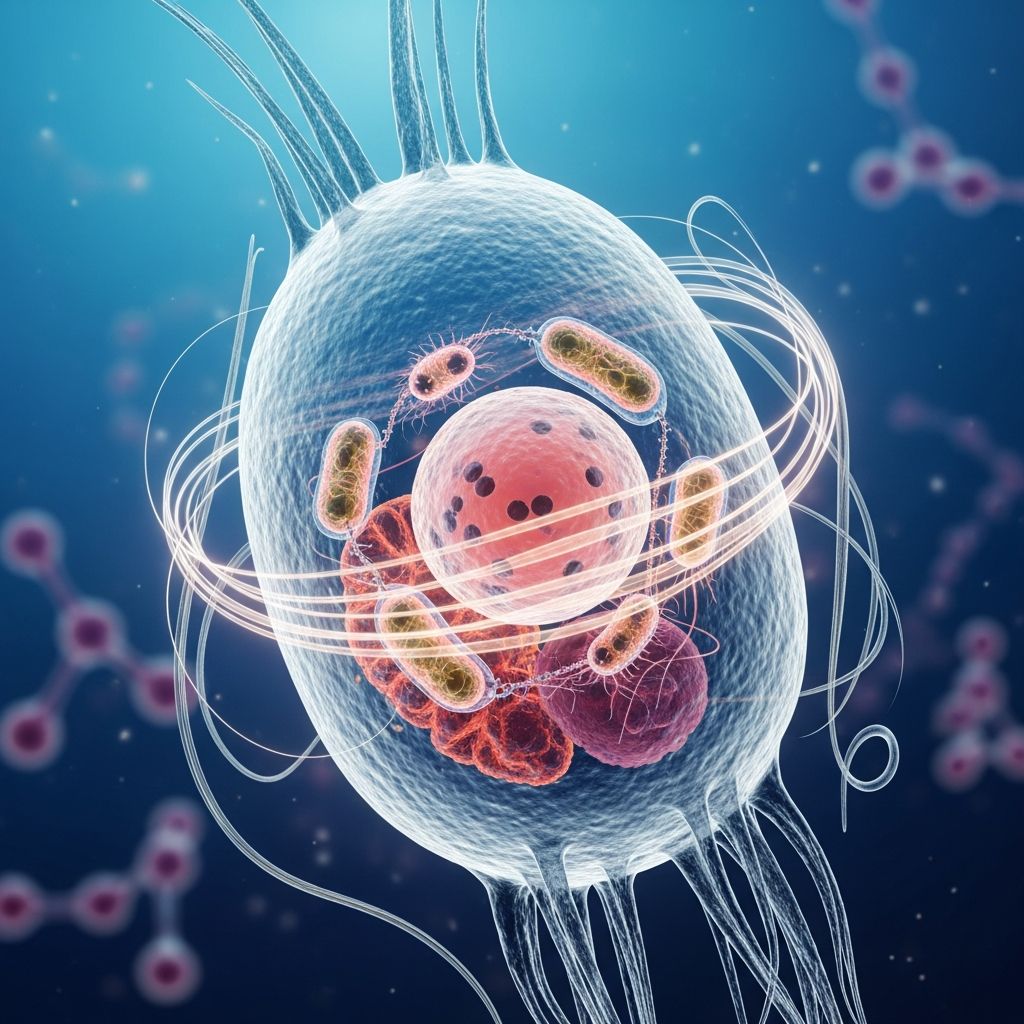
Life on Earth owes much of its complexity to processes beyond mere genetic mutations. Symbiogenesis, the creative fusion of distinct organisms into novel entities, stands as a cornerstone of evolutionary biology. This mechanism explains pivotal leaps, such as the emergence of cells with organelles, and extends to contemporary views of organisms as integrated communities.
Defining Symbiogenesis in Modern Biology
Symbiogenesis refers to the evolutionary process where separate organisms form a stable, heritable union, resulting in a new entity with enhanced capabilities. Unlike gradual mutation accumulation, it involves symbiosis—close, often permanent interactions—leading to integrated wholes greater than their parts. This concept, rooted in endosymbiotic theory, posits that key eukaryotic features arose from prokaryotic mergers.
At its core, symbiogenesis challenges the neo-Darwinian focus on competition and point mutations. Instead, it highlights cooperation as a driver of innovation. The holobiont, comprising a host and its persistent microbiota, exemplifies this: the combined genomes (holobiome) reflect a network of interactions evolving as a unit.
Historical Foundations and Key Proponents
The idea traces back to the early 20th century, when biologists began observing organelle similarities to free-living bacteria. Konstantin Mereschkowski proposed chloroplasts as symbiotic cyanobacteria, while Ivan Wallin suggested mitochondria derived from engulfed bacteria. Lynn Margulis, in the 1960s-1970s, synthesized these into the serial endosymbiosis theory, gaining acceptance despite initial skepticism.
Margulis expanded symbiogenesis beyond organelles, arguing it drives major evolutionary transitions. Her work emphasized that symbiosis fosters complexity, from prokaryote unions to multicellularity.
Endosymbiosis: Birth of Eukaryotic Cells
Eukaryotic cells, with nuclei and organelles, dominate complex life. Symbiogenesis explains their origin around 1.5-2 billion years ago: an archaeal host engulfed alpha-proteobacteria (mitochondria precursors) and cyanobacteria (chloroplast ancestors).
- Mitochondria: Related to Rickettsiales bacteria, these powerhouses provide ATP via oxidative phosphorylation, enabling larger, energy-demanding cells.
- Chloroplasts: Derived from cyanobacteria, they enable photosynthesis in plants and algae, fueling global oxygen production.
- Other Organelles: Evidence suggests peroxisomes and flagella may also stem from symbiosis.
Genetic evidence supports this: organelles retain circular DNA, 70S ribosomes, and divide independently, mirroring prokaryotes.
Evidence Supporting Endosymbiotic Origins
Multiple lines converge on symbiogenesis:
| Feature | Prokaryotic Trait | Eukaryotic Organelle |
|---|---|---|
| DNA Structure | Circular, no histones | Mitochondria, Chloroplasts |
| Ribosomes | 70S size | Organelle ribosomes |
| Replication | Binary fission | Independent division |
| Phylogeny | Alpha-proteobacteria | Mitochondria |
| Phylogeny | Cyanobacteria | Chloroplasts |
Phylogenetic analyses confirm mitochondrial genes cluster with Rickettsiales, while chloroplast genes align with cyanobacteria. Fossil records show eukaryotic-like microfossils post-dating prokaryotes by ~1.5 billion years, aligning with merger timelines.
Beyond Organelles: Symbiogenesis in Animals and Plants
Symbiogenesis permeates modern life. In animals, gut microbiomes form holobionts, influencing digestion, immunity, and behavior. Insects like aphids host bacterial symbionts providing essential amino acids, vertically transmitted across generations.
Plants rely on fungal mycorrhizae for nutrient uptake and bacterial endophytes for defense. Lichens epitomize this: fungal-algal unions create resilient pioneers colonizing harsh environments.
The Holobiont Paradigm
Recent research views organisms as holobionts—host plus microbiota—evolving together. Natural selection acts on this unit, not isolated genomes. The holobiome, summing host and microbial genes, captures this genomic synergy.
This framework explains microbiome stability despite host pressures. In corals, algal symbionts dictate bleaching resilience; disruptions cascade ecologically.
Symbiogenesis vs. Traditional Evolution
Neo-Darwinism emphasizes random mutations and natural selection. Symbiogenesis complements by addressing ‘punctuated equilibrium’—fossil gaps where species appear abruptly. Saltational evolution via mergers fills these voids, unlike gradualism unsupported by lab or field data.
| Aspect | Neo-Darwinism | Symbiogenesis ||——–|—————|—————|| Mechanism | Mutations, selection | Symbiotic fusions || Pace | Gradual | Punctuational || Evidence | Microevolution | Organelle origins, holobionts || Outcome | Adaptation | Novel taxa
Implications for Evolutionary Theory
Symbiogenesis reframes evolution as cooperative. Multicellularity likely arose from colonial aggregates stabilized by symbionts. It explains biodiversity bursts post-Precambrian, driven by endosymbioses enabling oxygen use and size increases.
In agriculture, harnessing holobionts promises sustainable crops via engineered microbiomes. Medicine targets dysbiosis in diseases like IBD, viewing patients as holobionts.
Challenges and Ongoing Research
Critics argue symbionts lose autonomy too readily. Yet, gene transfer to host nuclei (endosymbiotic gene transfer) explains genome streamlining. Metagenomics maps holobiomes, revealing vast microbial diversity shaping phenotypes.
Future studies probe viral roles in symbiosis and horizontal gene flow accelerating adaptation.
Frequently Asked Questions
What is the main difference between symbiogenesis and endosymbiosis?
Endosymbiosis is a specific type where one organism lives inside another; symbiogenesis is the broader evolutionary outcome creating new species via such unions.
Did Lynn Margulis invent symbiogenesis?
No, she popularized and expanded the endosymbiotic theory, building on earlier ideas from Mereschkowski and others.
Is symbiogenesis still relevant today?
Yes, the holobiont concept applies to human microbiomes, coral reefs, and agriculture, influencing health and ecology.
Can symbiogenesis explain all evolution?
No, it complements mutation and selection, particularly for macroevolutionary jumps.
How do we know mitochondria were once bacteria?
Genetic, structural, and phylogenetic evidence matches them to alpha-proteobacteria.
References
- Symbiogenesis: the holobiont as a unit of evolution — PubMed/NCBI. 2014-02-28. https://pubmed.ncbi.nlm.nih.gov/24568029/
- Symbiogenesis — Wikipedia. Accessed 2026. https://en.wikipedia.org/wiki/Symbiogenesis
- Symbiogenesis: The fringe belief of cooperative evolution — laulpogan.substack.com. Recent. https://laulpogan.substack.com/p/symbiogenesis-the-fringe-belief-of
- Symbiogenesis — kaiserscience.wordpress.com. Recent. https://kaiserscience.wordpress.com/biology-the-living-environment/cells/symbiogenesis/
- Symbiogenesis — scienceforthepublic.org. Recent. https://www.scienceforthepublic.org/they-didnt-believe-it/symbiogenesis
- Evolution’s Other Narrative — American Scientist. Recent. https://www.americanscientist.org/article/evolutions-other-narrative

- Integrated M.A. in Applied Linguistics, University of Hyderabad
- 5+ years in editorial, instructional, SEO, and research-based writing
Sneha is a relationships and lifestyle writer with a strong foundation in applied linguistics and certified training in relationship coaching. She brings over five years of writing experience to theskillvault, crafting thoughtful, research-driven content that empowers readers to build healthier relationships, boost emotional well-being, and embrace holistic living. Her writing and insights reflect the belief that beauty, happiness, and wellness…