
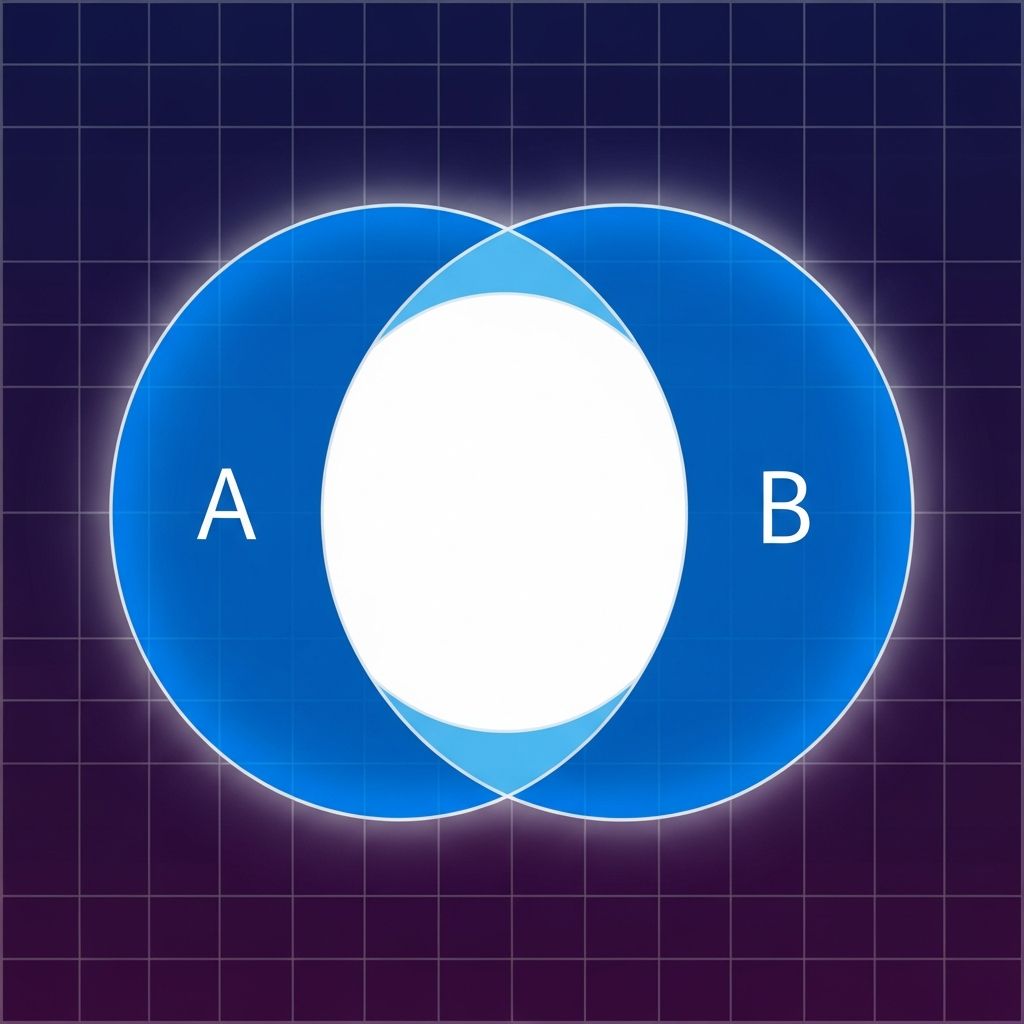
The symmetric difference is a fundamental operation in set theory that captures elements unique to each set, excluding their shared parts. It serves as the set-theoretic counterpart to the exclusive-or (XOR) operation in logic, making it invaluable in mathematics, computer science, and data processing.
Core Concept of Symmetric Difference
At its heart, symmetric difference identifies elements belonging to exactly one of two sets, ignoring overlaps. For sets A and B, this operation produces a new set containing items present in A but absent from B, or in B but absent from A.
Common notations include A Δ B, A ⊕ B, or A ⊖ B. Unlike standard set difference (A – B), which is directional, symmetric difference treats both sets equally—switching A and B yields identical results.
Mathematical Definitions and Formulas
Several equivalent formulas express this operation:
- Union of differences: \( A \Delta B = (A \setminus B) \cup (B \setminus A) \)
- Union minus intersection: \( A \Delta B = (A \cup B) \setminus (A \cap B) \)
- XOR analogy: Elements where membership in A and B differs (one true, one false)
These formulations highlight its symmetry and connection to binary logic operations.
Step-by-Step Calculation Methods
Computing symmetric difference follows straightforward procedures suitable for manual or programmatic execution.
Method 1: Difference Union Approach
- Identify elements in A not in B (A \ B).
- Identify elements in B not in A (B \ A).
- Combine these disjoint sets via union.
Method 2: Union-Exclusion Approach
- Form the union A ∪ B.
- Subtract the intersection A ∩ B from this union.
Both methods yield identical outcomes, with choice depending on data availability or computational efficiency.
Illustrative Examples Across Set Sizes
Concrete examples clarify application across simple and complex scenarios.
Basic Two-Set Example
Consider A = {1, 2, 3} and B = {3, 4, 5}:
- A \ B = {1, 2}
- B \ A = {4, 5}
- A Δ B = {1, 2, 4, 5}
Overlapping Heavy Sets
For A = {1,2,3,4,5} and B = {4,5,6,7,8}:
| Operation | Result |
|---|---|
| A \ B | {1,2,3} |
| B \ A | {6,7,8} |
| A Δ B | {1,2,3,6,7,8} |
Visualize via Venn diagram: shaded regions represent exclusive areas.
Empty and Identical Sets
- A Δ ∅ = A (empty set contributes nothing unique)
- A Δ A = ∅ (no unique elements)
- A Δ B = B Δ A (commutativity confirmed)
Advanced Properties and Algebraic Behaviors
Symmetric difference exhibits rich algebraic structure akin to addition modulo 2.
Key Properties Table
| Property | Formula | Description |
|---|---|---|
| Commutative | A Δ B = B Δ A | Order-independent |
| Associative | (A Δ B) Δ C = A Δ (B Δ C) | Grouping irrelevant |
| Idempotent | A Δ A = ∅ | Self-cancellation |
| Identity | A Δ ∅ = A | Empty set neutral |
| Involutive | (A Δ B) Δ B = A | Reversible operation |
Distributive Laws
Unlike intersection/union, symmetric difference distributes uniquely:
- Over union: \( A \Delta (B \cup C) = (A \Delta B) \cup (A \Delta C) \)
- Over intersection: \( A \Delta (B \cap C) = (A \Delta B) \cap (A \Delta C) \)
Multi-Set Extensions
For collections {A_i}, the symmetric difference \( \Delta_i A_i \) includes elements appearing in an odd number of sets—generalizing binary XOR to n-ary operations. Example: three sets where element x ∈ A and C but not B contributes to the result.
Visual Representation with Venn Diagrams
Venn diagrams provide intuitive visualization: symmetric difference shades the non-overlapping segments of two-circle diagrams.
- Two sets: Four regions total; intersection excluded, leaving three shaded zones.
- Three sets: Complex shading for odd-membership regions.
Software like Mathematica implements this via SymmetricDifference[A, B], unioning complements programmatically.
Practical Applications Across Disciplines
Computer Science and Programming
Symmetric difference powers database queries (exclusive record matching), version control diffs (changed lines), and network analysis (symmetric path differences). Python’s s.symmetric_difference(t) leverages this natively.
Logic and Boolean Algebra
Directly corresponds to XOR: \( A \Delta B = \{ x \mid (x \in A) \oplus (x \in B) \}\) where ⊕ denotes exclusive-or. Essential in digital circuit design for parity checks.
Data Science and Analytics
Identifies dataset discrepancies: unique customers between marketing campaigns, or variant-specific errors in A/B testing.
Probability Theory
Under uniform measures, |A Δ B| quantifies set dissimilarity, complementing Jaccard similarity.
Common Mistakes and Clarifications
- Confusing with union: Union includes intersection; symmetric difference excludes it.
- Directionality illusion: Despite appearance, A Δ B = B Δ A always holds.
- Multi-set parity: Even occurrences cancel; only odd counts remain.
Frequently Asked Questions (FAQs)
What distinguishes symmetric difference from regular set difference?
Regular difference (A – B) takes only A’s exclusive elements; symmetric difference includes exclusives from both, making it bidirectional.
Is symmetric difference associative?
Yes: (A Δ B) Δ C = A Δ (B Δ C), enabling arbitrary grouping in multi-set operations.
How does symmetric difference relate to XOR?
Perfectly: it applies XOR to characteristic functions of sets, yielding 1 where memberships differ.
Can symmetric difference apply to infinite sets?
Yes, definitions extend naturally; properties like commutativity hold in ZFC set theory.
What’s the symmetric difference of three sets?
Elements in an odd number of the sets: 1 or 3, excluding even counts (0 or 2).
Computational Implementations
Programming languages embed this operation:
# PythonA = {1,2,3}B = {3,4,5}print(A.symmetric_difference(B)) # {1,2,4,5}(* Mathematica *)SymmetricDifference[{1,2,3}, {3,4,5}] (* {1,2,4,5} *)Efficient O(n) time via hash sets in most implementations.
Symmetric difference enriches set theory toolkit, bridging pure math with computational practice through its elegant XOR foundation.
References
- Sets and Set Theory — Discrete Structures for Computing — University of Western Ontario (csd.uwo.ca). Accessed 2026. https://www.csd.uwo.ca/~abrandt5/teaching/DiscreteStructures/Chapter2/set-theory.html
- Symmetric Difference of Sets — GeeksforGeeks. 2023-10-15. https://www.geeksforgeeks.org/maths/symmetric-difference-of-sets/
- Symmetric difference — Wikipedia. 2026-04-01. https://en.wikipedia.org/wiki/Symmetric_difference
- Algebra 5 – Symmetric Difference — MyWhyU (YouTube). 2015-11-12. https://www.youtube.com/watch?v=PxffSUQRkG4
- Difference of Two Sets — BYJU’S. 2024-05-20. https://byjus.com/maths/difference-of-sets/
- What is the Symmetric Difference of 2 Sets? — Wrath of Math (YouTube). 2018-03-10. https://www.youtube.com/watch?v=UkFoUIokPrQ
- Symmetric Difference — Landon Lehman. 2023-07-22. https://www.landonlehman.com/post/symmetric-difference/

- Integrated M.A. in Applied Linguistics, University of Hyderabad
- 5+ years in editorial, instructional, SEO, and research-based writing
Sneha is a relationships and lifestyle writer with a strong foundation in applied linguistics and certified training in relationship coaching. She brings over five years of writing experience to theskillvault, crafting thoughtful, research-driven content that empowers readers to build healthier relationships, boost emotional well-being, and embrace holistic living. Her writing and insights reflect the belief that beauty, happiness, and wellness…