
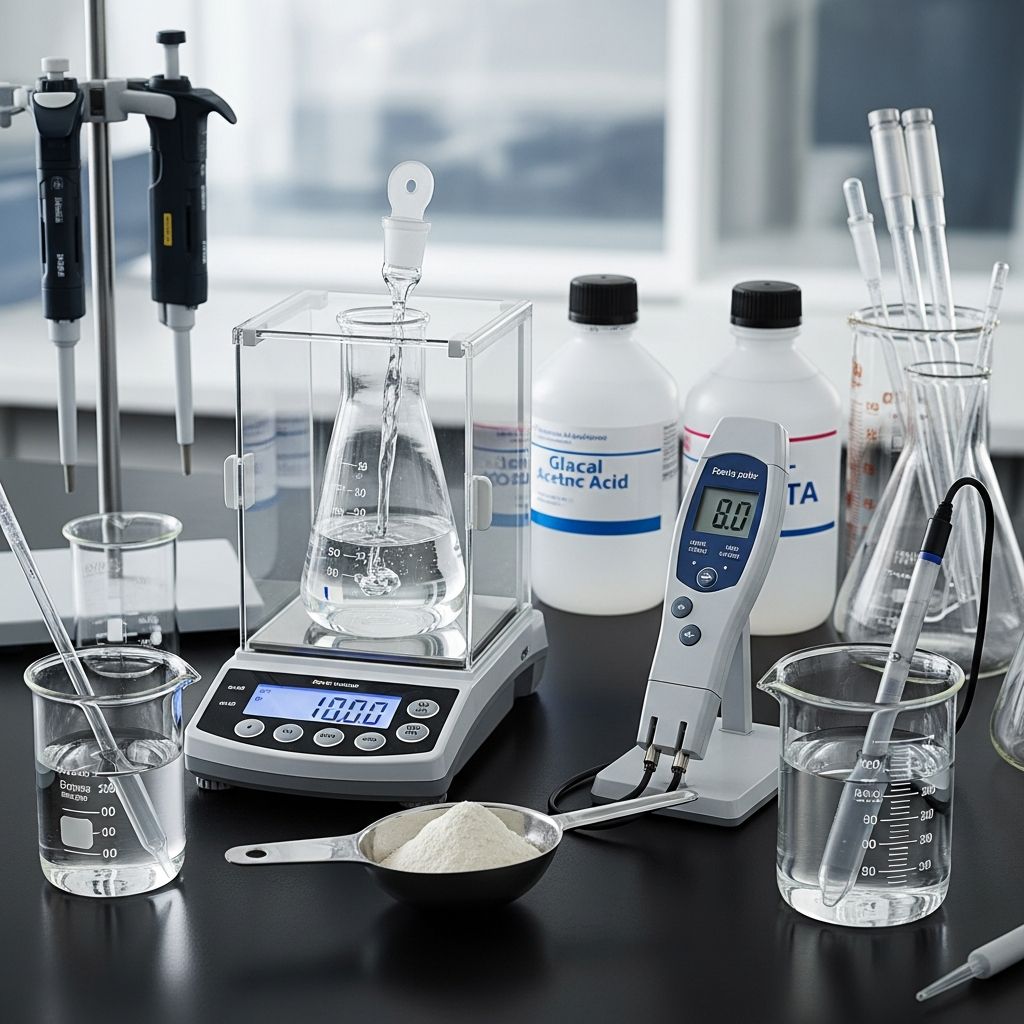
TAE buffer, composed of Tris, acetic acid, and EDTA, serves as a cornerstone in molecular biology labs for conducting agarose gel electrophoresis to separate DNA fragments. This guide provides an original, in-depth exploration of its formulation, usage, and optimization, drawing from established protocols to ensure reliable results in nucleic acid analysis.
Understanding the Role of TAE Buffer in Molecular Biology
TAE buffer maintains a stable pH environment, typically around 8.3, during electrophoresis, facilitating the migration of DNA through agarose gels under an electric field. Its components—Tris base for buffering, acetic acid for pH adjustment, and EDTA to chelate metal ions—prevent nuclease activity that could degrade samples. Unlike more rigid buffers, TAE allows faster migration of linear double-stranded DNA, making it ideal for routine sizing and visualization of fragments up to 20 kb.
In practice, labs prepare concentrated stocks like 50x, which are diluted to 1x working concentrations. A standard 1x TAE solution contains 40 mM Tris, 20 mM acetate, and 1 mM EDTA, providing low ionic strength for efficient runs. This buffer’s lower capacity compared to alternatives means it may require refreshing during long experiments, but its simplicity and cost-effectiveness keep it popular.
Essential Components and Their Functions
- Tris base (Tris(hydroxymethyl)aminomethane): Acts as the primary buffering agent, maintaining pH stability by absorbing protons. At 40 mM in 1x, it ensures consistent electric field conductivity.
- Glacial acetic acid: Provides acetate ions and fine-tunes pH to 8.0-8.6. It’s volatile, so handle with care to avoid fumes.
- EDTA (Ethylenediaminetetraacetic acid): Chelates divalent cations like Mg²⁺, inhibiting nucleases. Typically 1 mM in 1x solutions, prepared at pH 8.0 for solubility.
- Deionized water: Ultrapure H₂O prevents contamination from ions that could distort bands.
These ingredients interact synergistically: Tris and acetate form the conductive medium, while EDTA protects sample integrity.
Step-by-Step Recipe for 50x TAE Stock Solution
Preparing a 1-liter 50x stock is efficient for labs, yielding enough for hundreds of gels. Follow these precise steps using analytical-grade reagents and protective gear.
- Wear gloves, goggles, and lab coat. Work in a fume hood due to acetic acid vapors.
- Add ~800 mL deionized water to a clean 1-L beaker or bottle.
- Weigh 242 g Tris base and dissolve slowly with stirring. Use a magnetic stirrer for uniformity.
- Add 57.1 mL glacial acetic acid dropwise while monitoring pH. Do not adjust manually; it self-equilibrates to ~8.3.
- Add 100 mL of 0.5 M EDTA (pH 8.0). Stir until fully dissolved—EDTA may take 30-60 minutes.
- Top up to 1 L with deionized water. Mix thoroughly.
- Filter through 0.2 μm if needed, label with concentration, date, and storage info (room temp, dark place).
This yields 2.42 M Tris, 1.14 M acetate, 50 mM EDTA. Store up to 6 months; discard if cloudy.
Diluting Stock to 1x Working Buffer
To make 1 L of 1x TAE: Combine 20 mL 50x stock with 980 mL deionized water. Stir well. For smaller volumes, scale proportionally (e.g., 5 mL stock + 245 mL water for 250 mL). Always prepare fresh for best resolution, as buffer exhausts over runs.
| 1x Volume Needed | 50x Stock (mL) | Water (mL) |
|---|---|---|
| 500 mL | 10 | 490 |
| 1 L | 20 | 980 |
| 2 L | 40 | 1960 |
Alternative Concentrations: 10x and 1 M Recipes
For versatility, consider 10x stock: Dissolve 48.5 g Tris, 11.4 mL glacial acetic acid, 20 mL 0.5 M EDTA in water to 1 L. Dilute 1:10 for use.
High-strength 1 M TAE (pH 8.6): 242 g Tris, 59.955 g acetic acid (or equivalent), 18.61 g disodium EDTA in 800 mL water, adjust to 1 L. Rare but useful for specific protocols.
TAE vs. TBE: Choosing the Right Buffer
| Property | TAE (1x) | TBE (1x) |
|---|---|---|
| Composition | 40 mM Tris, 20 mM acetate, 1 mM EDTA | 89 mM Tris, 89 mM borate, 2 mM EDTA |
| pH | ~8.3 | ~8.3 |
| Buffer Capacity | Lower | Higher |
| DNA Migration | Faster for dsDNA | Slower, better for ssDNA/RNA |
| Best For | Large fragments (>5 kb), cloning prep | Small fragments, high-resolution |
| Cost/Heat | Cheaper, runs warmer | More stable, less heat |
TAE excels for routine DNA sizing due to sharper bands in larger gels, but TBE suits precise separations. Run at 5-10 V/cm to avoid artifacts.
Practical Applications in Agarose Gel Electrophoresis
TAE is standard for:
- PCR product verification
- Restriction digest analysis
- Plasmid purification checks
- RNA integrity (with modifications)
Cast 0.8-2% agarose in 1x TAE, load samples with dye, run 1-2 hours. Ethidium bromide or SYBR stains reveal bands under UV. For cloning, TAE minimizes EDTA interference post-gel.
Safety Protocols and Lab Best Practices
Glacial acetic acid is corrosive (handle in hood); Tris irritates skin; EDTA is safe but dusty. Neutralize spills with bicarbonate. Use nuclease-free reagents. Autoclave stocks if storing long-term, but filter preferred. Troubleshoot: Smiling bands? Refresh buffer. Faint bands? Check voltage.
Storage, Stability, and Troubleshooting
- Storage: 50x at RT (dark, 6-12 months); 1x refrigerated (1 month).
- Issues: Precipitation? Warm to 37°C. High current? Dilute further.
- Optimization: 0.5x TAE reduces heat for thick gels.
Frequently Asked Questions
Can I use TAE for RNA gels?
Yes, but TBE or urea additives preferred for sharp ssRNA bands. TAE works for total RNA checks.
Why does my gel smile?
Overheating from high voltage or exhausted buffer. Use 5 V/cm and recirculate.
Is pH adjustment necessary?
No, mixing yields ~8.3 naturally. Verify if protocol-specific.
How long does 50x stock last?
Up to a year if clear and uncontaminated.
TAE vs. commercial buffers?
Homemade matches quality if pure reagents used; cheaper long-term.
Advanced Tips for Professional Results
Scale recipes with buffer calculators. For high-throughput, prepare 5 L batches. Test conductivity (~10-20 mS/cm for 1x). Combine with recirculators for overnight runs. In research, TAE supports downstream apps like ligation better than TBE.
This comprehensive approach ensures reproducible electrophoresis, vital for genomics, forensics, and biotech.
References
- TAE buffer – Wikipedia — Wikipedia Contributors. 2023-10-15. https://en.wikipedia.org/wiki/TAE_buffer
- TAE (1 M, pH 8.6) Preparation and Recipe — AAT Bioquest. 2024-01-20. https://www.aatbio.com/resources/buffer-preparations-and-recipes/tae-ph-8-6
- TAE and TBE Running Buffers Recipe & Video — Sigma-Aldrich. 2023-05-10. https://www.sigmaaldrich.com/US/en/technical-documents/protocol/protein-biology/gel-electrophoresis/tae-and-tbe-running-buffers-recipe
- Modification of gel architecture and TBE/TAE buffer composition — PMC (NCBI). 2014-05-15. https://pmc.ncbi.nlm.nih.gov/articles/PMC4021863/
- Nucleic Acid Electrophoresis Bulletin — Bio-Rad Laboratories. 2022-08-01. https://www.bio-rad.com/webroot/web/pdf/lsr/literature/Bulletin_6230.pdf

- Integrated M.A. in Applied Linguistics, University of Hyderabad
- 5+ years in editorial, instructional, SEO, and research-based writing
Sneha is a relationships and lifestyle writer with a strong foundation in applied linguistics and certified training in relationship coaching. She brings over five years of writing experience to theskillvault, crafting thoughtful, research-driven content that empowers readers to build healthier relationships, boost emotional well-being, and embrace holistic living. Her writing and insights reflect the belief that beauty, happiness, and wellness…