
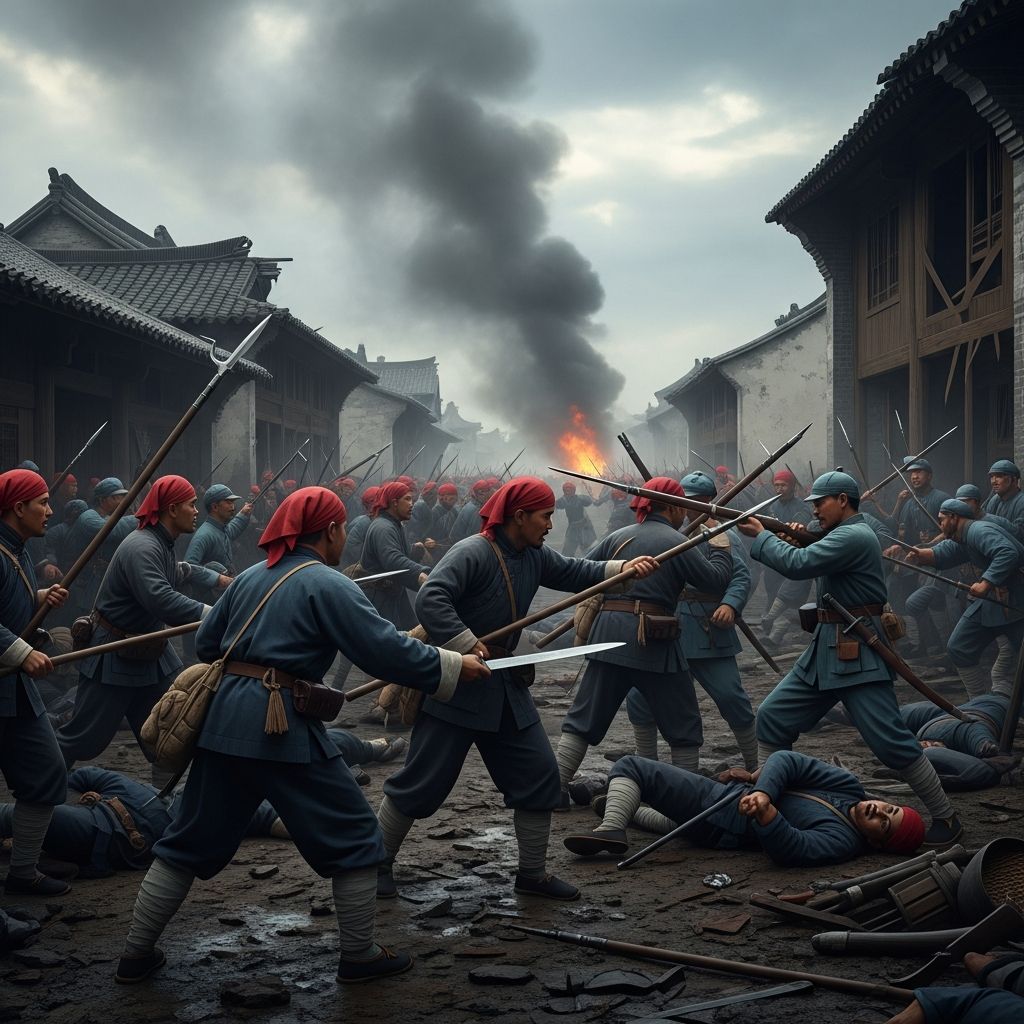
Between 1850 and 1864, China experienced one of the deadliest conflicts in human history—a civil war that would reshape the nation’s political landscape and accelerate the decline of imperial authority. The Taiping Rebellion, as it came to be known, was far more than a simple uprising against the ruling establishment; it represented a profound social, religious, and political upheaval that challenged the very foundations of Chinese civilization. With an estimated death toll exceeding 20 million people, this conflict devastated 17 provinces and left scars that would influence Chinese history for generations to come.
Origins of a Revolutionary Vision
The roots of the Taiping Rebellion can be traced to one man’s personal crisis and subsequent spiritual awakening. Hong Xiuquan, an ethnic Hakka from southern China, experienced a pivotal moment in 1847 when he failed the imperial civil service examination for the third consecutive time. Following this devastating setback, Hong fell into a delirium lasting thirty days, during which he experienced visions that would fundamentally alter the course of Chinese history. Upon recovery, Hong began interpreting his visions as divine revelation, concluding that he was the younger brother of Jesus Christ and possessed a sacred mandate to transform China.
What began as religious conviction evolved into a comprehensive ideological program. Hong Xiuquan synthesized Christian theology with indigenous Chinese philosophy, creating a unique religious framework that blended biblical concepts with Confucian principles and socialist ideals. More significantly, Hong articulated a vision for radical social transformation that extended far beyond religious reform. His movement promised land redistribution, gender equality, communal ownership of resources, and the abolition of the hierarchical social structures that had characterized Chinese society for centuries.
The Appeal to the Marginalized and Oppressed
The extraordinary popularity of Hong’s message cannot be separated from the material conditions faced by ordinary Chinese people during the mid-nineteenth century. The Qing Dynasty, ruled by the Manchu ethnic minority, presided over a nation wracked by social unrest and economic hardship. Foreign interference, particularly Western involvement in the opium trade, destabilized traditional economic relationships and created widespread discontent. Peasants faced crushing tax burdens, landlessness, and limited opportunities for advancement within the rigid imperial examination system.
Hong’s promise of a new social order resonated powerfully with these dispossessed populations. The prospect of land redistribution particularly appealed to the landless peasantry, while his commitment to gender equality attracted women who had been subordinated within Confucian patriarchal structures. The Taiping ideology represented not merely political revolution but the promise of comprehensive social liberation. This multifaceted appeal enabled Hong to assemble a coalition far broader than typical peasant rebellions, incorporating religious seekers, social reformers, nationalist elements, and those simply desperate for change.
Military Organization and Early Expansion
In 1851, Hong formally declared the establishment of the Taiping Heavenly Kingdom and mobilized his followers into a structured military force. The transformation from religious movement to organized military power occurred with remarkable speed. By the late 1850s, the Taiping rebels controlled more than one-third of China, demonstrating both the military competence of their leadership and the breadth of popular support behind their cause.
A crucial early victory came in 1853 when Taiping forces captured Nanjing, one of China’s most strategically and culturally significant cities. The rebels renamed the city Tianjing, meaning “heavenly capital,” and established it as the administrative center of their alternative state. This conquest represented more than a military achievement; it signaled that the Taiping Heavenly Kingdom was establishing itself as a rival authority capable of governing substantial territories and populations.
Ideological Framework and Governance
The Taiping vision extended beyond military conquest to encompass comprehensive state reorganization. Rather than merely replacing the Qing ruling class with another elite, the Taiping rebels sought to entirely upend China’s established social order and mechanisms of governance. This revolutionary ambition distinguished them from previous rebellions, which typically aimed at dynastic replacement rather than systemic transformation.
The Taiping Heavenly Kingdom attempted to implement radical policies that reflected their egalitarian ideology. These included:
- Redistribution of land to provide holdings for the peasantry
- Elevation of women’s status through reduced restrictions on female participation in society and governance
- Promotion of religious conversion to their syncretized Christian faith
- Implementation of communal economic systems
- Restructuring of administrative hierarchies to reduce traditional aristocratic privileges
Challenges and Internal Fragmentation
Despite their impressive military expansion and popular support, the Taiping Rebellion contained internal contradictions that progressively weakened its position. The movement faced significant difficulties maintaining cohesion across the vast territories under its control. Leadership disputes emerged as the movement matured, with different factions advocating divergent strategies and interpretations of Taiping ideology.
A failed campaign against Beijing between 1853 and 1855 represented a turning point in the rebellion’s trajectory. The inability to capture the northern capital and consolidate control over all Chinese territory revealed the limitations of Taiping military capabilities and strategic planning. Compounding these military setbacks, an attempted coup in September and October 1856 severely damaged internal cohesion and divert leadership attention from external threats.
These internal conflicts occurred precisely when external military pressure from Qing imperial forces was intensifying. The Qing Dynasty, recognizing the existential threat posed by the Taiping movement, mobilized resources and adopted new military strategies to confront the rebellion.
The Qing Response and Military Innovation
Initially, the Qing Dynasty struggled to mount an effective response to the Taiping threat. However, the imperial government eventually developed a decentralized military strategy that proved increasingly effective. Rather than relying exclusively on centrally-commanded armies, Qing authorities delegated significant military authority to provincial commanders who could organize regional forces more efficiently.
Zeng Guofan emerged as the most capable of these provincial military commanders. His Xiang Army, organized and commanded with considerable tactical sophistication, gradually pushed back Taiping forces and reclaimed territory. Zeng’s strategy combined conventional siege warfare with political maneuvering designed to isolate the Taiping Heavenly Kingdom from potential allies and sympathizers.
The Qing government also benefited from foreign military assistance. Western powers, initially interested in exploiting Chinese instability, ultimately determined that supporting the Qing Dynasty served their interests better than allowing the Taiping—whose ideology was less amenable to Western commercial dominance—to triumph.
The Final Campaign and Collapse
By 1862, Zeng Guofan’s forces had gradually repositioned themselves to threaten the Taiping heartland. After moving down the Yangtze River and recapturing the strategically vital city of Anqing, Zeng’s army initiated a methodical siege of Nanjing, beginning in May 1862. The siege represented the final, decisive phase of the rebellion.
As 1864 approached, the Taiping position deteriorated catastrophically. Zeng’s forces severed all supply lines to Nanjing, strangling the city’s ability to sustain its population and garrison. Within the besieged city, conditions became increasingly desperate. Hong Xiuquan, the rebellion’s founder and spiritual leader, confronted the reality of imminent defeat. Rather than surrender to his enemies, Hong reportedly poisoned himself on June 1, 1864, after appointing his 15-year-old son, Hongfu, as his successor.
The fall of Nanjing came shortly after Hong’s death. On July 19, 1864, Zeng’s forces breached the city’s defenses and overwhelmed the remaining Taiping garrison. The conquest proved brutally decisive: Qing soldiers carried out a merciless massacre of the city’s population, effectively ending organized Taiping resistance. Although Hongfu initially escaped, imperial forces captured and executed him in Jiangxi Province. Sporadic Taiping resistance continued in other regions until 1868, but the rebellion’s central authority and coordinated military capability had been definitively destroyed by late summer 1864.
Consequences and Historical Significance
The Taiping Rebellion’s conclusion marked not a return to stability but rather the beginning of a new phase in Chinese decline. The rebellion cost more than 20 million lives—more than double the total casualties of World War I—and devastated vast areas of Chinese territory, particularly in southern and central regions. Cities were destroyed, agricultural production was disrupted, and entire populations were displaced or decimated.
Beyond immediate devastation, the rebellion fundamentally altered the Qing Dynasty’s position and trajectory. The conflict exposed the central government’s weakness and revealed that substantial segments of the Chinese population were willing to challenge imperial authority with unprecedented military organization and ideological sophistication. The resources expended to suppress the rebellion depleted the imperial treasury and accelerated the dynasty’s financial decline.
Most significantly, the Taiping Rebellion signaled the beginning of the end for imperial China. The demonstration that the existing social and political order could be challenged so profoundly inspired subsequent reform movements and revolutionary ideologies. The rebellion illustrated that transformative change was possible and that large populations could be mobilized around visions of social reconstruction. These lessons would not be lost on the revolutionaries who, less than five decades later, would successfully overthrow the Qing Dynasty and establish the Chinese Republic in 1911.
Comparative Perspective: Scale and Significance
Understanding the Taiping Rebellion requires appreciating its extraordinary scale and destructiveness relative to other nineteenth-century conflicts. Contemporaneous with the American Civil War, the Taiping Rebellion was substantially more lethal in absolute terms, despite China’s larger population. The conflict consumed resources and attention across the entire eastern half of China for fourteen continuous years, demonstrating military organization and strategic persistence that rivaled or exceeded that of contemporary Western conflicts.
The rebellion’s significance extended beyond military and political dimensions to encompass profound questions about social organization, religious authority, and national identity. It was simultaneously a peasant rebellion, a religious movement, a nationalist uprising, and a social revolution—classifications that often seem to require separate historical categories but which the Taiping Rebellion seamlessly combined.
Frequently Asked Questions
Q: How many people died during the Taiping Rebellion?
A: An estimated 20 million people perished during the fourteen-year conflict, making it one of history’s deadliest civil wars. This casualty figure exceeds the total deaths in World War I and reflects the conflict’s devastating impact on Chinese society.
Q: What territory did the Taiping Heavenly Kingdom control?
A: At the height of their power in the late 1850s, the Taiping rebels controlled more than one-third of Chinese territory, centered on their capital in Nanjing and extending across significant portions of central and southern China.
Q: Why did Western powers eventually support the Qing Dynasty against the Taiping?
A: Western powers initially exploited Chinese instability but ultimately determined that a stable, albeit weakened, Qing Dynasty better served their commercial interests than a Taiping government whose ideology was less amenable to Western trade dominance.
Q: What happened to Hong Xiuquan?
A: As imperial forces besieged Nanjing in 1864, Hong Xiuquan poisoned himself rather than face capture. He died on June 1, 1864, after installing his teenage son as his successor.
Q: How did the Taiping Rebellion influence later Chinese history?
A: The rebellion demonstrated that imperial authority could be challenged through coordinated military and ideological action, inspiring subsequent reform and revolutionary movements. The lessons learned influenced the Chinese Revolution of 1911 and accelerated the Qing Dynasty’s decline.
References
- Taiping Rebellion — Wikipedia. Accessed April 2026. https://en.wikipedia.org/wiki/Taiping_Rebellion
- China’s Taiping Rebellion — EBSCO Research Starters. Accessed April 2026. https://www.ebsco.com/research-starters/history/chinas-taiping-rebellion
- Taiping Rebellion Worksheets: Origins, Figures, Goals, Summary — Kids Konnect. Accessed April 2026. https://kidskonnect.com/social-studies/taiping-rebellion/
- Taiping Rebellion: Causes, Effects, & Facts — Britannica. Accessed April 2026. https://www.britannica.com/event/Taiping-Rebellion
- Taiping Rebellion (1850-1864) — Asia for Educators, Columbia University. Accessed April 2026. https://afe.easia.columbia.edu/special/china_1750_taiping.htm
- Taiping: China’s Nineteenth-Century Civil War — JSTOR Daily. Accessed April 2026. https://daily.jstor.org/taiping-chinas-nineteenth-century-civil-war/

Medha Deb is an editor with a master's degree in Applied Linguistics from the University of Hyderabad. She believes that her qualification has helped her develop a deep understanding of language and its application in various contexts. Medha specializes in the areas of beauty, health, sports, and wellness and is committed to ensuring that the content on the website is…