
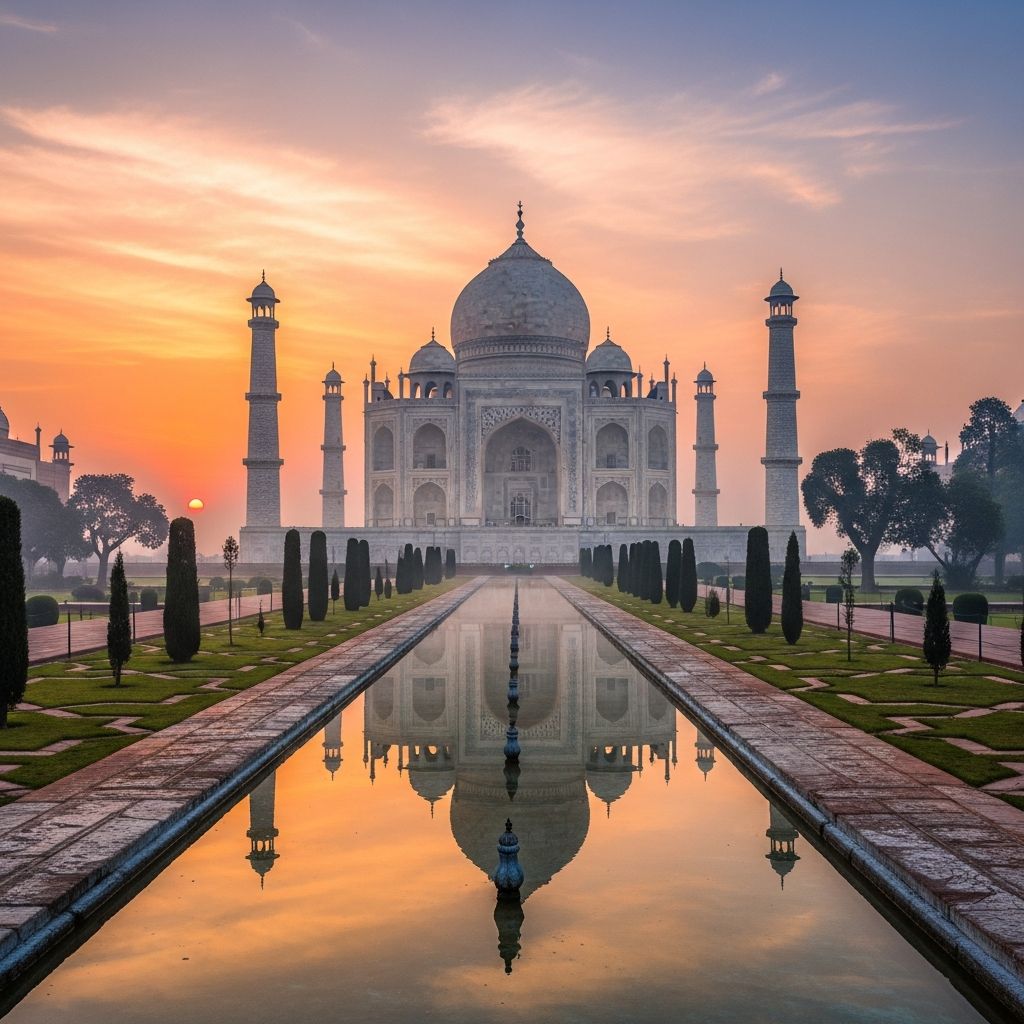
The Taj Mahal stands as one of the world’s most iconic structures, a testament to profound devotion and architectural genius. Commissioned by Mughal Emperor Shah Jahan, this white marble masterpiece in Agra, India, honors his wife Mumtaz Mahal and embodies the pinnacle of Indo-Islamic design.
Origins in Heartbreak and Devotion
At the core of the Taj Mahal’s creation lies a deeply personal story of love and loss. Shah Jahan, who ascended the Mughal throne in 1628, was married to Mumtaz Mahal, his third wife whom he cherished above all. Known for accompanying him on military campaigns, she bore him 14 children. Tragically, during the birth of their 14th child in 1631 at Burhanpur, Mumtaz Mahal died from complications, leaving Shah Jahan devastated.
Overcome with grief, the emperor vowed to build a monument that would immortalize her memory, surpassing all others in beauty. Construction commenced in 1632 on the southern banks of the Yamuna River in Agra, a city already renowned for its gardens and trade under Mughal rule. The site was chosen for its serene riverside location, symbolizing a gateway to paradise.
Masterminding the Architectural Marvel
The Taj Mahal’s design drew from the finest minds of the era, blending Persian, Islamic, and Indian influences into a harmonious whole. Chief architect Ustad Ahmad Lahori, of Persian descent, led a team of over 30 designers. Other key figures included Ustad Isa Khan Effendi and possibly Ismail Khan for the dome. Many artisans hailed from Persia, bringing expertise in intricate stonework.
Envisioned as an earthly replica of Mumtaz Mahal’s paradisiacal abode, the complex spans 42 acres (17 hectares) and integrates gardens, tombs, and pavilions in perfect symmetry. This adherence to Mughal principles ensured no later alterations, preserving its unified vision.
Construction: A Feat of Scale and Logistics
Building the Taj Mahal demanded immense resources over 22 years, from 1632 to 1653. More than 20,000 workers from India, Persia, the Ottoman Empire, and Europe toiled alongside 1,000 elephants for transport. The mausoleum was completed by 1643, with finishing touches extending to 1653.
Materials were sourced globally: white marble from Makrana quarries in Rajasthan (250 miles away), red sandstone from nearby regions, and semi-precious stones like jasper, lapis lazuli, and carnelian from India, Tibet, and beyond. These were inlaid using pietra dura technique, creating floral motifs that shimmer in light.
| Material | Source Location | Purpose |
|---|---|---|
| White Marble | Makrana, Rajasthan | Main mausoleum and dome |
| Red Sandstone | Fatehpur Sikri, India | Auxiliary buildings, gateway |
| Semi-precious Stones | India, Tibet, Sri Lanka | Inlaid decorations |
| Jasper, Jade | China, Persia | Floral and calligraphy inlays |
Layout and Key Features of the Complex
The Taj Mahal is more than its famed dome; it’s a vast ensemble designed along a north-south axis for dramatic approach. Visitors enter through a grand red sandstone gateway, revealing a long reflecting pool flanked by gardens that lead to the elevated mausoleum platform.
- Main Mausoleum: A cubic structure with chamfered corners, featuring large pishtaq arches. Crowned by a bulbous double dome (57 meters high) and four minarets (slightly tilted outward for safety), it houses cenotaphs of Shah Jahan and Mumtaz Mahal.
- Gardens (Chahar Bagh): Divided into quadrants symbolizing paradise, with water channels and fountains representing the four rivers of Quran.
- Mosque and Jawab: Identical red sandstone buildings on either side; the mosque for prayers, the jawab for symmetry.
- Gateway and Environs: Ornate entrance with inlaid marble; subsidiary tombs and a small town once supported workers.
The complex measures about 1,860 feet north-south and 1,000 feet east-west, emphasizing balance and optical illusions—like the dome appearing to float above.
Artistic Techniques and Symbolic Elements
Intricate details elevate the Taj Mahal’s artistry. Calligraphy by Abdul Haqq adorns entrances with Quranic verses, increasing in size upward to counter perspective distortion. Floral inlays cover walls, changing hues with sunlight—white marble glows golden at dawn, pink at dusk.
Symbolism abounds: the octagonal star plan evokes hasht bishisht (eight paradises); white marble signifies purity, red sandstone the earthly realm. Minarets frame the dome without functional use, prioritizing aesthetics.
Shah Jahan’s Fate and the Monument’s Legacy
After completion, Shah Jahan’s son Aurangzeb imprisoned him in Agra Fort in 1658, from where he could gaze at the Taj until his death in 1666. He was buried beside Mumtaz Mahal, their tombs now below false cenotaphs in the upper chamber.
Designated a UNESCO World Heritage Site in 1983, the Taj Mahal draws millions annually. It faces threats from pollution and tourism, prompting conservation by the Archaeological Survey of India and World Monuments Fund.
Visiting the Taj Mahal: Practical Insights
Access is via three gates; sunrise visits offer ethereal beauty. Tickets vary for Indians/foreigners; women enter separately for security. Photography is allowed outside; no tripods inside. Best months: October-March to avoid heat.
- Entry Fee: ~₹50 Indians, ~₹1,100 foreigners
- Open: Sunrise to sunset (closed Fridays for prayers)
- Duration: 2-3 hours recommended
- Tips: Wear shoe covers, modest clothing
Frequently Asked Questions (FAQs)
Why is the Taj Mahal called a “symbol of love”?
It was built by Shah Jahan as a tribute to his wife Mumtaz Mahal, who died in childbirth, embodying eternal devotion.
How long did it take to build the Taj Mahal?
Construction spanned 22 years from 1632 to 1653, involving massive labor and global materials.
What materials make the Taj Mahal glow?
White Makrana marble reflects light, changing colors throughout the day due to inlaid semi-precious stones.
Who was the main architect?
Ustad Ahmad Lahori led the design, with contributions from Persian masters like Ustad Isa.
Is the Taj Mahal still under threat?
Yes, air pollution yellows the marble; ongoing restoration uses mud packs and limits vehicles.
Preservation Challenges in Modern Times
Today, the Taj Mahal battles environmental degradation. Acid rain from nearby factories discolors the marble, while insect damage threatens foundations. The Supreme Court of India mandated closures of polluting industries in 1996, and a 500-meter buffer zone restricts vehicles. International aid supports laser cleaning and protective barriers.
Climate change exacerbates issues, with rising Yamuna River levels risking erosion. Visitor management caps daily entries at 40,000, promoting sustainable tourism.
Cultural Impact and Global Fascination
Beyond architecture, the Taj Mahal inspires art, literature, and film. Poets like Rabindranath Tagore called it “a teardrop on the cheek of eternity.” It symbolizes Indo-Islamic synthesis, influencing modern designs worldwide.
In popular culture, it appears in UNESCO campaigns and Bollywood romances. Annual light-and-sound shows recount its love story, drawing families and romantics alike.
The monument’s allure persists, proving architecture’s power to transcend time. As one of the New Seven Wonders, it reminds us of love’s enduring monumentality.
References
- Taj Mahal | Definition, History & Architecture – Lesson — Study.com. Accessed 2026. https://study.com/academy/lesson/the-taj-mahal-history-architecture.html
- Origins and architecture of the Taj Mahal — Wikipedia. Accessed 2026. https://en.wikipedia.org/wiki/Origins_and_architecture_of_the_Taj_Mahal
- Taj Mahal | Definition, Story, Site, Agra, History, & Facts — Britannica. 2026-04-04. https://www.britannica.com/topic/Taj-Mahal
- The Taj Mahal — Smarthistory. Accessed 2026. https://smarthistory.org/the-taj-mahal/
- Architecture – Taj Mahal — tajmahal.gov.in. Accessed 2026. https://www.tajmahal.gov.in/architecture.aspx
- Taj Mahal – World Monuments Fund — World Monuments Fund. Accessed 2026. https://www.wmf.org/projects/taj-mahal

- Integrated M.A. in Applied Linguistics, University of Hyderabad
- 5+ years in editorial, instructional, SEO, and research-based writing
Sneha is a relationships and lifestyle writer with a strong foundation in applied linguistics and certified training in relationship coaching. She brings over five years of writing experience to theskillvault, crafting thoughtful, research-driven content that empowers readers to build healthier relationships, boost emotional well-being, and embrace holistic living. Her writing and insights reflect the belief that beauty, happiness, and wellness…