
TBE buffer, or Tris-borate-EDTA buffer, is a vital solution in molecular biology laboratories, primarily used for agarose gel electrophoresis to separate DNA and RNA fragments. This guide provides an original, in-depth exploration of its preparation, from understanding its composition to advanced troubleshooting, ensuring reliable results in nucleic acid analysis.
Understanding the Role of TBE Buffer in Electrophoresis
TBE buffer maintains a stable pH and ionic strength during electrophoresis, allowing consistent migration of nucleic acids under an electric field. Its low conductivity reduces heat generation compared to TAE buffer, making it ideal for high-resolution separations of small DNA fragments (under 2 kb). The borate component enhances stability, while EDTA chelates divalent cations that could degrade DNA.
Key advantages include superior buffering capacity at pH 8.3 and compatibility with pulsed-field gel electrophoresis. Researchers often prefer TBE for its ability to resolve DNA ladders precisely, supporting applications like genotyping, cloning verification, and forensic analysis.
Essential Components of TBE Buffer
TBE consists of three primary ingredients:
- Tris base (tris(hydroxymethyl)aminomethane): Provides the primary buffering at alkaline pH.
- Boric acid: Contributes to buffering and forms a complex with Tris for enhanced stability.
- EDTA (ethylenediaminetetraacetic acid, disodium salt): Chelates Mg²⁺ and other ions to protect nucleic acids from nucleases.
Standard concentrations for 1X TBE are 89 mM Tris, 89 mM boric acid, and 2 mM EDTA. These ensure optimal conductivity and pH around 8.3, critical for DNA negative charge-driven migration.
Standard Recipes for TBE Buffer Preparation
Laboratories typically prepare 5X or 10X stock solutions for dilution to 1X working buffer. Below is a table of common recipes for 1 liter of stock:
| Stock Concentration | Tris Base (g) | Boric Acid (g) | EDTA Na₂·2H₂O (g) | Final Volume |
|---|---|---|---|---|
| 5X TBE | 27.5 | 27.5 | 3.7 (0.5 M stock) | 1 L |
| 10X TBE | 54 | 27.5 | 20 (0.5 M stock) | 1 L |
For 10X TBE: Dissolve 108 g Tris base, 55 g boric acid, and 40 ml of 0.5 M EDTA (pH 8.0) in ~800 ml distilled water, adjust to 1 L. This yields a versatile stock dilutable to 1X.
Step-by-Step Preparation Process
Follow these detailed steps for safe and accurate TBE buffer preparation:
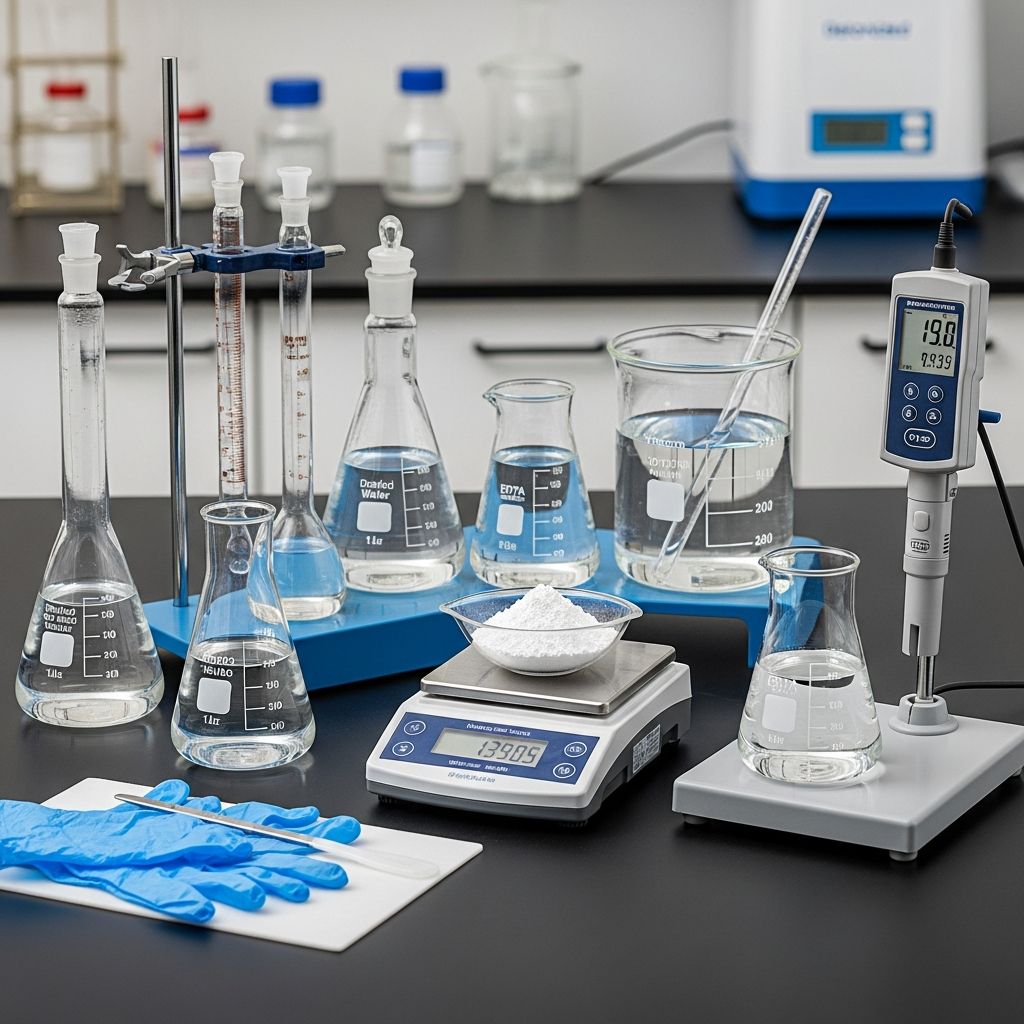
- Gather Materials: Analytical balance, 1-2 L volumetric flask, magnetic stirrer, pH meter, distilled/deionized water, gloves, safety goggles.
- Weigh Components: Accurately measure Tris base, boric acid, and EDTA using a balance calibrated to 0.01 g precision. Add to flask containing ~60-70% of final volume water to aid dissolution.
- Dissolve Solids: Stir gently at room temperature until fully dissolved. Tris and boric acid dissolve readily; EDTA may require mild heating (<40°C).
- Adjust pH: Measure pH; it should be ~8.3. If low, add dilute HCl dropwise while stirring. Recheck frequently to avoid overshooting.
- Top Up Volume: Add deionized water to the mark. Mix thoroughly.
- Filter and Store: Vacuum filter through 0.22 μm membrane to remove particulates. Store at room temperature.
Precise Calculations Using Henderson-Hasselbalch Equation
Buffer pH is calculated via the Henderson-Hasselbalch equation: pH = pKa + log([A⁻]/[HA]). For TBE, Tris (pKa ~8.1) and boric acid (pKa ~9.2) combine for effective buffering near pH 8.3.
Example: For 1 L 1X TBE, molarities are [Tris] = 0.089 M, [Boric] = 0.089 M, [EDTA] = 0.002 M. Verify pH: Approximate pH ≈ pKa(Tris) + log(0.089/0.089) = 8.1. Fine adjustments ensure exactness.
To customize: Solve for ratios. If targeting pH 8.0, adjust [base]/[acid] accordingly. Use: log(ratio) = pH – pKa.
Safety Precautions and Best Practices
Boric acid is toxic if ingested; wear PPE. EDTA irritates skin/eyes. Work in a fume hood if heating. Dispose as hazardous waste per lab protocols. Always use nuclease-free water to prevent contamination.
Best practices: Calibrate pH meter daily, use Class A glassware, document batch details (date, pH, preparer). Verify conductivity (~1-2 mS/cm for 1X) with a meter.
Storage, Stability, and Usage Tips
Store 5X/10X stocks at 4°C for 6-12 months or room temp for 3 months. 1X buffer stable 1 week at 4°C; discard if cloudy. Reuse up to 5-10 runs if recirculated.
Dilution: 100 ml 10X + 900 ml water = 1 L 1X. For gels, use 1X directly. Avoid metal containers to prevent EDTA precipitation.
Common Issues and Troubleshooting
| Problem | Cause | Solution |
|---|---|---|
| Poor DNA resolution | Incorrect pH or dilution | Recheck pH; prepare fresh 1X |
| High background | Contaminants | Filter sterilize; use fresh |
| Band smearing | Overheating | Lower voltage; use TBE’s low heat |
| Precipitate formation | EDTA-metal interaction | Plastic storage; discard old stock |
Monitor run temp <40°C. For long runs, recirculate buffer.
Advanced Applications of TBE Buffer
Beyond standard gels, TBE excels in SSCP (single-strand conformation polymorphism), DGGE (denaturing gradient gel electrophoresis), and RNA separations. Its stability suits automated systems. Compare to TAE: TBE better for small fragments; TAE for large (>5 kb) due to lower sieving.
Frequently Asked Questions (FAQs)
What is the difference between TBE and TAE buffer?
TBE uses borate for better resolution of small DNA; TAE uses acetate, better for large fragments and easier RNase removal for RNA.
Can I autoclave TBE buffer?
No, autoclaving degrades components. Prepare fresh or filter sterilize.
How do I make EDTA stock for TBE?
Dissolve 186.1 g Na₂EDTA·2H₂O in 800 ml water, adjust pH to 8.0 with NaOH, top to 1 L (0.5 M).
Is TBE buffer reusable?
Yes, up to 5-10 gels if pH stable and no contamination; test post-use.
Why is my TBE pH drifting?
CO₂ absorption; seal containers, prepare fresh 1X runs.
Conclusion
Mastering TBE buffer preparation enhances electrophoresis reliability. Follow these steps for consistent, high-quality results in your lab workflows.
References
- Buffer Preparation – Solutions, Calculation & Solving Common Problems — Mettler Toledo. 2023. https://www.mt.com/us/en/home/applications/Laboratory_weighing/buffer-preparation.html
- 5 steps to making up a buffer — YouTube (Organic Chemistry Tutor). 2020-10-15. https://www.youtube.com/watch?v=t9CtGN0cQxI
- Buffer Calculations Simplified Into 3 Easy Methods! — Tutor Hunt. 2022. https://www.tutorhunt.com/resource/22353/
- Buffer Solutions — Purdue University Chemistry. 2024. https://www.chem.purdue.edu/gchelp/howtosolveit/Equilibrium/Buffers.htm
- Preparing Buffer Solutions — Chemistry LibreTexts. 2023-08-12. https://chem.libretexts.org/Bookshelves/Physical_and_Theoretical_Chemistry_Textbook_Maps/Supplemental_Modules_(Physical_and_Theoretical_Chemistry)/Acids_and_Bases/Buffers/Preparing_Buffer_Solutions

Medha Deb is an editor with a master's degree in Applied Linguistics from the University of Hyderabad. She believes that her qualification has helped her develop a deep understanding of language and its application in various contexts. Medha specializes in the areas of beauty, health, sports, and wellness and is committed to ensuring that the content on the website is…