
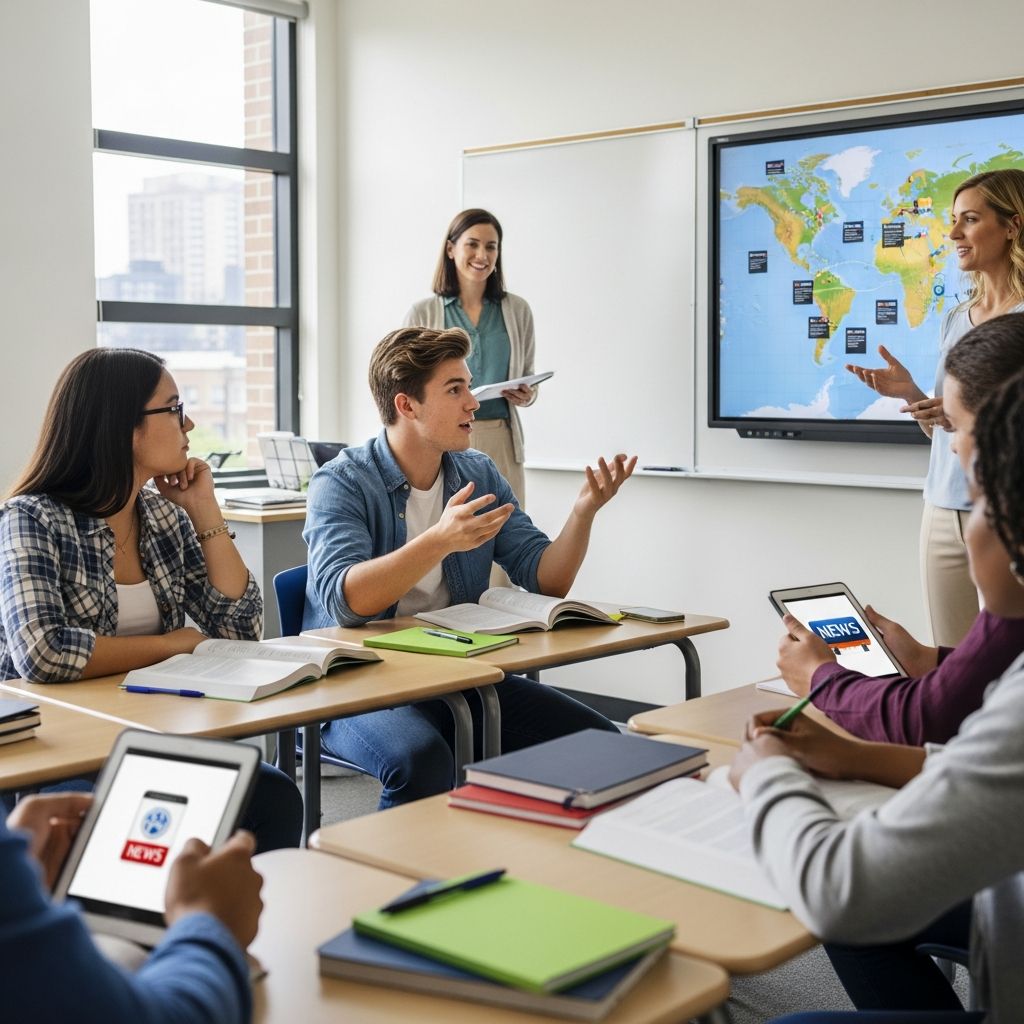
Integrating discussions about ongoing world events into classroom routines helps students connect academic concepts to real-life complexities. These conversations sharpen analytical abilities, promote empathy across viewpoints, and equip young learners to engage responsibly in society. Educators play a pivotal role in creating environments where such exchanges thrive without escalating into conflict.
Why News Discussions Matter in Education
Bringing contemporary issues into lessons bridges the gap between textbooks and reality, making learning relevant and dynamic. Students confronted with headlines on politics, environment, or social justice gain tools to dissect information critically. This approach not only boosts engagement but also cultivates proactive problem-solvers ready for tomorrow’s challenges.
Research highlights how these talks enhance cognitive skills. Discussions expose learners to varied opinions, prompting them to evaluate evidence and refine arguments. They also strengthen interpersonal bonds, as peers learn to navigate disagreements constructively. In diverse classrooms, this fosters inclusivity, ensuring every voice contributes to collective understanding.
- Increased motivation: Timely topics spark curiosity, turning passive listeners into active participants.
- Skill development: Analyzing news hones media literacy and ethical reasoning.
- Social growth: Practicing dialogue builds resilience against echo chambers.
Building a Foundation for Open Conversations
Success starts with preparation. From day one, establish norms that prioritize respect and equity. Include these expectations in your syllabus and review them before sensitive topics arise. Co-create rules with students, such as active listening and assuming good intent, to build shared ownership.
Acknowledge emotional impacts upfront. Events like elections or crises can affect students personally. Begin sessions by validating feelings: “These topics might hit close to home; it’s okay to share or pass.” This sets a tone of care, encouraging participation without pressure.
| Norm | Purpose | Example Phrase |
|---|---|---|
| Active Listening | Ensures understanding | “I hear you saying…” |
| No Interruptions | Promotes equity | “One speaker at a time” |
| Evidence-Based Claims | Reduces bias | “What source supports that?” |
Selecting and Introducing Relevant Topics
Choose events aligning with curriculum goals, avoiding overload. Link news to subjects like history (e.g., immigration debates echoing past policies) or science (climate reports). Curate age-appropriate, balanced sources from reputable outlets to model reliability.
Introduce topics neutrally. Pose foundational questions: Who is involved? What happened? Why does it matter? Allow think time for notes, reducing anxiety for quieter students. Provide context, like historical parallels, to deepen insights and counter misinformation.
Techniques for Engaging Every Learner
Diverse methods keep all students involved. Start with low-stakes sharing: “What have you heard, true or not?” This gathers perspectives without commitment, easing entry. Progress to structured formats like think-pair-share, where pairs discuss before group input.
Incorporate multimedia for variety. Play short podcast clips on events, then have students produce their own summaries. This appeals to auditory learners and personalizes learning. For visual thinkers, use timelines or infographics comparing viewpoints.
- Perspective Rounds: Each student voices one pro and one con.
- Role-Play: Assign opposing stances to build empathy.
- Gallery Walk: Post articles; students rotate and note reactions.
Navigating Challenges and Sensitivities
Sensitive issues demand care. Monitor dynamics to prevent dominance by vocal few; use timers or draws for turns. If tensions rise, pause and redirect to facts: “Let’s check sources before opinions.” Model neutrality by highlighting multiple angles equally.
Address biases head-on. Assign students to defend unfamiliar positions, challenging preconceptions. For local matters, like community policies, invite guest speakers or simulate votes, making abstract concepts tangible.
When events overwhelm, offer opt-outs respectfully. Pair discussions with resources like counseling contacts, supporting well-being alongside academics.
Integrating Discussions into Curriculum
Make news talks routine, not reactive. Dedicate weekly slots, tying to standards like civic literacy. Project-based extensions, such as student-led news briefs or solution proposals, extend learning. Track growth via rubrics assessing reasoning and respect.
Assess formatively: Journals reflect personal insights; group projects synthesize findings. This reinforces skills without grading pressure, focusing on process over product.
Advanced Formats for Deeper Analysis
Once basics solidify, elevate with debates or Socratic seminars. Prep with credible readings to ground arguments. Time debates for fresh events post-reflection, teaching bias detection.
Seminars circle students probing a central question, facilitator asking: “What other views exist? How do they shift solutions?” This models civil discourse, valuing inquiry over victory.
Frequently Asked Questions (FAQs)
What if a student gets upset during discussion?
Validate emotions, offer breaks, and refocus on shared goals. Follow up privately; share support resources.
How do I handle biased opinions?
Gently probe for evidence: “What facts back that?” Present counter-sources to broaden views.
Can young students handle current events?
Yes, with simplified topics and guidance. Start local, build to global for age-appropriateness.
How often should we discuss news?
Weekly integrates without dominating; adjust for relevance.
What tools track discussion effectiveness?
Student feedback surveys and participation rubrics gauge growth.
Long-Term Benefits for Students
Consistent practice yields informed citizens. Graduates adept at civil talk navigate democracy better, valuing nuance over division. Classrooms become micro-societies modeling healthier discourse.
Teachers report heightened engagement and retention when news connects to core content. This holistic approach prepares learners not just to consume news, but to shape it responsibly.
References
- Seven Ways to Bring Current Events Into the Classroom (Opinion) — Education Week. 2020-01-07. https://www.edweek.org/teaching-learning/opinion-seven-ways-to-bring-current-events-into-the-classroom/2020/01
- Creating a Safe Space for Students to Discuss Sensitive Current Events — Edutopia. N/A. https://www.edutopia.org/discussion/creating-safe-space-students-discuss-sensitive-current-events
- How to Respond: Facilitating Productive Discussions about Current Events — Washington University in St. Louis Center for Teaching and Learning. N/A. https://ctl.wustl.edu/how-to-respond-facilitating-productive-discussions-about-current-events/
- Teaching Current Events – Benefits and Classroom Strategies — Building Wings. N/A. https://www.buildingwings.com/blog/teaching-current-events-benefits-and-classroom-strategies/
- Discussing Current Events: Part of Regular Classroom Practice — Roots Connected. N/A. https://www.rootsconnected.org/resources-list/discussing-current-events-part-of-regular-classroom-practice
- Facilitating class conversation in the wake of distressing current events — University of Washington Teaching & Learning. N/A. https://teaching.washington.edu/engaging-students/facilitating-difficult-conversation/
- Teaching Current Events: Educator Guide — Facing History & Ourselves. 2022-07. https://www.facinghistory.org/sites/default/files/2022-07/Teaching_Current_Events_Educator_Guide.pdf

Medha Deb is an editor with a master's degree in Applied Linguistics from the University of Hyderabad. She believes that her qualification has helped her develop a deep understanding of language and its application in various contexts. Medha specializes in the areas of beauty, health, sports, and wellness and is committed to ensuring that the content on the website is…