
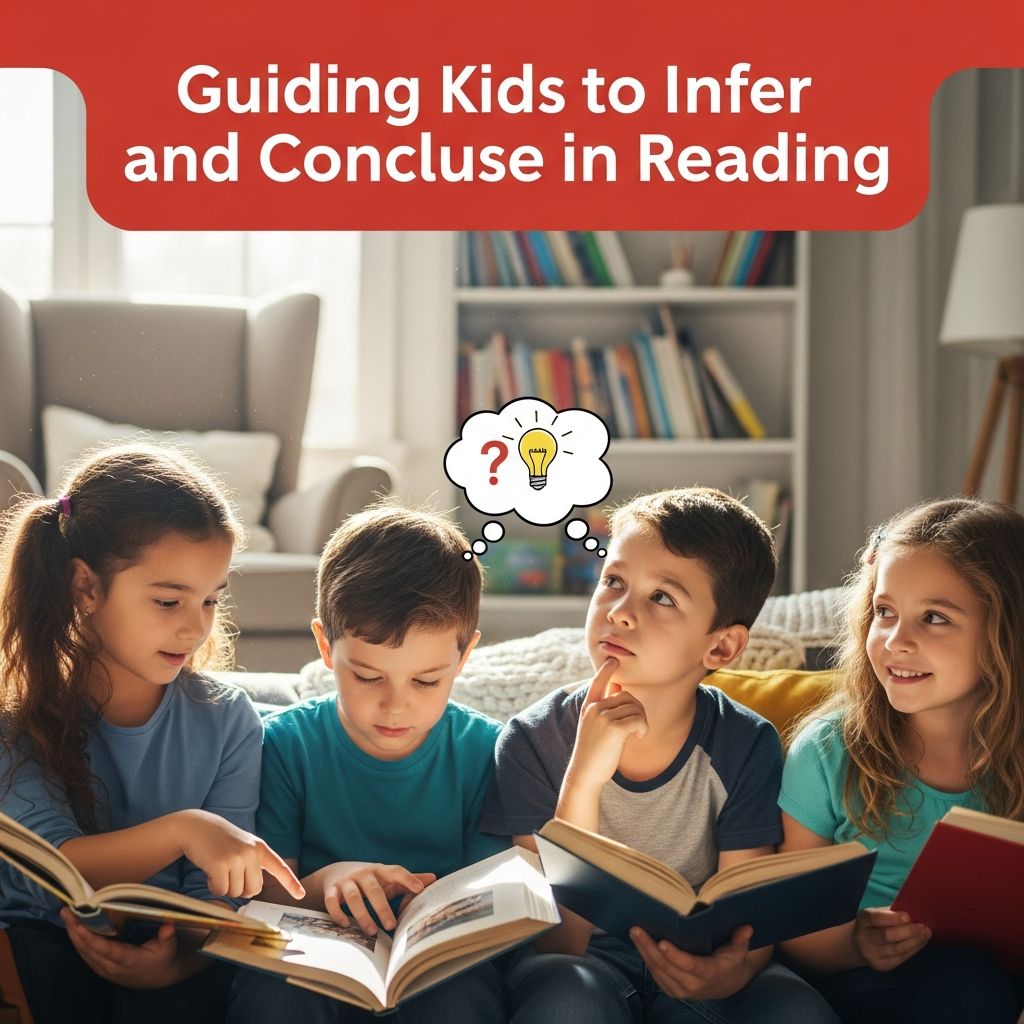
Developing the ability to read between the lines is a cornerstone of strong literacy skills for children. By coaching young readers to make **inferences**—conclusions based on text clues combined with their own knowledge—and draw logical conclusions, parents and teachers can transform passive reading into an active, engaging process. This skill not only improves comprehension but also fosters critical thinking that extends beyond books into everyday life.
Why Inference Skills Matter for Young Readers
Inference is the mental process where readers piece together explicit information from a story with their background knowledge to understand implied meanings. Unlike straightforward facts, inferences require detective-like thinking: spotting subtle hints in words, actions, or illustrations and filling in gaps the author leaves intentionally. Research shows this is one of the most tested elements in reading assessments, yet many children struggle because proficient readers often do it unconsciously.
For beginners, explicit instruction bridges this gap. Studies emphasize that inferential thinking develops through repeated practice and guidance, helping kids grasp character emotions, predict outcomes, and uncover themes without direct statements. Strong inference skills correlate with better overall comprehension, vocabulary growth, and even enjoyment of reading, as children feel empowered to ‘unlock’ deeper layers of stories.
Foundational Steps: Building Blocks for Inference
Before diving into complex inferences, ensure children master prerequisites. Start with vocabulary comprehension, as unfamiliar words block access to evidence. Teach contextual clues—surrounding sentences that hint at meanings—and morphemic analysis, breaking words into roots like ‘unhappy’ (un + happy).
- Vocabulary preview: Scan texts ahead, highlighting tricky words and discussing them with visuals or synonyms.
- Retrieval practice: Locate key details explicitly stated, training kids to hunt for evidence before inferring.
- Background activation: Link text to real-life experiences, like inferring a character’s fear from storm descriptions if the child recalls thunder scares.
These steps create a sturdy scaffold, much like constructing a house: solid foundations support higher-level thinking.
Practical Techniques to Teach Inferring
Explicit modeling is key. Use a ‘think-aloud’ approach where you verbalize your thought process. For example, reading “The boy slammed the door and stomped away,” say: “The text says he slammed and stomped. From my knowledge, people do that when angry. So, I infer he’s upset.” This demystifies the ‘invisible’ steps.
Incorporate visual aids for younger learners. Show pictures or wordless books first: “What do you think happened here?” Progress to sentences, then paragraphs. Graphic organizers clarify the formula: Text clues + My schema = Inference.
| Strategy | Description | Age Group | Example Prompt |
|---|---|---|---|
| Picture Inference | Use images to practice before text | 4-7 | “Why is the dog hiding?” |
| Question Stems | Prompt with who/why/how | 6-9 | “How might she feel?” |
| Think-Aloud | Model internal monologue | 7-10 | “This clues anger, so…” |
| Partner Talk | Discuss inferences aloud | 8-11 | “What do you think next?” |
Metacognitive Strategies: Thinking About Thinking
Turn inference into a self-regulated skill with metacognition. Aidan Severs proposes a sequence: decode vocabulary, retrieve facts, then infer. Children self-question: “What’s my inference? Evidence? Is it solid? Adjust?” This mirrors detective work, building independence.
Marzano’s four questions amplify this:
- What is my inference?
- What evidence supports it?
- How valid is my reasoning?
- Revise if needed?
Practice across subjects—PSHE for emotions in pictures, science for experiment predictions—making it versatile.
Hands-On Activities to Practice Inference
Engage with interactive exercises. Create ‘mystery boxes’ with object descriptions under ‘microscopes’ (metaphorically), using schema + clues = guess. Or, read aloud pausing at inference points: “Sirens wail, smoke rises—what’s happening?” Discuss text evidence versus assumptions.
- Book clubs: Select inference-rich stories like Charlotte’s Web; chart character feelings via actions.
- Clue hunts: Highlight text evidence in colors, link to inferences with arrows.
- Genre variety: Narratives for emotions, expository for cause-effect, poetry for figurative language.
- Student questioning: Have kids generate ‘why’ questions, boosting metacognition.
For diverse learners, differentiate: visuals for ELLs, drawing inferences for kinesthetics, tech videos for digital natives.
From Inference to Drawing Conclusions
Inferences build to conclusions—broader insights like themes or outcomes. Guide with ‘So what?’ questions: After inferring a character’s motive, conclude the moral. Use gradual release: model, guide, independent practice. Track progress with rubrics scoring evidence use and accuracy.
Challenges and Solutions in Coaching Inference
Common hurdles include weak vocab or over-reliance on guesses. Solutions: Pre-teach words, emphasize evidence. For strugglers, start concrete (pictures) before abstract text. Inclusive classrooms benefit all via universal design—model for everyone.
Parental tips: During bedtime stories, pause and query: “What clues show sadness? Your ideas?” Reinforce daily: Infer from news headlines or ads.
Measuring Progress and Long-Term Benefits
Assess via journals: Students log inferences with justifications. Over time, reduce scaffolding until self-directed. Benefits extend to writing (implied details) and subjects like history (source analysis). Inference hot-houses critical thinkers ready for complex texts.
Frequently Asked Questions (FAQs)
What age should inference teaching start?
From kindergarten with pictures, advancing to text by grade 2-3.
How often to practice?
Daily 10-15 minutes yields best gains; integrate into all reading.
What if a child guesses wildly?
Redirect to text evidence: ‘Show me where it says that.’
Tools for remote learning?
Shared screens for think-alouds, digital graphic organizers.
Books ideal for practice?
The Mysteries of Harris Burdick (pictures), Because of Winn-Dixie (emotions).
Mastering inferences equips children for lifelong learning, turning every page into an adventure of discovery.
References
- Teaching a Metacognitive Approach to Inference-Making — Aidan Severs. 2016. https://www.aidansevers.com/post/reading-comprehension-teaching-a-metacognitive-approach-to-inference-making
- Inferencing | Reading Rockets — Reading Rockets. 2024. https://www.readingrockets.org/classroom/classroom-strategies/inferencing
- Making Inferences to Support Comprehension — Keys to Literacy. 2024. https://keystoliteracy.com/blog/making-inferences-to-support-comprehension/
- Making Inferences and Helping Kids See Beyond the Obvious — Reading Partners. 2023. https://readingpartners.org/blog/making-inferences-see-beyond-the-obvious/
- Teaching Inference Skills Overview — One Education. 2023-05-01. https://www.oneeducation.co.uk/wp-content/uploads/2023/05/Teaching-Inference-Skills-Overview.pdf

Medha Deb is an editor with a master's degree in Applied Linguistics from the University of Hyderabad. She believes that her qualification has helped her develop a deep understanding of language and its application in various contexts. Medha specializes in the areas of beauty, health, sports, and wellness and is committed to ensuring that the content on the website is…