
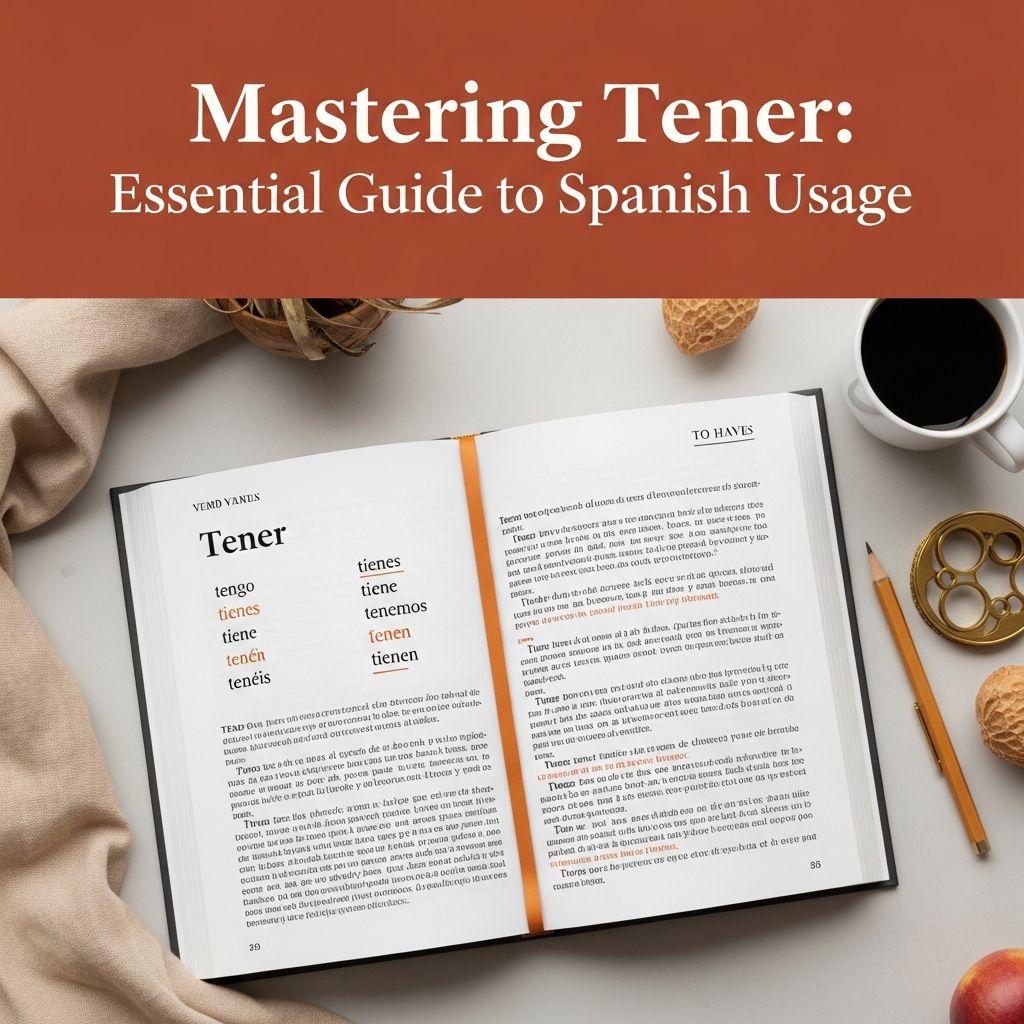
The verb tener stands as one of the cornerstones of Spanish grammar, translating primarily to ‘to have’ in English but extending far beyond simple possession. Learners often encounter it early due to its frequency in daily speech, making mastery crucial for natural communication. This guide explores its conjugations across tenses, diverse applications, and idiomatic phrases, equipping you with tools for confident usage.
Understanding the Core Role of Tener in Spanish
Tener belongs to the irregular -er verb family, demanding attention to its unique forms. Unlike regular verbs, it deviates in several conjugations, particularly in the present tense. Its versatility allows speakers to describe ownership, quantify age, express bodily sensations, outline obligations, and depict physical traits. Native speakers weave tener seamlessly into conversations, often where English opts for ‘to be’ or other structures.
Grasping tener unlocks doors to idiomatic fluency, as many fixed expressions rely on it. For instance, stating hunger becomes ‘tener hambre’ rather than ‘ser hambriento.’ This shift from English patterns challenges beginners but rewards persistent practice with authentic expression.
Present Tense Conjugation: Your Starting Point
Begin with the present indicative, the most utilized form. Tener’s stem changes from ‘ten-‘ to ‘teng-‘ in the first person singular, with ‘ie’ diphthongs appearing in certain positions, forming a ‘boot’ pattern if visualized on a conjugation chart.
| Pronoun | Conjugation | Example Sentence |
|---|---|---|
| Yo | tengo | Tengo un perro. (I have a dog.) |
| Tú | tienes | ¿Tienes tiempo? (Do you have time?) |
| Él/Ella/Usted | tiene | Mi amigo tiene suerte. (My friend has luck.) |
| Nosotros | tenemos | Tenemos ganas de bailar. (We feel like dancing.) |
| Vosotros | tenéis | Tenéis razón. (You all are right.) |
| Ellos/Ellas/Ustedes | tienen | Ellos tienen miedo. (They are afraid.) |
Practice these forms through repetition and contextual sentences to internalize them. Note that ‘nosotros’ and ‘vosotros’ follow more predictable -er endings.
Expressing Possession with Tener
The most straightforward application mirrors English: indicating ownership of objects, family, or abstract qualities. Use it for tangible items like ‘Tengo dos gatos’ (I have two cats) or intangibles like ‘Tengo esperanza’ (I have hope).
- Tengo una bicicleta nueva. (I have a new bicycle.)
- ¿Tienes hermanos? (Do you have siblings?)
- Tenemos un jardín grande. (We have a big garden.)
This usage aligns directly with English, easing the transition for English speakers. Quantify possessions with numbers or articles for precision.
Tener for Age: A Cultural Linguistic Twist
Spanish diverges notably when discussing age. Instead of ‘I am 25 years old,’ say ‘Tengo veinticinco años’—literally, ‘I have 25 years.’ This applies to people, animals, or even object durations.
- ¿Cuántos años tienes? (How old are you?)
- Mi abuela tiene ochenta años. (My grandmother is 80 years old.)
- El edificio tiene cien años. (The building is 100 years old.)
Extend to months or days for infants: ‘Mi bebé tiene tres meses’ (My baby is three months old). This pattern reinforces tener’s foundational role.
Describing Sensations and Emotions
Tener conveys physical and emotional states via nouns, not adjectives. Common phrases include:
- Tengo hambre (I am hungry)
- Tengo sed (I am thirsty)
- Tengo calor (I am hot)
- Tengo frío (I am cold)
- Tengo miedo (I am afraid)
- Tengo sueño (I am sleepy)
These structures highlight Spanish’s preference for ‘having’ a condition. Intensify with adverbs: ‘Tengo mucho sueño’ (I am very sleepy).
Physical Characteristics and Descriptions
Attribute body features using tener plus nouns: ‘Tengo ojos azules’ (I have blue eyes) or ‘Ella tiene pelo largo’ (She has long hair). This method suits traits like height or build: ‘Tengo dos metros de altura’ (I am two meters tall).
- Mi hermano tiene barba. (My brother has a beard.)
- Tenemos manos grandes. (We have big hands.)
Contrast with English’s ‘to be’ usage; practice swaps to build intuition.
Obligations and Necessities: Tener Que
Express duties with ‘tener que’ + infinitive, akin to English ‘have to.’ This semi-auxiliary construction is indispensable for plans and requirements.
- Tengo que estudiar. (I have to study.)
- ¿Tienes que trabajar mañana? (Do you have to work tomorrow?)
- Tenemos que salir temprano. (We have to leave early.)
Variations include ‘tener ganas de’ for desires: ‘Tengo ganas de comer’ (I feel like eating).
Idiomatic Expressions: Elevating Your Spanish
Tener powers numerous idioms, adding color to speech:
| Expression | Meaning | Example |
|---|---|---|
| Tener suerte | To be lucky | Tuviste suerte en el examen. (You got lucky on the exam.) |
| Tener razón | To be right | Tienes razón sobre eso. (You’re right about that.) |
| Tener prisa | To be in a hurry | ¿Tienes prisa? (Are you in a hurry?) |
| Tener resaca | To have a hangover | Tengo resaca después de la fiesta. (I have a hangover after the party.) |
| Tener celos | To be jealous | No tengas celos. (Don’t be jealous.) |
These phrases demand memorization as wholes, not literal translations.
Beyond Present: Other Tenses Essentials
While present dominates, explore preterite (tuve, tuviste), imperfect (tenía), future (tendré), and perfect (he tenido). For example, preterite for completed actions: ‘Tuve una idea genial’ (I had a great idea).
Subjunctive forms like ‘que tenga’ appear in wishes: ‘Espero que tengas éxito’ (I hope you succeed).
Practical Tips for Integrating Tener Daily
- Flashcards for conjugations and phrases.
- Journal entries using varied tener structures.
- Listen to podcasts noting tener usage.
- Role-play scenarios like shopping or doctor visits.
Combine with ser/estar for nuanced contrasts, enhancing overall proficiency.
Frequently Asked Questions (FAQs)
Why use ‘tener’ for hunger instead of ‘ser’?
Spanish favors ‘tener + noun’ for states like hunger (‘tener hambre’), reflecting a ‘possession’ of the sensation, unlike English adjectives.
Is ‘tener’ ever used like English ‘have been’?
No; for perfect tenses, use ‘haber’: ‘He estado’ (I have been), not tener.
How does ‘tener que’ differ from ‘deber’?
‘Tener que’ implies external obligation (have to); ‘deber’ suggests moral duty (should).
Can ‘tener’ describe relationships?
Yes: ‘Tengo novia’ (I have a girlfriend) or ‘Tienen hijos’ (They have children).
What’s the subjunctive form of ‘tener’?
Present subjunctive: tenga, tengas, tenga, tengamos, tengáis, tengan.
References
- How to use TENER in Spanish — Direct Español. 2023-01-15. https://www.directespanol.com/how-to-use-tener-in-spanish/
- 6 ways to use Tener (to have) in Spanish — AM Spanish Lessons. 2022-05-20. https://amspanish.com/6-ways-to-use-tener-to-have-in-spanish-explanation/
- TENER in SPANISH: Don’t Learn Conjugations By Heart — YouTube (Butterfly Spanish). 2021-11-10. https://www.youtube.com/watch?v=uqZF0SipPsE
- How do you use tener in a sentence? — Learn Spanish with Pedro. 2023-08-05. https://spanishwithpedro.com/how-do-you-use-tener-in-a-sentence/
- Tener Verb Conjugation in Spanish & How to Use it — Busuu. 2024-02-14. https://www.busuu.com/en/spanish/tener
- How to Use Tener: 4 Key Uses of “To Have” in Spanish — YouTube (Spanish with Vicente). 2022-07-22. https://www.youtube.com/watch?v=OTouwGa4hl0
- 10 essential Spanish expressions with ‘tener’ — Coffee Break Languages. 2024-06-12. https://coffeebreaklanguages.com/2024/06/essential-spanish-expressions-with-tener/
- Tener Conjugation — SpanishDict. 2024-03-01. https://spanishdict.com/conjugate/tener

- Integrated M.A. in Applied Linguistics, University of Hyderabad
- 5+ years in editorial, instructional, SEO, and research-based writing
Sneha is a relationships and lifestyle writer with a strong foundation in applied linguistics and certified training in relationship coaching. She brings over five years of writing experience to theskillvault, crafting thoughtful, research-driven content that empowers readers to build healthier relationships, boost emotional well-being, and embrace holistic living. Her writing and insights reflect the belief that beauty, happiness, and wellness…