
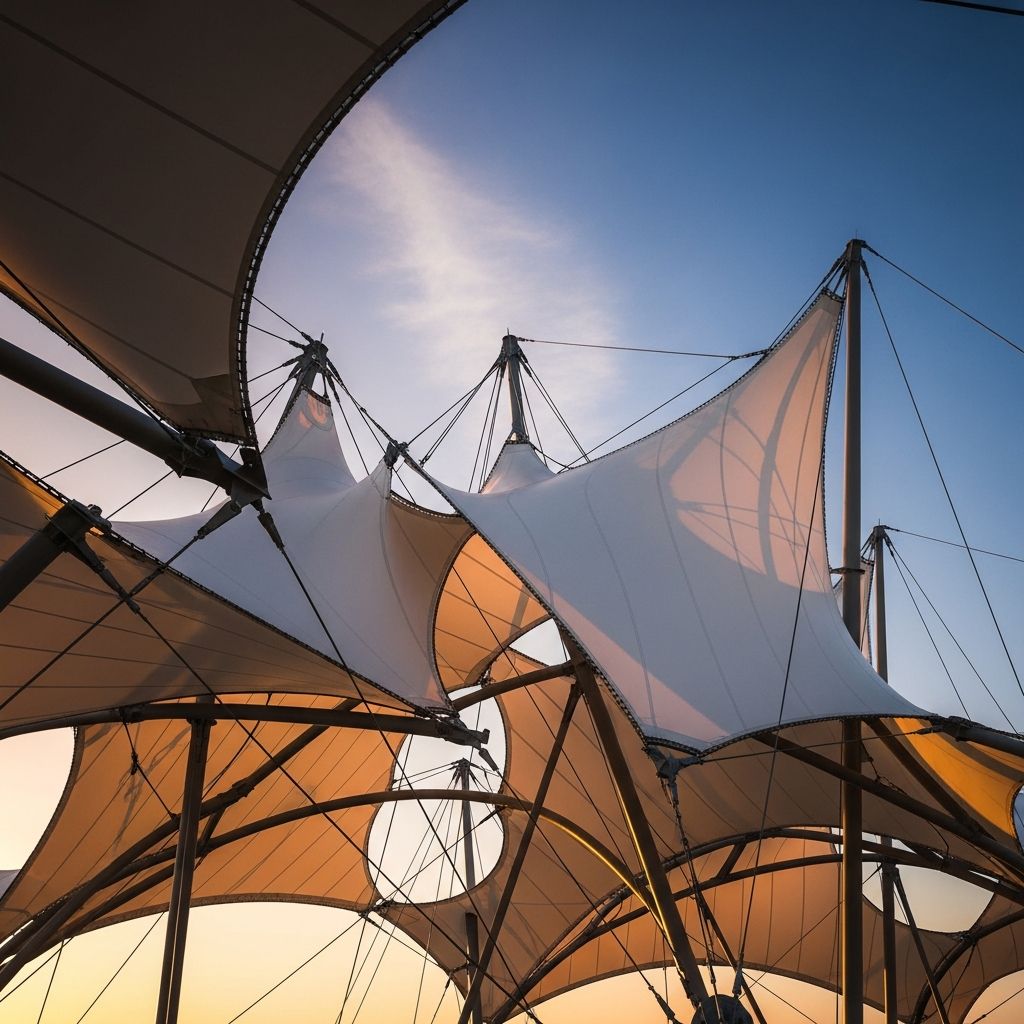
Tensile architecture represents a paradigm shift in structural engineering, harnessing the power of tension to create lightweight, expansive coverings that defy traditional building norms. By relying on stretched membranes and cables rather than heavy compressive elements, this approach enables vast open spaces with minimal material use, blending functionality, aesthetics, and efficiency.
Core Principles of Tension-Driven Design
The foundation of tensile architecture lies in its use of tension as the dominant force for stability. Unlike conventional structures that combat gravity through compression and rigidity, tensile systems maintain form through continuous pretension in flexible elements. This pretension—a deliberate pre-stressing—ensures the membrane remains taut under varying loads like wind or snow, distributing forces evenly across the surface.
Imagine a drumhead: when tightly stretched, it gains rigidity capable of withstanding impacts. Similarly, tensile membranes achieve structural integrity by balancing internal tension against external pressures, supported by masts, cables, or boundary frames. This equilibrium allows for fluid, organic shapes impossible with rigid materials.
Advanced Materials Powering Modern Tensile Builds
High-performance fabrics are the backbone of tensile architecture, engineered for durability, weather resistance, and longevity. Common choices include PTFE-coated glass fiber, offering 25-50 years of service with superior UV and fire resistance, and PVC-coated polyester for cost-effective, 10-15 year applications.
- PTFE (Polytetrafluoroethylene-coated fiberglass): Translucent, self-cleaning, and highly durable; ideal for permanent installations.
- PVC (Polyvinyl chloride-coated polyester): Affordable, customizable colors, but requires periodic recoating.
- ETFE (Ethylene tetrafluoroethylene): Lightweight foil cushions for superior light transmission and insulation.
Cables, typically galvanized or stainless steel, provide the tensile backbone, classified as load-bearing (primary force transfer) or stabilizing (shape maintenance). Supporting elements like aluminum masts or concrete anchors complete the system.
Design Process: From Concept to Equilibrium
Creating a tensile structure demands sophisticated form-finding techniques to determine the precise membrane shape for equilibrium. Engineers employ software simulations analyzing stress patterns, wind dynamics, and load distributions. Physical scale models often validate digital results, ensuring the final form minimizes wrinkles and maximizes performance.
The process unfolds in stages:
- Conceptual Sketching: Define span, supports, and aesthetic goals.
- Form-Finding Analysis: Use nonlinear finite element modeling for optimal geometry.
- Patterning and Prototyping: Cut fabric panels to fit the computed curves.
- On-Site Tensioning: Install and incrementally tension to design specifications.
Primary Types of Tensile Configurations
Tensile structures diversify into distinct categories based on support mechanisms and form.
| Type | Description | Key Features | Applications |
|---|---|---|---|
| Membrane-Tensioned | Single or multi-layer fabric held by cables and masts. | Large spans, lightweight, translucent options. | Roofs, canopies, arenas. |
| Mesh-Tensioned (Cable Nets) | Interwoven cable grids supporting panels like glass or wood. | High transparency, complex geometries. | Facades, atriums. |
| Pneumatic | Air-pressurized membranes or cushions. | Modular, relocatable, energy-efficient. | Temporary enclosures, greenhouses. |
Basic geometries include cones (radial tension from a central peak), saddles (hyperbolic paraboloids with double curvature), and barrels (cylindrical waves), which can combine for hybrid forms.
Iconic Projects Demonstrating Real-World Impact
Tensile architecture shines in landmark developments. The Munich Olympic Stadium (1972) by Frei Otto pioneered draped membranes over cable nets, spanning 74,000 square meters for the Olympics. Denver International Airport’s tensile roof, covering vast terminals, exemplifies longevity with PTFE fabrics enduring decades.
London’s O2 Arena (formerly Millennium Dome) features a 12-acre PTFE-coated fiberglass canopy tensioned by 100km of cables on a steel mast ring, hosting millions annually. Recent advancements appear in Beijing’s Water Cube, using ETFE pillows for the 2008 Olympics, prioritizing translucency and insulation.
Sustainability and Efficiency Advantages
Tensile designs excel in eco-friendliness, using 1% of steel required for equivalent spans, slashing embodied carbon. Translucent membranes harness daylight, reducing lighting needs by up to 30%, while low thermal mass aids passive cooling.
Life-cycle benefits include recyclability of fabrics and cables, minimal maintenance, and adaptability for disassembly. Compared to traditional roofing:
| Aspect | Tensile Architecture | Conventional Steel/Concrete |
|---|---|---|
| Material Use | Lightweight (fabric + cables) | Heavy compressive elements |
| Span Capability | 200m+ | Limited without intermediates |
| Energy Savings | High (daylighting, ventilation) | Moderate |
| Construction Speed | Weeks (prefab panels) | Months |
These attributes position tensile systems as vital for green building certifications like LEED.
Engineering Challenges and Solutions
Despite strengths, tensile architecture grapples with issues like UV degradation, requiring robust coatings; wind-induced vibrations, mitigated by dampers; and precise installation tolerances. Nonlinear behavior under loads necessitates advanced analysis, often involving iterative simulations.
Fire safety is addressed via inherent fabric resistance (e.g., PTFE’s non-combustibility) and integrated suppression systems. Cost-wise, initial engineering premiums offset long-term savings in materials and operations.
Future Directions in Tensile Innovation
Emerging trends integrate smart sensors for real-time tension monitoring, adaptive facades responding to weather, and hybrid composites blending carbon fiber cables with bio-based membranes. Parametric design tools accelerate customization, promising broader adoption in urban infills and disaster-relief shelters.
Climate-responsive ETFE systems, inflating/deflating for shading, enhance energy performance. As computational power grows, tensile architecture will evolve from spectacles to everyday solutions for sustainable sprawl.
Frequently Asked Questions (FAQs)
What differentiates tensile structures from tents?
Tensile structures are permanent, engineered architectures with high-durability fabrics, precise form-finding, and code-compliant performance, unlike temporary, loosely tensioned tents.
How long do tensile membranes last?
PTFE versions endure 25-50 years; PVC types 10-20 years with maintenance.
Are tensile structures cost-effective?
Yes for large spans, due to material savings and quick installs, though design phases add upfront costs.
Can they withstand extreme weather?
Designed for snow, wind (up to 150 mph), and seismic events via rigorous modeling and anchors.
What software is used in design?
Tools like Rhino/Grasshopper, ANSYS, or custom FEM software for form-finding and analysis.
References
- What makes it a Tensile Structure – and not just a tent? — Architen. Accessed 2026. https://www.architen.com/articles/what-makes-it-a-tensile-structure-and-not-just-a-tent/
- Tensile Structures: How Do They Work and What Are the Different Types — ArchDaily. 2018-11-20. https://www.archdaily.com/887462/tensile-structures-how-do-they-work-and-what-are-the-different-types
- Tensile Architecture 101 — Greenline. Accessed 2026. https://greenline.com.au/blog/tensile-architecture
- How Tensile Architecture Combines Sustainability with Striking Design — Pressmach. Accessed 2026. https://www.pressmach.com/blog/how-tensile-architecture-combines-sustainability-with-striking-design
- Tensile structure — Wikipedia. Accessed 2026. https://en.wikipedia.org/wiki/Tensile_structure
- An Architect’s Guide To: Tensile Fabrics — Architizer. Accessed 2026. https://architizer.com/blog/product-guides/product-guide/tensile-fabrics/

- Integrated M.A. in Applied Linguistics, University of Hyderabad
- 5+ years in editorial, instructional, SEO, and research-based writing
Sneha is a relationships and lifestyle writer with a strong foundation in applied linguistics and certified training in relationship coaching. She brings over five years of writing experience to theskillvault, crafting thoughtful, research-driven content that empowers readers to build healthier relationships, boost emotional well-being, and embrace holistic living. Her writing and insights reflect the belief that beauty, happiness, and wellness…