
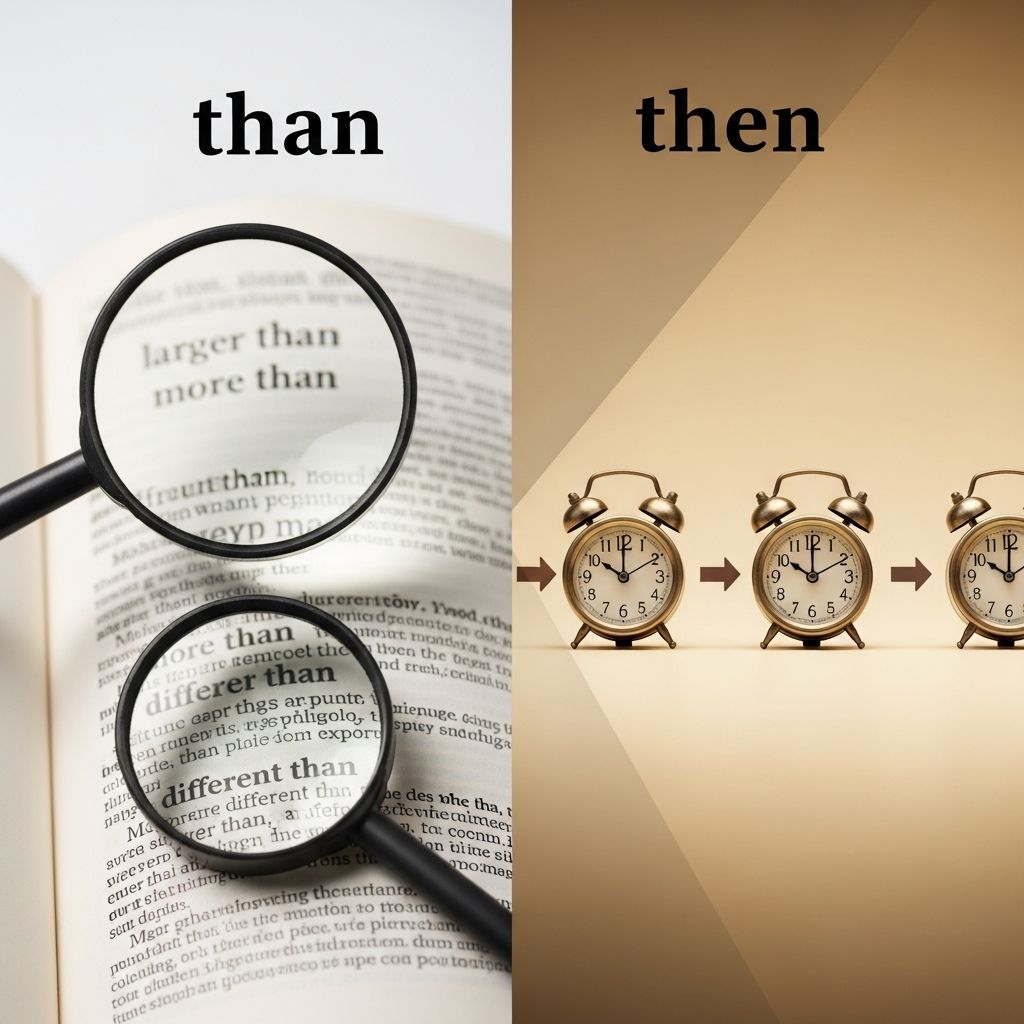
Two of the most frequently confused words in English are than and then. Despite their similar appearances and pronunciation, these words serve entirely different purposes in writing and speech. The confusion stems from their phonetic similarity and nearly identical spelling, yet their meanings could not be more distinct. Understanding when to use each word is essential for anyone seeking to improve their writing quality and communicate with precision.
The distinction between these homophones is straightforward once you recognize their primary functions: than operates as a comparative tool, while then functions as a temporal marker. Grasping this fundamental difference will immediately improve your ability to use these words correctly in virtually any context.
The Role of Than in Comparative Language
Than exists exclusively to facilitate comparisons between two or more entities. Whether you’re comparing quantities, qualities, abilities, or characteristics, this word is your tool for establishing a relationship of difference or similarity between items. The word than consistently appears in sentences where one thing is being measured against another on some scale or dimension.
Comparative adjectives and adverbs naturally pair with than. When you use words like taller, shorter, faster, slower, more intelligent, or less expensive, you typically need than to complete the comparison. These adjectives express relative qualities rather than absolute ones, requiring a reference point for their meaning to be complete.
Common Structures Using Than
- Direct comparisons: Your coffee is stronger than mine. This house is larger than that one.
- Comparative phrases with more/less: She has more experience than her colleague. This task requires less effort than I anticipated.
- Phrases following other and rather: I prefer chocolate other than vanilla. He chose to walk rather than drive.
- Proportional comparisons: The new model costs more than twice the original price. I’ve visited fewer countries than you have.
- The “no sooner…than” construction: We had no sooner arrived than the celebration began. She had barely finished speaking than everyone applauded.
Understanding these patterns helps you recognize when than is the appropriate choice. Each structure involves setting up a comparison framework where two elements are being measured against each other using a specific criterion.
The Temporal Function of Then
Then operates in the realm of time and sequence. This versatile word can reference specific moments, express sequential order, indicate causation, or suggest hypothetical situations. Unlike than, which has a singular purpose, then demonstrates remarkable flexibility in how it functions within sentences and conversations.
The most straightforward use of then involves placing events on a timeline. When you say “back then,” you’re referencing a specific period in the past. When you say “we’ll talk about it then,” you’re pointing to a specific moment in the future. This temporal capability makes then invaluable for narrative writing, instructions, and any communication involving sequences of events.
Diverse Applications of Then
- Past time reference: I lived in Boston back then. Things were different then. The weather was much hotter then.
- Sequential ordering: First, preheat the oven. Then, mix your ingredients. Then, pour the batter into a pan.
- Conditional logic: If you study diligently, then you’ll succeed on the exam. If it rains tomorrow, then we’ll postpone the event.
- Consequence or result: She forgot her keys, and then realized she was locked out. The power went out, and then the entire neighborhood lost internet service.
- Phrases indicating additional or occasional occurrence: We go to the beach now and then. Besides helping at home, he works part-time, and then some.
- As an adjective describing former status: The then-president addressed the crowd. Her then-husband became a successful entrepreneur.
Each of these applications demonstrates then’s ability to convey temporal relationships in different ways. The word essentially answers the question “when?” or provides information about the sequence in which events occur.
Memory Devices and Recognition Strategies
Remembering which word to use becomes significantly easier when you employ helpful mnemonic devices. One particularly effective technique involves examining the vowels within each word: than contains the letter “a,” and “a” also appears in the word “comparison.” This connection helps many writers instinctively choose than when making comparisons. Conversely, then contains the letter “e,” and “e” also appears in the word “when,” helping writers recognize this word’s connection to temporal contexts.
Another practical strategy involves substituting test phrases. When uncertain whether to use than or then, try replacing the word with “in comparison to” (for than) or “at that time” (for then). If your sentence maintains logical sense with either substitution, you’ve selected the correct word. This method works because it forces you to consider the core meaning of your sentence, which naturally leads to the appropriate choice.
Some writers find success by associating than with comparison and then with time, both of which share the same first three letters as their corresponding homophones. Creating personal associations or visual reminders of these connections can reinforce correct usage over time.
Frequently Encountered Errors and Corrections
| Incorrect Usage | Correct Usage | Explanation |
|---|---|---|
| “More than ever” | “More than ever” | This is correct. “More” signals comparison, requiring than. |
| “No later then noon” | “No later than noon” | Comparing two times requires than, not then. |
| “Earlier then expected” | “Earlier than expected” | Comparing arrival times to expectations requires than. |
| “First we eat, and then we study” | “First we eat, and then we study” | This is correct. Then shows sequence. |
| “Back than, things were simpler” | “Back then, things were simpler” | Referring to past time requires then. |
Advanced Uses and Nuanced Contexts
While the basic distinction between than and then is straightforward, certain contexts present greater complexity. Understanding these nuanced situations helps you navigate advanced writing scenarios with confidence. Sometimes both words can appear in the same sentence, each serving its proper function without creating confusion.
Consider this example: “He was wealthier then than he is now.” The first “then” establishes a time reference (in the past), while “than” makes a comparison (his past wealth versus his current wealth). Both words are necessary and correct in this construction, though it requires careful attention to avoid mistakes.
In conditional statements, then frequently appears as part of if-then logic structures. These constructions are common in academic writing, technical documentation, and logical reasoning. The “then” in these contexts indicates what result or consequence follows from the condition established in the “if” clause. This usage requires grammatical precision to ensure clarity and logical coherence.
Practical Applications in Different Writing Contexts
Academic Writing: Formal academic work demands precise language. Scholars frequently use comparisons (requiring than) when analyzing different theories, methodologies, or research findings. They also employ then extensively when discussing historical development, methodological procedures, or logical progressions within arguments.
Creative Writing: Narrative fiction relies heavily on temporal markers like then to establish sequence and pacing. Authors use then to guide readers through plot development. However, character descriptions often employ than for vivid comparisons that bring characters and scenes to life. A skilled writer seamlessly alternates between these words depending on narrative needs.
Technical Documentation: Instructions and procedures depend almost entirely on then to establish sequence. Recipes, assembly guides, software tutorials, and procedural documents use then to walk users through steps in logical order. These contexts rarely require than unless the documentation involves comparing different methods or approaches.
Business Communication: Professional correspondence uses both words strategically. Competitive analyses and market reports employ than extensively. Project timelines and scheduling communications rely on then. Using these words correctly enhances professional credibility and ensures clear communication of complex information.
Common Questions About Than and Then Usage
Q: Can I use “then” in comparisons?
A: Generally, no. “Then” does not function as a comparative word. However, in very rare historical or archaic contexts, you might encounter “then” used in this way, but modern English exclusively uses “than” for comparisons. Always use “than” when making direct comparisons.
Q: Is there ever a situation where “than” and “then” are interchangeable?
A: No, these words are never interchangeable. Their meanings are completely distinct, and using one when the other is required creates grammatical errors that confuse readers and undermine your credibility as a writer.
Q: How do I remember which word goes with which meaning?
A: The vowel method works well: “than” (with “a”) for comparisons, “then” (with “e”) for time. Additionally, “than” contains similar letters to “comparison,” while “then” contains similar letters to “when,” both of which relate to time.
Q: What about “than” versus “then” in the phrase “more than ever”?
A: Always use “than” in this phrase because you’re comparing the degree of something (usually love, gratitude, or appreciation) to its previous degree. The word “more” signals a comparison, requiring “than.”
Q: Does “then” ever function as a noun or adjective?
A: Yes, “then” can function as a noun meaning “that time” (e.g., “since then”) or as an adjective meaning “existing at that time” (e.g., “the then-president”). However, in these uses, it still relates to time, maintaining its fundamental temporal nature.
Mastering Consistent Correct Usage
Developing mastery over than and then usage requires conscious attention initially, but the habit eventually becomes automatic. Start by carefully proofreading your writing specifically for these two words. When you encounter either word, pause and ask yourself: “Am I making a comparison or referring to time?” This simple question will guide you toward the correct choice almost every time.
Reading widely exposes you to correct usage in various contexts, helping your brain internalize proper patterns. Notice how published authors use these words, and observe how professional writers avoid confusion through careful word selection. Over time, reading reinforces correct usage through pattern recognition.
Practice writing sentences that deliberately use both words, creating diverse examples that explore their different functions. Challenge yourself to write complex sentences where both words appear, ensuring each performs its proper function. This active practice accelerates the development of automatic, accurate usage.
Finally, don’t hesitate to consult reference materials when uncertainty arises. Even experienced writers occasionally double-check word usage to ensure accuracy. Using grammar resources, style guides, or online references demonstrates commitment to excellence in communication rather than carelessness.
References
- When To Use ‘Then’ and ‘Than’ — Merriam-Webster. Accessed 2026-04-05. https://www.merriam-webster.com/grammar/when-to-use-then-and-than
- Than vs. Then – The Correct Way to Use Each — Ginger Software. Accessed 2026-04-05. https://www.gingersoftware.com/english-online/spelling-book/confusing-words/than-then
- Then vs. Than | Meaning, Examples & Sentences — Scribbr. Accessed 2026-04-05. https://www.scribbr.com/commonly-confused-words/then-vs-than/
- Then vs Than | Difference, Meaning & Examples — QuillBot. Accessed 2026-04-05. https://quillbot.com/blog/commonly-confused-words/than-vs-then/
- Than vs. Then—What’s the Difference? — Grammarly Blog. Accessed 2026-04-05. https://www.grammarly.com/blog/commonly-confused-words/than-then/

Medha Deb is an editor with a master's degree in Applied Linguistics from the University of Hyderabad. She believes that her qualification has helped her develop a deep understanding of language and its application in various contexts. Medha specializes in the areas of beauty, health, sports, and wellness and is committed to ensuring that the content on the website is…