
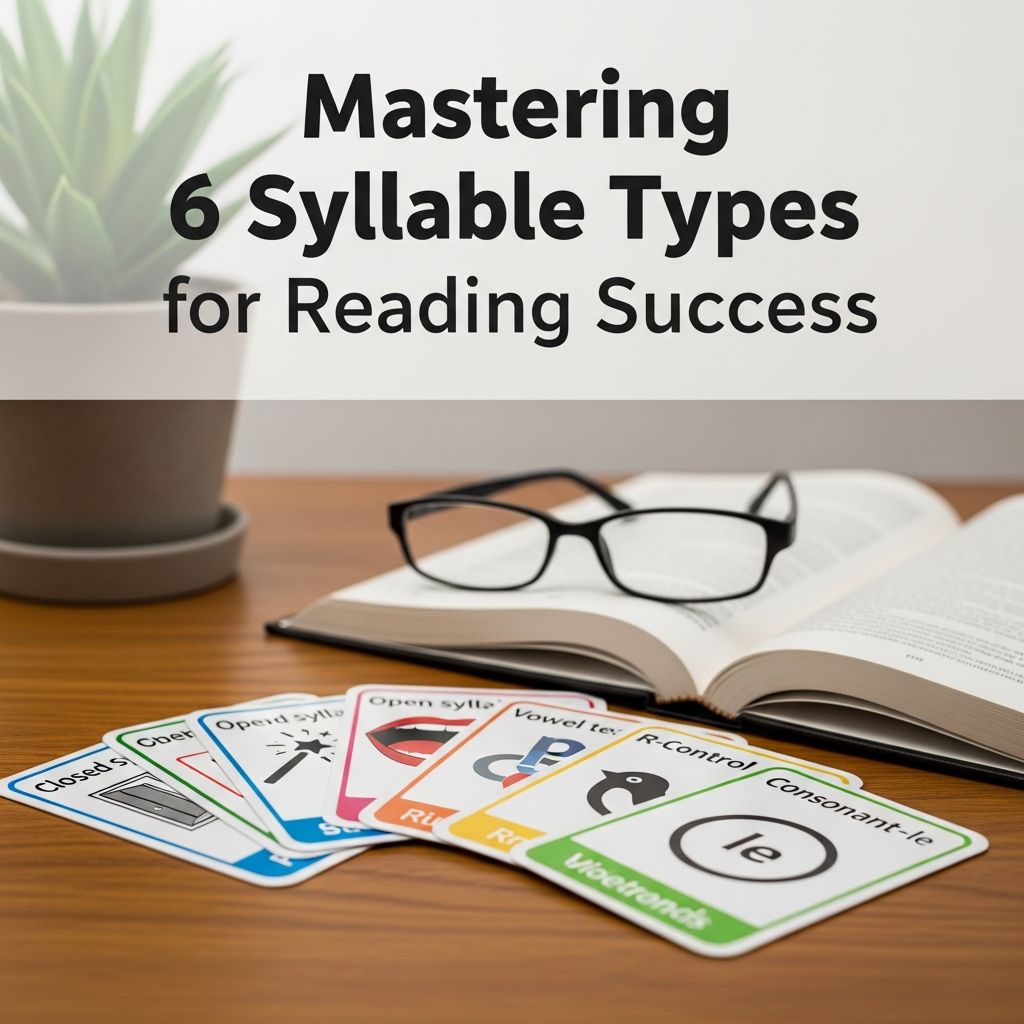
Every word in English breaks down into syllables, the fundamental units that drive pronunciation, reading, and spelling. Recognizing the six primary syllable types equips students with powerful tools to tackle unfamiliar words, enhancing overall literacy. This guide explores each type in depth, offering clear definitions, examples, and strategies to build confident readers.
Why Syllable Types Matter in Literacy Development
Syllables serve as the building blocks of language, helping learners predict vowel sounds and divide multisyllabic words accurately. Mastery of these patterns aligns with structured literacy approaches, supporting the science of reading by fostering phonemic awareness and orthographic mapping. Students who understand syllable types read more fluently, spell with greater accuracy, and comprehend complex texts better. Research from educational resources emphasizes starting with the most common types to build a strong foundation.
In classrooms, teaching syllable types systematically prevents confusion with irregular English spellings. For instance, knowing a syllable’s structure reveals whether a vowel sounds short or long, reducing guesswork in decoding. Parents and teachers can integrate these concepts through games, songs, and daily reading, making learning engaging and effective.
Closed Syllables: The Foundation of Short Vowel Sounds
Closed syllables form the most frequent pattern in English, where a vowel is “closed in” by one or more consonants, producing a short vowel sound. This structure traps the vowel, forcing it to say its name briefly. Common in simple words like cat, bed, and pin, they appear in multisyllabic terms too, such as rab-bit or pic-nic.
To identify a closed syllable, look for a vowel followed immediately by a consonant before the next vowel or word end. Practice tip: Clap the beats in words like jump (one clap) or basket (bas-ket, two claps) to feel the closure. These syllables dominate early reading materials, making them ideal for initial phonics lessons in kindergarten and first grade.
- Examples: dog, fish, stop, win-dow
- Teaching activity: Sort words by medial vowel sounds (e.g., /ă/ in hat, /ĕ/ in pen).
Open Syllables: Embracing Long Vowel Freedom
Open syllables end with a vowel that pronounces its long sound, as no consonant follows to block it. Think of words like me, go, or ro-bot, where the vowel stands alone at the syllable’s end. This type often appears in the first syllable of two-syllable words, like pa-per or zebra.
Recognition comes from spotting the vowel at the boundary without a trailing consonant in that unit. Learners initially mix them with closed patterns but improve with targeted practice, such as highlighting vowels in words like rain (though rain is vowel team; pure open: he). Open syllables expand vocabulary, aiding fluency in sight words and compounds.
| Word | Syllable Break | Vowel Sound |
|---|---|---|
| robot | ro-bot | Long o |
| music | mu-sic | Long u |
| April | A-pril | Long a |
VCe Syllables: The Magic of Silent E
Also called vowel-consonant-e or silent-e syllables, these feature a vowel, a consonant, and a final e that lengthens the vowel without sounding itself. Examples include cake, bike, and home, where the e “jumps over” the consonant. In longer words: hope-less or time-line.
The silent e rule is a cornerstone of English phonics, often dubbed “magic e” to captivate young minds. Teach by contrasting pairs: cap/cape, kit/kite, showing how e transforms short to long vowels. This pattern boosts encoding skills, as students learn to add e for long sounds in spelling.
- Key words: lake, cube, nice
- Strategy: Cover the e in gate to hear gat, then uncover for the change.
Vowel Team Syllables: Vowels in Harmony
Vowel team syllables contain two or more vowels collaborating to produce a single sound, such as team (ee), boat (oa), or coin (oi). These digraphs or diphthongs defy single-vowel rules, requiring memorization of common pairings.
Teams like ai, ay, ee, ea, oa, ow vary by position—many make long sounds initially (rain), short medially (bread). Introduce gradually: common teams first (ee, ai), then diphthongs (boy, out). Multisyllabic: rain-bow, sea-son. Activities include vowel team hunts in texts.
Challenges arise from inconsistencies (e.g., great vs. head), so pair with explicit instruction.
R-Controlled Syllables: The Bossy R Effect
R-controlled syllables have a vowel dominated by a following r, creating unique sounds: ar (car), er/ir/ur (her, bird, fur), or (for). The r “controls” the vowel, neither short nor long. Examples: star, shirt, turn; compounds like far-mer.
Nicknamed “bossy r,” this type trips learners who default to pure vowel sounds. Teach the five patterns separately, using color-coding: red for ar, etc. Practice blends like car-pet. Prevalence in content words makes mastery essential for grade-level reading.
| Pattern | Example | Sound |
|---|---|---|
| ar | star | /är/ |
| er | her | /ûr/ |
| ir | bird | /ûr/ |
| or | fork | /ôr/ |
| ur | turn | /ûr/ |
Consonant-LE Syllables: The Tricky Endings
Consonant-le (CLE) syllables end words with a consonant + le, featuring a schwa vowel sound (mumbled /ul/). Always final, three letters: ta-ble, can-dle, pur-ple. The e is silent; le forms the syllable.
Hardest to spot due to weak vowel, teach by rule: after two syllables, check last three letters. Examples: ap-ple, puz-zle. Drop le for rhyming practice: ta-ble/sta-ple. Crucial for multisyllabic decoding in upper elementary.
Teaching Sequence and Practical Strategies
Optimal order: closed, open, VCe, vowel teams, r-controlled, CLE—one per week with review. Use anchor charts, games (syllable sorts), and decodable texts. Multisensory: arm tapping for syllables, magnetic letters for building.
- Daily practice: 10 minutes segmenting/blending.
- Assess: Oral reading of mixed-type words.
- Differentiate: Visuals for ELLs, extra reps for dyslexia.
Frequently Asked Questions (FAQs)
What is the best order to teach the six syllable types?
Begin with closed, then open, VCe, vowel teams, r-controlled, and consonant-le for logical progression.
How do syllable types help struggling readers?
They provide decoding strategies, reducing reliance on memorization and improving automaticity.
Are there seven syllable types?
Some programs split vowel teams into digraphs/diphthongs, but six is standard.
Can parents teach syllable types at home?
Yes, via read-alouds, word games, and apps focusing on phonics patterns.
How many words use closed syllables?
Most common, over 50% of English monosyllables.
References
- The 6 Syllable Types: What They Are & Why They’re Important — Begin Learning. 2023. https://www.beginlearning.com/parent-resources/syllable-types/
- Science of Reading and the Syllable Types For Elementary — Jodi Durgin. 2023-10-15. https://jodidurgin.com/syllable-types/
- How to Introduce the 6 Syllable Types — Lucky Little Learners. 2023. https://luckylittlelearners.com/how-to-introduce-the-6-syllable-types/
- The Six Syllable Types — Lead in Literacy. 2022. https://leadinliteracy.com/the-six-syllable-types/
- Exploring the 6 Syllable Types: A Closer Look — Voyager Sopris. 2024-01-12. https://www.voyagersopris.com/vsl/blog/exploring-the-six-syllable-types
- Teaching the Six Syllable Types — The Dyslexia Classroom. 2023. https://www.thedyslexiaclassroom.com/blog/teaching-the-six-syllable-types

Medha Deb is an editor with a master's degree in Applied Linguistics from the University of Hyderabad. She believes that her qualification has helped her develop a deep understanding of language and its application in various contexts. Medha specializes in the areas of beauty, health, sports, and wellness and is committed to ensuring that the content on the website is…