
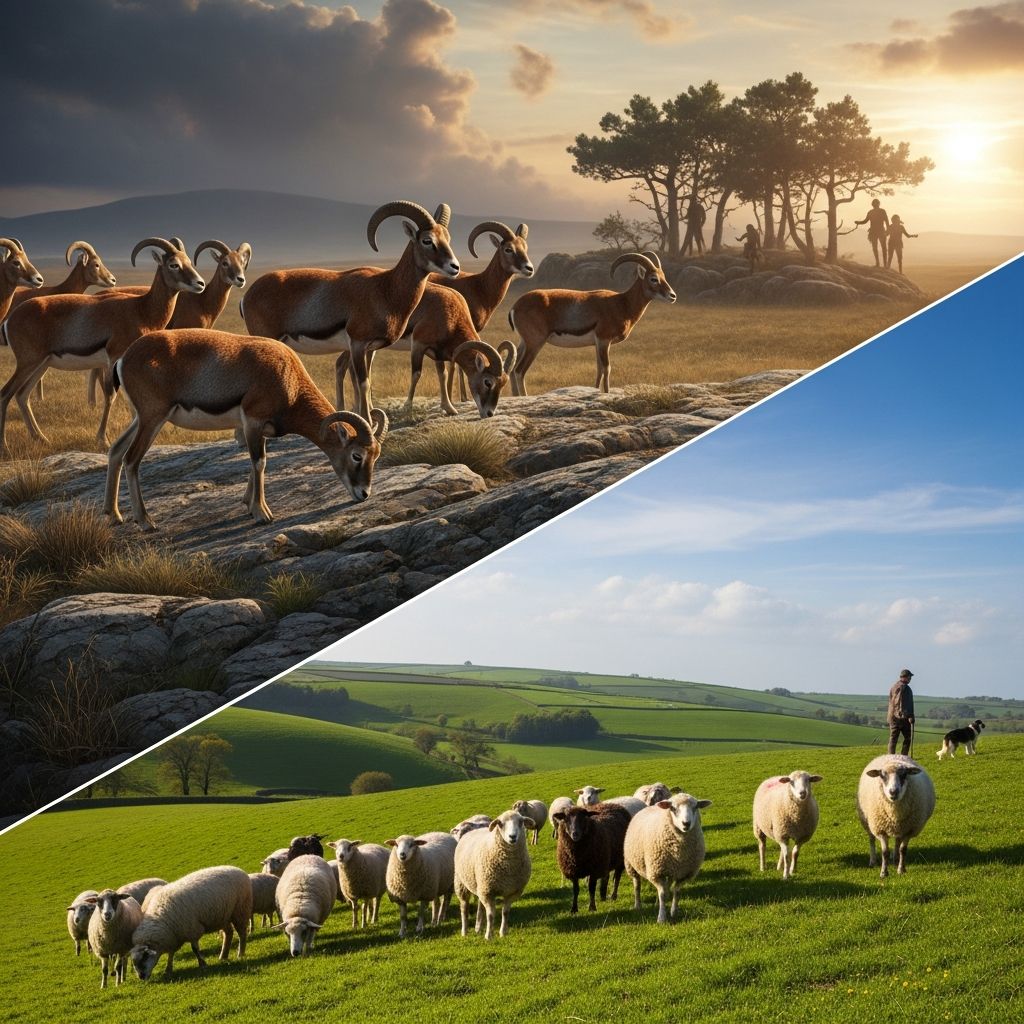
The domestication of sheep represents one of humanity’s most pivotal agricultural achievements, fundamentally altering the course of civilization. Unlike many modern farming practices that developed gradually, the transition from hunting wild sheep to maintaining controlled herds emerged during a critical period of human development when societies were transitioning from nomadic lifestyles to settled communities. This remarkable transformation occurred across thousands of years and multiple geographical regions, eventually creating the diverse breeds and productive animals we recognize today.
When Domestication First Occurred
Archaeological and genetic evidence points to a clear timeframe for the initial domestication of sheep. Sheep were domesticated approximately 11,000 to 9,000 years before the present era, placing this development squarely within the early Neolithic period. This timeline coincides with the broader Agricultural Revolution that transformed human societies across Southwest Asia, a region that served as the cradle for early civilization itself.
More precisely, recent paleogenomic research has identified a central Anatolian source for domestication, with evidence suggesting the process began around the ninth millennium BCE. Archaeological excavations at sites such as Aşıklı Höyük in central Turkey, dated to approximately 10,400 to 10,100 years ago, reveal compelling evidence of early sheep management. These discoveries demonstrate that the first farmers didn’t gradually domesticate sheep over centuries but rather implemented relatively rapid changes in animal husbandry practices.
Geographic Origins and Wild Ancestors
The geographical origin of domesticated sheep centers on a specific region that encompasses parts of modern-day Turkey, Iraq, and Iran. The primary wild ancestor of all modern domestic sheep is the Asiatic mouflon, a hardy wild species whose natural range extended from Turkey eastward to Iran. Understanding the mouflon is essential to comprehending sheep domestication, as these animals possessed the genetic and behavioral characteristics that made them suitable for domestication.
The Asiatic mouflon possessed distinctive physical features that differentiated it from domesticated sheep. These wild animals maintained a short-haired coat with a reddish-brown coloration and a bristly outer layer that did not naturally shed—characteristics quite different from the woolly coats we associate with modern sheep. This distinction becomes important when examining the selective breeding practices that later transformed sheep appearances and capabilities.
Recent genetic analysis has revealed that Central Anatolia, particularly the Cappadocian region in what is now central Turkey, likely served as the primary domestication center. However, scholars acknowledge that multiple domestication events may have occurred, as evidenced by the discovery of different mitochondrial lineages in modern sheep breeds. This suggests that while one major domestication center existed, secondary domestication processes may have transpired in other Southwest Asian regions or that different wild populations were independently brought under human control.
The Transition from Hunting to Herding
The pathway from wild sheep hunting to deliberate domestication represents a fascinating chapter in human behavioral and economic history. Evidence suggests that humans initially transitioned to controlled hunting and herd management in response to declining wild sheep populations caused by over-hunting. Rather than abandoning a depleted food resource, early communities innovatively adapted their practices, moving from pure predation to active management.
This progression occurred in distinct phases. Initially, humans may have penned wild sheep within or near their settlements, as archaeological evidence from Aşıklı Höyük suggests. Early farmers kept wild sheep in enclosures positioned in the middle of their villages, effectively creating the first domestication infrastructure. This practice allowed humans to control animal movements, regulate breeding patterns, and ensure reliable food supplies—revolutionary advantages over relying entirely on hunting.
As these management practices continued across generations, selective breeding naturally emerged. Humans unconsciously selected for animals that were easier to handle, more docile, and capable of thriving in captive conditions. Over time, these pressures led to morphological and behavioral changes that increasingly distinguished domestic sheep from their wild ancestors. The process demonstrates how human ingenuity transformed environmental necessity into technological advancement.
Purpose Evolution: From Meat to Specialized Products
The uses humans derived from sheep shifted dramatically throughout the domestication process and subsequent millennia. Initially, sheep were reared primarily for meat, providing essential protein to early communities. In the immediate post-domestication period spanning the early Neolithic, this remained the predominant function. However, as civilizations expanded and technologies advanced, sheep became increasingly valuable for alternative products.
A significant transformation occurred during what researchers term the “secondary products revolution.” During the fifth millennium BP in Southwest Asia and the fourth millennium BP in Europe, specialization for secondary products such as wool became increasingly apparent. This transition represented more than a simple shift in economic emphasis; it reflected developing technologies and changing social structures that could support specialized textile production.
Selective breeding for wool-producing capabilities accelerated around 6000 BCE, with deliberate efforts to develop sheep with improved fleece characteristics. Over subsequent centuries, breeders focused on obtaining white-fleeced sheep, a goal that became particularly emphasized in Mesopotamia around 3000 BCE. By the Bronze Age (2300-600 BCE), sheep with characteristics resembling modern breeds were widespread throughout Western Asia. These selective breeding programs created animals optimized for fiber production, milk, and continued meat provision.
Spread Across Continents and Cultural Integration
Following initial domestication in Southwest Asia, sheep populations expanded dramatically across multiple continents through human migration and trade networks. Domestic sheep began spreading to Europe around 6000 BCE, eventually reaching Scandinavia by 4000 BCE. This expansion followed the broader patterns of Neolithic agricultural diffusion as human populations migrated northward and westward, bringing their domestic animals and farming practices with them.
By approximately 6,000 years before present, agro-pastoralism had become the predominant food production system throughout prehistoric Europe, from Mediterranean regions northward to Britain, Ireland, and Scandinavia. This dramatic shift reshaped European societies, replacing hunter-gatherer economies with mixed agricultural-pastoral systems. Ancient sheep dispersed across Eurasia and Africa through distinct migratory episodes, creating populations that subsequently developed into recognizable breed groups.
In the Mediterranean region and beyond, sheep became economically and culturally central. By approximately 500 BCE in ancient Greece, sheep and wool production were sufficiently established to appear in written historical records. Roman writers including Virgil, Varro, and Columella documented sheep breeding processes and wool fabric production, even describing sheep farms that maintained herds numbering in the tens of thousands. This literary evidence confirms that sheep had become integral to classical Mediterranean civilizations.
Later Introduction to the Americas
The global expansion of domestic sheep continued into historical periods. Spanish conquistadors introduced sheep to the Americas beginning in 1493 when they arrived in Florida, followed by introductions to Mexico in 1519 and the Southwestern United States in 1540. These early Spanish introductions featured hardy Iberian Churra breeds specifically selected for their ability to thrive in challenging environments and produce multiple products including milk, meat, and wool.
These Iberian breeds became the foundation for sheep populations throughout Spanish colonial territories, eventually contributing to the diverse sheep populations found in the Americas today. The hardy characteristics of these Spanish breeds made them particularly suited to the varied climates and conditions they encountered during colonial expansion, ensuring their successful establishment in new territories.
Technological Developments Associated with Sheep
Sheep domestication facilitated numerous technological advances that extended far beyond animal husbandry itself. Humans didn’t learn to spin wool until approximately 3500 BCE, thousands of years after initial sheep domestication. This considerable time gap indicates that early domestication focused on meat and milk production, with textile technology emerging as a later development.
Once spinning technology emerged, it catalyzed the development of complex textile industries that became foundational to later civilizations. The ability to transform raw wool into usable fiber and subsequently into woven fabrics created new economic opportunities, trade networks, and cultural practices. Textile production became so significant that it shaped settlement patterns, occupational specialization, and international commerce patterns throughout the ancient world.
Multiple Domestication Events and Genetic Diversity
Modern genetic research has revealed that sheep domestication may not have occurred as a single, isolated event. Multiple domestication events, inferred through multiple mitochondrial lineages, likely gave rise to domestic sheep. This genetic complexity suggests that humans may have independently domesticated sheep populations in different locations, or that multiple waves of domestication occurred in the same general region using different wild populations.
The existence of multiple genetic lineages explains the considerable breed diversity observed in modern sheep. Ancient sheep breeds recognized for their “primitive” morphological characteristics, such as the Orkney, Soay, and Nordic short-tailed sheep, represent relicts of early migrations and domestication events. These breeds, now largely confined to the periphery of northwestern Europe, preserve genetic and morphological characteristics that reflect ancient domestication processes.
Importance to Civilization
Sheep domestication occupies a unique position in human history as one of the transformative events that enabled complex civilization. Sheep and goats were the first livestock species to be domesticated, preceding cattle and other domesticated animals. This pioneering status makes sheep central to understanding how humans transitioned from hunter-gatherer societies to settled agricultural communities.
Sheep production was sufficiently established by Biblical times that numerous Old Testament references confirm their central role in ancient Middle Eastern societies. These literary references provide cultural documentation of sheep’s integration into daily life, religious practice, and economic systems. The prominence of sheep in ancient texts reflects their fundamental importance to human civilization at that historical moment.
Key Characteristics of Sheep Domestication
- Timeline: 11,000 to 9,000 years before present, with specific evidence from 10,400 to 10,100 years ago
- Geographic origin: Central Anatolia, particularly the Cappadocian region of modern-day Turkey
- Wild ancestor: The Asiatic mouflon, with range extending from Turkey to Iran
- Initial purpose: Meat production, later expanded to wool, milk, and fiber
- Domestication mechanism: Controlled hunting leading to penning, herd management, and selective breeding
- Expansion pattern: Dispersal across Europe (6000 BCE), Scandinavia (4000 BCE), and later to Americas (1493 CE onward)
- Textile development: Spinning technology emerged around 3500 BCE, thousands of years after initial domestication
Frequently Asked Questions About Sheep Domestication
Q: Why were sheep domesticated before other livestock species?
A: Sheep were domesticated first partly due to their availability in Southwest Asian regions and their suitability for domestication. Environmental pressures, particularly declining wild populations from overhunting, motivated communities to develop management strategies. Additionally, sheep’s behavioral characteristics and size made them more manageable than larger animals like cattle.
Q: How did wild mouflon differ from modern domestic sheep?
A: Wild mouflon possessed short-haired coats with reddish-brown coloration and bristly outer layers that didn’t shed naturally. Modern domestic sheep, particularly wool breeds, have woolly coats resulting from thousands of years of selective breeding. This transformation represents one of humanity’s most successful breeding programs.
Q: Did sheep domestication happen in multiple locations simultaneously?
A: While Central Anatolia appears to be the primary domestication center, genetic evidence suggests multiple domestication events likely occurred, either in different Southwest Asian locations or through waves of domestication using different wild populations. This complexity explains the genetic diversity in modern sheep breeds.
Q: When did humans begin using sheep for wool production?
A: Initial domestication focused on meat production. Selective breeding for wool characteristics began around 6000 BCE, with systematic efforts to develop white-fleeced varieties emerging around 3000 BCE in Mesopotamia. Spinning technology enabling wool processing developed later, around 3500 BCE.
Q: How did sheep reach the Americas?
A: Spanish conquistadors introduced sheep to the Americas starting in 1493 in Florida, followed by Mexico in 1519 and the Southwestern United States in 1540. These introductions featured hardy Iberian Churra breeds selected for their ability to thrive in diverse climates and produce meat, milk, and wool.
References
- Revealing the History of Sheep Domestication Using Endogenous Retroviruses — National Center for Biotechnology Information (NCBI). 2011. https://www.ncbi.nlm.nih.gov/pmc/articles/PMC3145132/
- Heritage Sheep in American History — The Livestock Conservancy. 2026-02-17. https://livestockconservancy.org/
- Population History of Domestic Sheep Revealed by Paleogenomes — Oxford University Press, Molecular Biology and Evolution. 2024. https://academic.oup.com/mbe/article/41/10/msae158/7826489
- History of Sheep: Learn About the Origins of Sheep — International Wool Textile Organization (IWTO). https://iwto.org/sheep-wool/history-of-sheep/
- Sheep in History — Sheep 101. https://www.sheep101.info/history.html
- Sheep: How We Got Here — The Open Sanctuary Project. https://opensanctuary.org/sheep-how-we-got-here/
- The Middle Eastern Origins of Sheep — Biblical Archaeology Society. https://www.biblicalarchaeology.org/daily/ancient-cultures/ancient-near-eastern-world/the-middle-eastern-origins-of-sheep/
- How Sheep Became Livestock — Science Magazine, American Association for the Advancement of Science. https://www.science.org/content/article/how-sheep-became-livestock

Medha Deb is an editor with a master's degree in Applied Linguistics from the University of Hyderabad. She believes that her qualification has helped her develop a deep understanding of language and its application in various contexts. Medha specializes in the areas of beauty, health, sports, and wellness and is committed to ensuring that the content on the website is…