
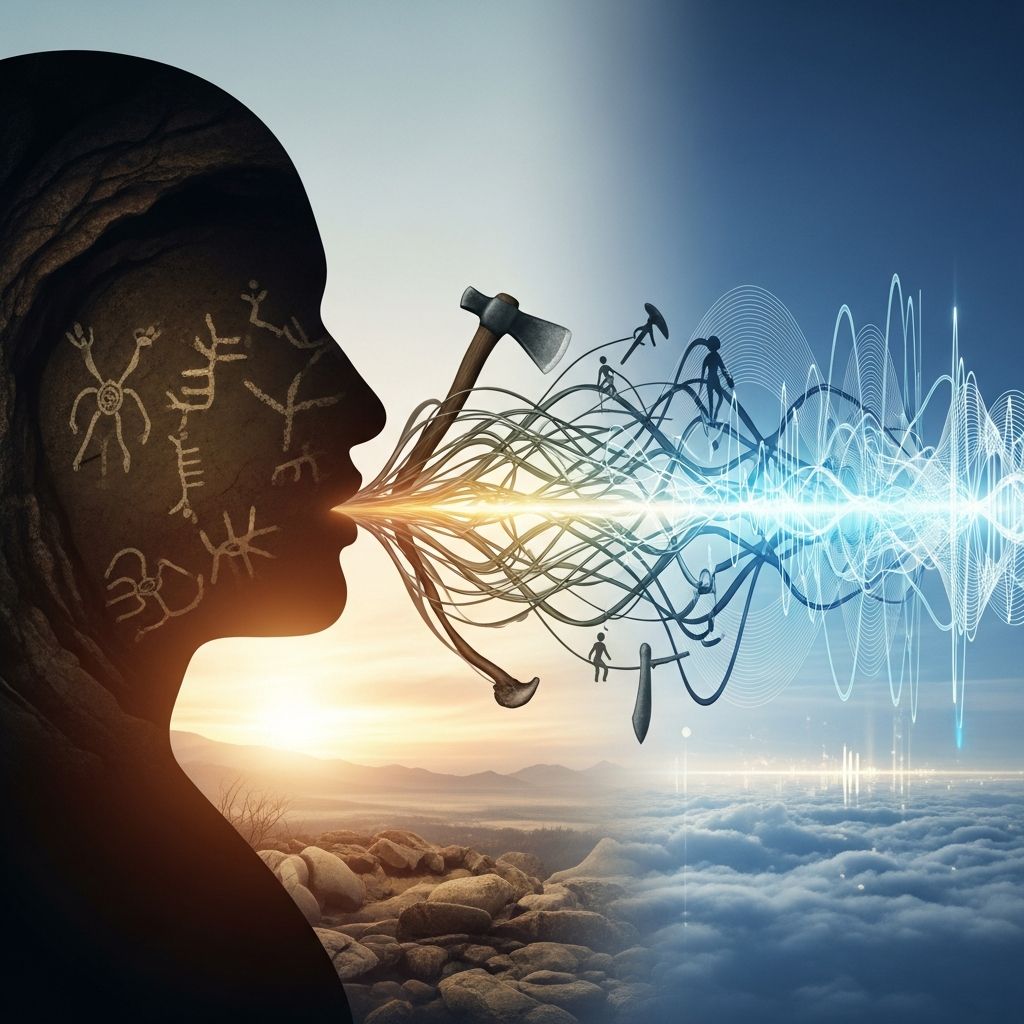
Human language stands as one of the most remarkable achievements in our evolutionary history, enabling complex thought, social bonding, and cultural transmission. Unlike any other species, our capacity for symbolic communication through structured sounds, gestures, and grammar defines us. But how did this intricate system arise? Scientists draw from genetics, archaeology, neuroscience, and comparative biology to piece together its story, revealing a gradual process intertwined with brain development, social needs, and environmental pressures.
The Evolutionary Timeline of Language Capacity
Pinpointing when humans first wielded language remains challenging due to the absence of direct fossils for speech. However, genomic studies provide compelling clues. Research indicates that the cognitive foundation for modern human language existed at least 135,000 years ago, coinciding with early divergences in Homo sapiens populations. This timeline aligns with the species’ emergence around 230,000 years ago, suggesting language capacity predated widespread geographic spread.
Archaeological evidence supports this, showing symbolic behaviors—like ochre processing and meaningful engravings—emerging around 100,000 years ago. These innovations likely stemmed from language-facilitated learning and idea-sharing, marking a shift to “modern human behavior.” Earlier proposals push origins further back; some linguists argue language traces to Homo erectus, approximately 1.5 to 2 million years ago, based on tool complexity and social structures implying proto-communication.
| Proposed Timeline | Key Evidence | Supporting Species |
|---|---|---|
| 1.5-2 million years ago | Tool use, social coordination | Homo erectus |
| 135,000 years ago | Genomic divergence, cognitive capacity | Homo sapiens |
| 100,000 years ago | Symbolic artifacts, behavioral modernity | Homo sapiens |
Gesture-First: From Hands to Words
One prominent theory posits that language began with manual gestures, evolving from primate communication systems. The mirror system hypothesis, pioneered by neuroscientists, links language to brain mechanisms for observing and imitating actions. Mirror neurons, first identified in monkeys, fire both when performing and watching movements, laying groundwork for shared understanding.
Michael Arbib’s work extends this: complex hand gesture imitation for skill-sharing predated speech, enabling proto-sign languages. Grasping tools or demonstrating techniques fostered social learning, richer than primate calls or points. Over time, these visual signals may have incorporated vocalizations, transitioning to spoken language as bipedalism freed hands and environmental demands favored auditory channels.
- Advantages of gestures: Visible in daylight, precise for object reference, supported by existing primate behaviors.
- Transition to speech: Vocal grooming or emotional calls supplemented gestures, eventually dominating for efficiency in low-light or distant communication.
Speech-First Perspectives: Vocal Roots of Communication
Contrasting views emphasize innate vocal abilities. Proponents argue speech emerged first, leveraging pre-existing mammalian vocalizations for social cohesion. Robin Dunbar’s “grooming and gossip” hypothesis suggests language evolved from vocal grooming signals, strengthening large group bonds beyond physical touch limits.
Physiological evidence points to vocal tract adaptations in Homo sapiens, but earlier hominins like Homo erectus showed similar descent, hinting at proto-speech capabilities. Critics note gestures’ primacy in infant development and ape signing experiments, yet speech’s current dominance—spanning 7,000+ languages—suggests evolutionary favoritism for auditory speed and simultaneity.
Neurological Foundations and Mirror Systems
At language’s core lies brain evolution. The mirror system, evolving for action recognition, underpinned communication. In humans, this expanded into Broca’s area, vital for speech production and comprehension, originally tied to hand control. Grammar likely arose next, combining words into phrases for nuanced descriptions—e.g., distinguishing a stalking leopard from a sleeping one enhances survival.
Charles Darwin speculated language grew from natural and sexual selection, akin to birdsong learning. Infants’ babbling mirrors this, experimenting with sounds until meaningful patterns emerge. Modern neuroscience confirms: language engages whole-brain networks, blending biology and culture.
Proto-Language to Full Grammar: Building Complexity
Early communication likely formed a “protolanguage”—holistic utterances lacking syntax, similar to some primate calls. Grammar’s emergence allowed infinite expression via rules, revolutionizing thought. PNAS research outlines this progression: from single words naming objects/actions to syntactic combinations conveying relations.
This mirrors child language acquisition, where basic rules form rapidly. Cultural evolution accelerated diversity; all human groups branched with language, implying a shared ancient root.
Animal Precursors and Comparative Insights
Non-human primates offer glimpses: chimpanzees gesture meaningfully (e.g., play bows), and birds/vocal learners like parrots mimic with intent. Yet none achieve recursive grammar or displacement (referring to absent events). These vestiges suggest language built on conserved traits, uniquely amplified in humans.
- Chimpanzees: 60+ gestures with learned meanings.
- Parrots: Contextual phrase use, but no novel syntax.
- Implication: Humans extended imitation into symbolic systems.
- Language: Its Origin and Ongoing Evolution — PMC (National Library of Medicine). 2023-04-28. https://pmc.ncbi.nlm.nih.gov/articles/PMC10142271/
- When did human language emerge? — MIT News. 2025-03-14. https://news.mit.edu/2025/when-did-human-language-emerge-0314
- How Speech Began — National Endowment for the Humanities. N/A. https://www.neh.gov/article/how-speech-began
- The evolution of language — PNAS. 1999-07-06. https://www.pnas.org/doi/10.1073/pnas.96.14.8028
- The origin of language — Darwin Correspondence Project. N/A. https://www.darwinproject.ac.uk/commentary/human-nature/origin-language
- Integrated M.A. in Applied Linguistics, University of Hyderabad
- 5+ years in editorial, instructional, SEO, and research-based writing
Historical Theories and Philosophical Debates
Eighteenth-century thinkers like Johann Herder rejected divine origins, proposing vocal imitation of nature as language’s spark. Shared environments made mimicry mutually intelligible. Max Müller envisioned a monogenetic origin from Proto-Indo-European, a “Rubicon” separating humans from beasts.
Today, debates persist: sudden “miracle” (Chomsky) vs. gradual evolution. Genomic and fossil data favor incrementality, with cognitive readiness preceding social use.
Modern Implications: Language in a Digital Age
Language continues evolving, blending with technology—emojis as neo-gestures, AI translation bridging divides. Understanding origins informs AI development and conservation of endangered tongues, preserving humanity’s legacy.
Frequently Asked Questions (FAQs)
What is the earliest evidence for human language?
Genomic data suggests cognitive capacity by 135,000 years ago, with symbolic artifacts at 100,000 years ago.
Did language start with gestures or speech?
The gesture-first hypothesis, backed by mirror neuron research, argues hands preceded voice; speech-first views emphasize vocal dominance.
Can animals use language?
Animals communicate complexly but lack full human grammar and recursion; precursors exist in gestures and calls.
How did grammar evolve?
From protolanguage words to syntactic rules combining elements for richer meaning, driven by survival needs.
Is there a single origin for all languages?
Evidence points to a common human capacity, with diversification post-135,000 years ago.
References

Sneha is a relationships and lifestyle writer with a strong foundation in applied linguistics and certified training in relationship coaching. She brings over five years of writing experience to theskillvault, crafting thoughtful, research-driven content that empowers readers to build healthier relationships, boost emotional well-being, and embrace holistic living. Her writing and insights reflect the belief that beauty, happiness, and wellness…