
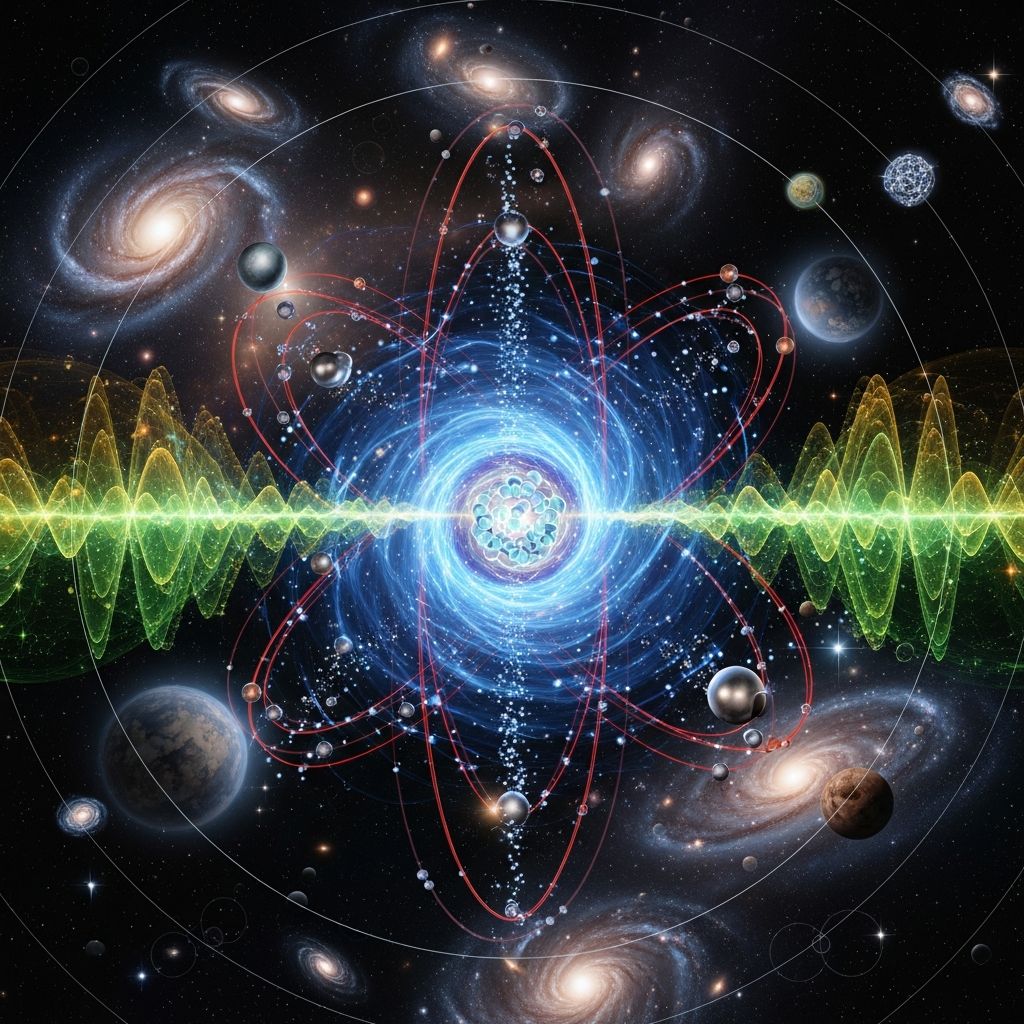
The universe operates under a set of basic rules defined by four fundamental forces that dictate how matter and energy interact at every scale. These forces—gravity, electromagnetism, the strong nuclear force, and the weak nuclear force—are the building blocks of all physical phenomena, from the orbits of planets to the stability of atomic nuclei.
Understanding the Core Interactions
Physicists have long sought to explain the myriad interactions we observe through these irreducible forces. Each force is mediated by specific particles called bosons, which act as carriers facilitating exchanges between matter particles. While gravity shapes the large-scale structure of the cosmos, the other three forces dominate at the microscopic level, ensuring the integrity of atoms and enabling processes like nuclear fusion in stars.
In the Standard Model of particle physics, three of these forces are elegantly described, with gravity standing somewhat apart as it awaits full integration into quantum theory. This framework reveals how quarks and leptons, the fundamental constituents of matter, respond to these interactions.
Gravity: The Universal Attractor
Gravity is the force we experience most directly, pulling objects toward each other with a strength proportional to their masses and inversely proportional to the square of the distance between them. It governs the motion of planets, stars, and galaxies, keeping Earth in orbit around the Sun.
Unlike the other forces, gravity is always attractive and acts over infinite distances, though its effects weaken rapidly. It is the weakest of the four, yet pervasive because it cannot be shielded and accumulates over large masses. Described by Einstein’s general relativity, gravity is understood as the curvature of spacetime caused by mass and energy.
- Mediator: Hypothetical graviton (massless, spin-2 boson, not yet observed).
- Range: Infinite.
- Relative Strength: 1 (weakest).
Without gravity, stars would not form, and the universe would expand unchecked after the Big Bang.
Electromagnetism: The Force of Light and Matter
Electromagnetism unifies electricity and magnetism, manifesting as forces between charged particles. It follows Coulomb’s law for static charges and extends to dynamic fields via the Lorentz force law. This force powers chemistry, holds electrons in atoms, and produces light, radio waves, and all electromagnetic radiation.
Photons, massless bosons, mediate this infinite-range force, which can be attractive (opposite charges) or repulsive (like charges). It is about 10^36 times stronger than gravity but cancels out in neutral matter, making its macroscopic effects subtle except in charged or polarized systems.
| Property | Electromagnetism | Gravity |
|---|---|---|
| Mediator | Photon | Graviton (predicted) |
| Range | Infinite | Infinite |
| Strength (relative to strong force) | ~1/137 | ~10^-38 |
Quantum electrodynamics (QED) provides a precise theory for electromagnetism, verified to extraordinary accuracy.
The Strong Nuclear Force: Binding the Atom’s Heart
The strong nuclear force is the most powerful interaction, approximately 100 times stronger than electromagnetism and vastly exceeding gravity. It operates only over extremely short distances, about 10^-15 meters—the size of atomic nuclei—holding quarks together inside protons and neutrons, and binding those nucleons into stable nuclei.
Unique among the forces, its strength increases as particles approach each other, peaking at maximum separation within its tiny range, then dropping sharply. Gluons, massless bosons carrying ‘color charge,’ mediate this force between quarks via quantum chromodynamics (QCD). The residual strong force between nucleons is carried by pions.
- Key Role: Overcomes proton repulsion in nuclei; powers nuclear fusion and fission.
- Range Limitation: Uncertainty principle restricts it due to massive exchange particles or confinement.
This force accounts for nearly all visible mass in the universe, as quark binding energy dominates nucleon mass.
The Weak Nuclear Force: Master of Transformation
The weak nuclear force mediates processes changing particle types, such as quark flavor changes leading to radioactive beta decay. Mediated by massive W and Z bosons (around 80-90 GeV/c²), its range is minuscule, about 10^-18 meters, dictated by the uncertainty principle.
Responsible for solar fusion—converting protons to neutrons—and stellar nucleosynthesis, it enables the creation of heavier elements. Weaker than the strong and electromagnetic forces but crucial for cosmic evolution.
In the electroweak theory, it unifies with electromagnetism at high energies, with W and Z bosons acquiring mass via the Higgs mechanism.
Comparing the Fundamental Forces
Each force has distinct properties, as summarized below:
| Force | Mediator | Relative Strength | Range | Main Role |
|---|---|---|---|---|
| Strong | Gluon | 1 (strongest) | 10^-15 m | Nuclear binding |
| Electromagnetic | Photon | 10^-2 | Infinite | Atomic structure, light |
| Weak | W, Z bosons | 10^-6 | 10^-18 m | Particle decay, fusion |
| Gravity | Graviton? | 10^-38 | Infinite | Planetary motion, cosmology |
Strengths are approximate, normalized at nuclear scales; they vary by distance.
Unified Theories and Future Prospects
Grand Unified Theories (GUTs) propose merging the strong, weak, and electromagnetic forces at ultra-high energies, while quantum gravity efforts like string theory aim to include all four. Experiments at CERN and gravitational wave detectors probe these frontiers.
Speculation about a fifth force persists, but evidence remains elusive.
Frequently Asked Questions (FAQs)
What are the four fundamental forces?
The four fundamental forces are gravity, electromagnetism, the strong nuclear force, and the weak nuclear force.
Which force is the strongest?
The strong nuclear force is the strongest, binding quarks and nucleons.
Why is gravity so weak compared to others?
Gravity’s weakness may stem from extra dimensions or diluted effects in quantum regimes, per theories like string theory.
How do force carriers work?
Bosons like photons and gluons are exchanged between particles, transferring momentum and force.
Can forces be unified?
Electroweak unification succeeded; full unification including gravity remains a goal.
Everyday Impacts of Fundamental Forces
Gravity keeps us grounded; electromagnetism enables technology from smartphones to MRI machines; strong force powers nuclear energy; weak force drives the Sun’s energy. Understanding them unlocks advancements in energy, medicine, and space exploration.
These forces interplay: electromagnetic repulsion challenges nuclei, countered by strong force; weak force enables change where strong force binds.
References
- The Four Fundamental Forces of Nature — Space.com. 2023-10-25. https://www.space.com/four-fundamental-forces.html
- Fundamental Forces — HyperPhysics, Georgia State University. 2024-01-15. http://hyperphysics.phy-astr.gsu.edu/hbase/Forces/funfor.html
- Fundamental Interaction — Wikipedia (informed by primary sources). 2026-04-01. https://en.wikipedia.org/wiki/Fundamental_interaction
- Four Fundamental Forces — Khan Academy. 2023-11-10. https://www.khanacademy.org/science/grade-9-physics-snc-aligned/x9650cb4941ab1ab5:kinematics/x9650cb4941ab1ab5:types-of-forces/v/four-fundamental-forces
- The Four Fundamental Forces of Nature – Origin & Function — YouTube (Arvin Ash channel). 2022-05-15. https://www.youtube.com/watch?v=669QUJrF4u0
- Forces — NASA Science. 2024-03-20. https://science.nasa.gov/universe/overview/forces/
- Deep Dive into the Known Forces — Fermilab (YouTube). 2023-07-12. https://www.youtube.com/watch?v=NwbsffunM10

- Integrated M.A. in Applied Linguistics, University of Hyderabad
- 5+ years in editorial, instructional, SEO, and research-based writing
Sneha is a relationships and lifestyle writer with a strong foundation in applied linguistics and certified training in relationship coaching. She brings over five years of writing experience to theskillvault, crafting thoughtful, research-driven content that empowers readers to build healthier relationships, boost emotional well-being, and embrace holistic living. Her writing and insights reflect the belief that beauty, happiness, and wellness…