
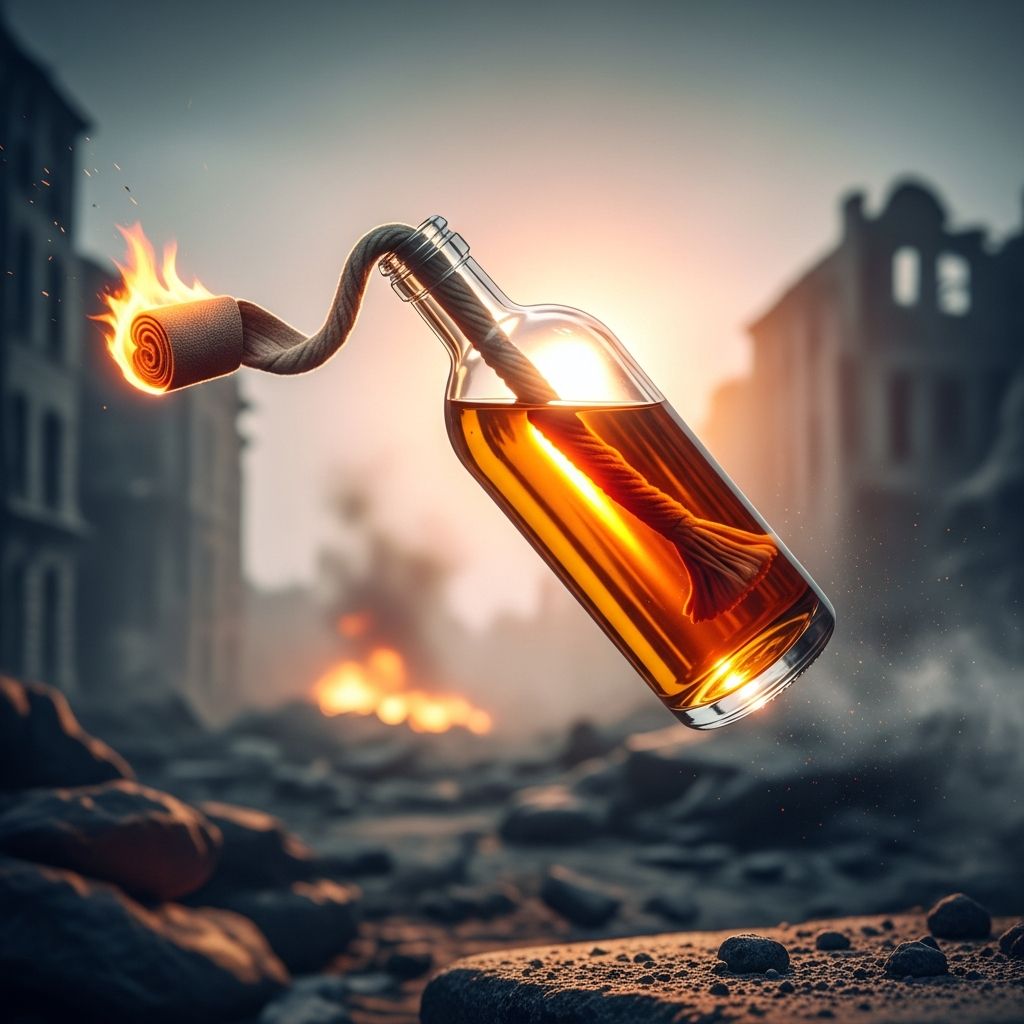
Understanding Improvised Incendiary Devices in Armed Conflict
Throughout military history, combatants facing superior firepower have developed unconventional weapons to level the playing field. Among the most enduring and recognizable of these improvised devices is the firebomb known as the Molotov cocktail—a bottle filled with flammable liquid and fitted with an ignition mechanism. This deceptively simple weapon has played a significant role in numerous conflicts spanning nearly a century, from civil wars to major military campaigns, fundamentally demonstrating how resourcefulness and desperation can produce effective military tools.
The Molotov cocktail represents more than just a tactical weapon; it embodies a broader narrative about asymmetrical warfare, civilian resistance, and the democratization of military capability. Its relatively low cost and ease of manufacture have made it accessible to poorly equipped fighters, revolutionaries, and civilian populations defending their territories. Understanding this weapon requires examining not only its technical specifications but also its cultural significance and the historical circumstances that gave it prominence.
Early Origins: Before Official Recognition
While the Molotov cocktail is most commonly associated with later twentieth-century conflicts, historical records indicate that bottle-based incendiary weapons emerged earlier than many realize. The documented use of such devices traces back to 1922, when the Irish Republican Army employed bottles filled with petrol and paraffin as weapons during their struggle for independence. These early iterations represented experimentation with improvised explosive devices by organized military units, establishing a precedent for future development.
The transition from isolated experimental use to widespread tactical deployment occurred during the Spanish Civil War, which erupted in 1936. Francisco Franco’s Nationalist forces, equipped with modern German and Italian military hardware including tanks, faced Republican forces backed by Soviet weapons and volunteers. During this conflict, Nationalist soldiers discovered that bottle-based incendiary devices could effectively target Soviet-supplied tanks operating in support of the Republican side. This discovery proved pivotal, as it demonstrated the weapon’s practical military value against heavily armored vehicles—a revelation that would reverberate through subsequent conflicts.
The Winter War and Christening of a Weapon
Although bottle bombs existed before 1939, the Finnish-Soviet Winter War provided the context for the weapon’s official naming and emergence as a recognized military tool. On November 30, 1939, the Soviet Union invaded Finland, initiating a conflict that would last approximately 100 days and capture international attention. The Finns, vastly outnumbered and outgunned, required innovative defensive strategies to resist Soviet mechanized forces.
The naming of the weapon originated from an act of rhetorical spin by Soviet foreign minister Vyacheslav Molotov. As Soviet aircraft conducted bombing campaigns across Finland, Molotov made the controversial claim that these bombing runs were actually delivering food supplies to the Finnish population, referring to them as “food parcels.” This transparent propaganda attempt became the source of dark humor among Finnish defenders, who began sarcastically referring to their bottle-based incendiary weapons as “Molotov cocktails”—drinks to accompany the supposed “food packages” from the Soviet Union.
The Finnish military quickly recognized the effectiveness of these devices against Soviet armor and infrastructure. Documentation reveals that Finnish manufacturers, particularly workers at the State Liquor Factory in Rajamäki, produced Molotov cocktails on an industrial scale. According to historical records, approximately 92 workers labored intensively to hand-craft over 540,000 Molotov cocktails during the Winter War, with this production credited with destroying roughly 350 Soviet tanks and vehicles.
Technical Refinements and Composition Advances
The Finns elevated the Molotov cocktail from a crude improvisation to a sophisticated incendiary device through systematic experimentation and refinement. Initial versions employed relatively simple compositions, but Finnish engineers discovered that specific fuel mixtures produced superior results. The refined Finnish formula consisted of a combination of alcohol, kerosene, tar, and potassium chlorate—a sticky, carefully calibrated mixture designed for maximum effect.
Innovation extended beyond fuel composition to ignition mechanisms. Early versions relied on pre-lit fuses or cloth wicks, creating risks for the person deploying the weapon. Finnish engineers addressed this vulnerability by incorporating chemical ignition systems, specifically ampules of sulfuric acid attached to the bottle’s exterior. Upon impact, the ampule would break, triggering spontaneous ignition without requiring advance preparation.
Additional refinements included:
- Careful selection of bottle types—one-liter vodka bottles proved ideal for Finnish production due to their availability and structural properties
- Strategic bottle design modifications, including vertical scoring to ensure breakage upon impact
- Precise volumetric calibration, leaving approximately one-third of the bottle empty to maximize breakage probability
- Later evolution toward even more specialized compositions, such as formulas incorporating white phosphorus, benzene, and raw rubber in crown-stoppered half-pint bottles
Widespread Adoption During World War II
The demonstrated effectiveness of Molotov cocktails during the Winter War prompted several nations to develop their own versions during World War II. Britain, particularly concerned about potential German invasion following the fall of France, established production protocols for Molotov cocktails. By August 1940, the British War Office had generated formal training instructions for manufacturing and deploying these devices, distributing them to Home Guard units responsible for civilian defense.
British instructions recommended specific manufacturing techniques, including scoring bottles vertically with diamonds to ensure predictable breakage patterns and utilizing fuel-soaked rags, windproof matches, or highly flammable cinema film as ignition sources. Nazi Germany, the Soviet Union, and Sweden similarly incorporated Molotov cocktails into their military arsenals, recognizing the weapon’s value in anti-tank and urban combat scenarios.
The widespread standardization of Molotov cocktail production represented a significant shift in military thinking. What began as an improvised weapon born from necessity evolved into an officially recognized armament produced under government sanction. This transition reflected military establishments’ acknowledgment that asymmetrical warfare tools possessed legitimate tactical applications.
The Hungarian Uprising and Civilian Resistance
The Hungarian Uprising of 1956 represents perhaps the most iconic deployment of Molotov cocktails in popular consciousness and military history. When Soviet forces invaded Hungary to suppress anti-communist rebellion, Budapest’s civilian population and resistance fighters faced overwhelming mechanized military power with minimal conventional armaments. In this desperate situation, Molotov cocktails emerged as the primary defensive tool available to popular resistance movements.
The symbolism proved as powerful as the weapon’s physical impact. Photographs of Hungarian freedom fighters hurling gasoline-filled bottles at massive Soviet “Stalin” tanks circulated globally, capturing Western imagination and representing asymmetrical resistance against authoritarian military force. By the time Soviet forces suppressed the uprising, Hungarian resistance had destroyed approximately 400 Soviet tanks and armored vehicles, with Molotov cocktails and similar improvised devices accounting for roughly three-quarters of these losses.
The Hungarian experience cemented the Molotov cocktail’s reputation as the “poor man’s anti-tank missile” and the “great equalizer of urban warfare.” For approximately seven decades following the Spanish Civil War, this humble incendiary device remained the most effective tool available to poorly equipped combatants facing superior military forces.
Modern Conflict Applications and Evolution
Contemporary military forces have continued employing Molotov cocktails and variations thereof in modern conflicts. During the Second Battle of Fallujah in 2004, United States Marines deployed homemade incendiary devices specifically formulated from laundry detergent and gasoline while conducting house-to-house clearing operations against guerrilla fighters. This adaptation illustrated how even technologically advanced militaries occasionally employ improvised incendiary tactics when facing unconventional adversaries in urban environments.
The persistence of Molotov cocktails across nearly a century of military history demonstrates their fundamental utility in specific tactical scenarios. Modern tactical doctrines increasingly recognize that asymmetrical conflicts and urban warfare environments create situations where improvised or unconventional weapons retain relevance despite technological advancement.
Composition Variations and Technical Specifications
| Historical Period | Primary Components | Ignition Method | Deployment Context |
|---|---|---|---|
| Spanish Civil War (1936) | Petrol, alcohol | Pre-lit cloth fuse | Anti-tank operations |
| Winter War (1939-1940) | Alcohol, kerosene, tar, potassium chlorate | Sulfuric acid ampule | Anti-tank and infrastructure destruction |
| World War II (British) | Resin, petrol, tar | Windproof matches, cinema film | Anti-invasion defense |
| Hungarian Uprising (1956) | Gasoline-based formulas | Various methods | Anti-tank urban resistance |
| Modern Conflicts (2000s) | Laundry detergent, gasoline | Various | Urban warfare, structural fires |
Cultural and Symbolic Significance
Beyond their technical military specifications, Molotov cocktails have acquired substantial cultural and symbolic meaning in twentieth and twenty-first century conflicts. They represent popular resistance against overwhelming force, civilian defiance in the face of invasion, and the resourcefulness of underdogs facing superior opponents. The weapon’s association with freedom fighters, revolutionaries, and civilian populations has embedded it in popular culture, historical memory, and political symbolism.
The nomenclature itself—specifically naming the weapon after a Soviet official in the context of Soviet aggression—represents a form of rhetorical resistance. By appropriating Molotov’s name and transforming it into a weapon’s designation, Finnish soldiers transformed propaganda into a tool for popular mockery and psychological resistance.
Manufacturing Scale and Industrial Production
The transition from improvised weapons to factory-produced military hardware during World War II represented a significant development in Molotov cocktail history. What had begun as makeshift creations by individual fighters or small units evolved into systematized production under government authority. The Finnish case exemplifies this industrial scaling, with nearly 100 workers producing over half a million units during the Winter War alone.
This mass production capability reflected several factors: the weapon’s recognized military value, the relative simplicity of manufacturing processes, the availability of necessary materials, and the strategic imperative of arming civilian populations and military units with defensive capabilities. The accessibility of petroleum products, glass bottles, and chemical agents meant that nations could rapidly establish production facilities without requiring specialized infrastructure or exotic materials.
Historical Impact and Military Assessment
Historical analysis consistently demonstrates that Molotov cocktails achieved significant military effects in multiple conflicts, particularly during the Winter War and Hungarian Uprising. The destruction of hundreds of tanks and armored vehicles through these relatively simple devices validated their tactical utility and influenced military thinking regarding unconventional weapons and asymmetrical warfare.
Military historians generally acknowledge that the widespread adoption of Molotov cocktails during World War II represented an important development in recognizing improvised weapons as legitimate military tools worthy of standardization, training, and official deployment. This recognition challenged traditional military hierarchies that had previously dismissed improvised weapons as desperate measures unworthy of professional military consideration.
Common Questions About Molotov Cocktails
Q: How did the Molotov cocktail receive its name?
A: The weapon was named after Vyacheslav Molotov, Soviet foreign minister during World War II, who claimed Soviet bombing runs over Finland were actually delivering food supplies. Finnish defenders sarcastically called their incendiary bottles “Molotov cocktails”—drinks to accompany the supposed food deliveries.
Q: When were Molotov cocktails first used in combat?
A: While documented bottle-based incendiary weapons emerged in 1922 with the Irish Republican Army, the first organized military deployment occurred during the Spanish Civil War in 1936, when Nationalist forces used them against Soviet-supplied Republican tanks.
Q: How effective were Molotov cocktails against tanks?
A: Historical records demonstrate substantial effectiveness. During the Winter War, approximately 350 Soviet vehicles were destroyed; during the Hungarian Uprising, roughly 400 Soviet tanks were destroyed with Molotov cocktails accounting for approximately 75 percent of these losses.
Q: Which nations produced Molotov cocktails during World War II?
A: Finland, Nazi Germany, the Soviet Union, Sweden, and Britain all manufactured Molotov cocktails under government authority during World War II, reflecting widespread recognition of their tactical value.
Q: How did Finnish manufacturers improve Molotov cocktails?
A: The Finns refined fuel composition by combining alcohol, kerosene, tar, and potassium chlorate into a sticky mixture, replaced cloth fuses with sulfuric acid ampules for reliable ignition, and strategically designed bottles to maximize breakage upon impact.
References
- Molotov Cocktail: The Fiery History Of The ‘Bottle Bomb’ — All That’s Interesting. https://allthatsinteresting.com/molotov-cocktail
- How did ‘Molotov cocktails’ get their name? — Live Science. https://www.livescience.com/molotov-cocktails-history
- Molotov cocktail — Wikipedia. https://en.wikipedia.org/wiki/Molotov_cocktail
- Molotov Cocktail — Russia in Global Perspective, Harvard University. https://russiaglobal.omeka.fas.harvard.edu/exhibits/show/objects/politics/molotov
- What is a Molotov cocktail? — HistoryExtra. https://www.historyextra.com/period/modern/molotov-cocktail-history/
- History of the Molotov Cocktail — WFYI. https://media.wfyi.org/fireandice/history/molotov_cocktail.htm
- The History of the Molotov Cocktail | Defending Europe — National Geographic UK. September 17, 2024. https://www.youtube.com/watch?v=0cpTW4vf-W0

Medha Deb is an editor with a master's degree in Applied Linguistics from the University of Hyderabad. She believes that her qualification has helped her develop a deep understanding of language and its application in various contexts. Medha specializes in the areas of beauty, health, sports, and wellness and is committed to ensuring that the content on the website is…