
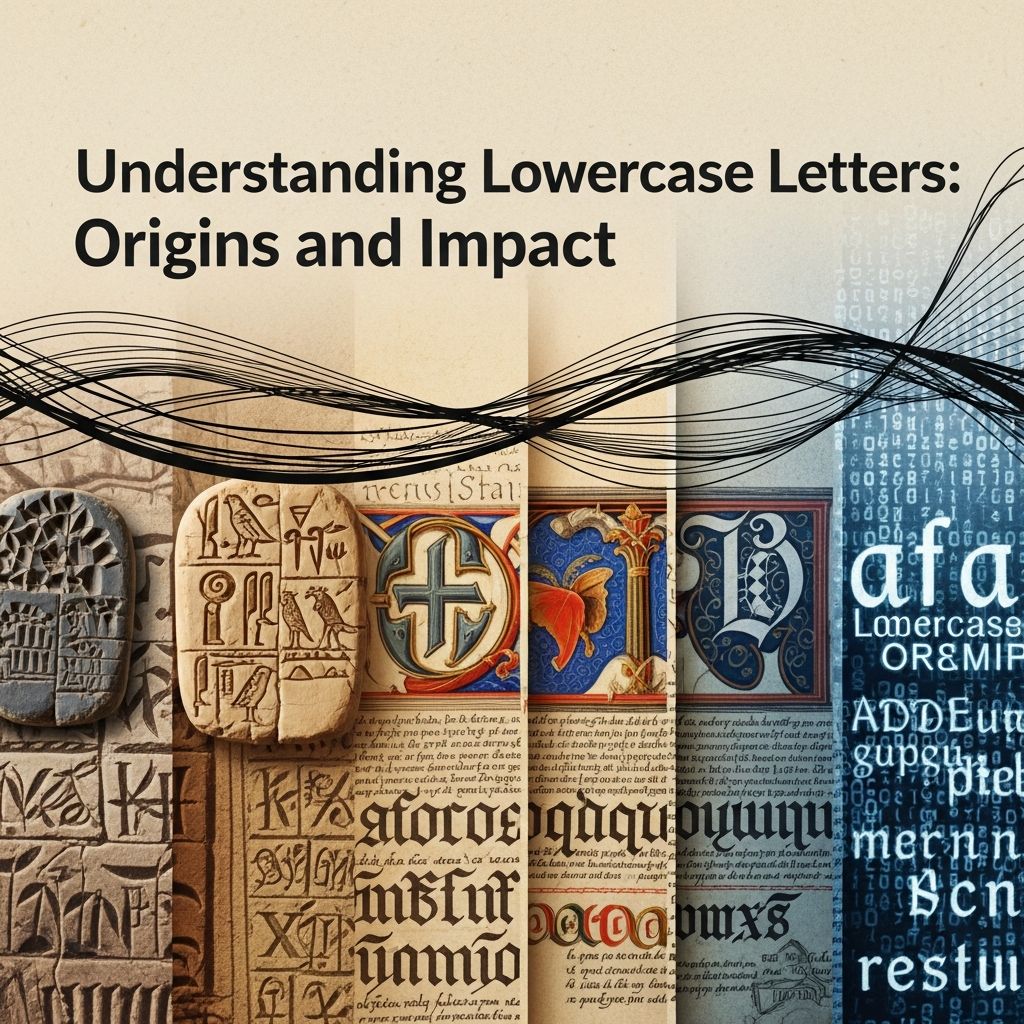
Lowercase letters form the backbone of everyday writing, enabling fluid readability and efficient communication across languages. These smaller letterforms, distinct from their uppercase counterparts, emerged through centuries of scribal innovation and printing advancements, fundamentally shaping how we express ideas today.
The Birth of Distinct Letter Forms in Ancient Writing
In the classical world of ancient Rome, all inscriptions on stone, metal, and public monuments featured what we now call uppercase or majuscule letters. These bold, angular forms were designed for durability and visibility, carved with chisels into hard surfaces. Daily writing on softer materials like papyrus or wax tablets, however, demanded speed and adaptability. Scribes naturally softened these rigid shapes over time, introducing curves and ligatures to accelerate the pen’s movement.
By late antiquity, scripts such as uncial and half-uncial appeared, marking the first steps toward lowercase. Uncial script rounded out the majuscules, making them more suitable for manuscript production, while half-uncial introduced ascenders (upward extensions like in ‘b’ or ‘h’) and descenders (downward tails like in ‘g’ or ‘p’). These variations improved legibility on parchment and allowed for denser text packing, crucial for copying lengthy religious and scholarly works.
Charlemagne’s Script Revolution: Carolingian Minuscule
The pivotal moment for lowercase letters arrived in the 8th and 9th centuries during the Carolingian Renaissance. Holy Roman Emperor Charlemagne sought to standardize writing across his vast empire to enhance administration, education, and religious uniformity. He enlisted Alcuin of York, an English scholar, to lead this effort in monastic scriptoria.
Carolingian minuscule, the resulting script, featured uniform letter heights, clear word spacing, and consistent punctuation—innovations that made texts faster to produce and easier to read. Its x-height (the body of lowercase letters like ‘x’ or ‘a’) provided a rhythmic baseline, with ascenders and descenders adding visual distinction without sacrificing compactness. This script spread rapidly through Europe’s monasteries, becoming the medieval standard and directly influencing today’s lowercase forms.
- Key Features of Carolingian Minuscule:
- Rounder, more fluid letter shapes for swift writing.
- Consistent baseline and x-height for improved readability.
- Systematic spacing between words, a rarity before then.
- Balanced ascenders and descenders for hierarchy without capitals.
From Manuscripts to Movable Type: The Renaissance Bridge
As the Middle Ages waned, Carolingian minuscule faded but was rediscovered in the 15th century by Italian humanists like Poggio Bracciolini. Mistaking these medieval manuscripts for authentic ancient Roman handwriting, they revived and refined the script. This humanist minuscule, paired with classical Roman capitals, formed the bicameral (two-case) system we recognize.
Johannes Gutenberg’s printing press in the 1450s amplified this evolution. Printers cast metal type in two sizes: larger capitals for headings and smaller minuscules for body text. Venetian printer Aldus Manutius later introduced italic variants, inspired by chancery cursive, further diversifying lowercase applications. Regional styles emerged too—high-contrast blackletter in the north versus airy Roman types in Italy—yet the core Carolingian structure endured.
Why Printers’ Cases Gave Us ‘Uppercase’ and ‘Lowercase’
The terms ‘uppercase’ and ‘lowercase’ originated in the printing workshops of the 15th century. Typesetters stored metal letters in shallow wooden trays called cases. The upper case, positioned higher on the workbench, held capitals (majuscules), used sparingly for emphasis. The lower case, closer to hand for frequent access, contained the more common minuscules.
This practical arrangement persisted into the 18th century, when the terms entered common parlance amid English grammar standardization. Before then, capitalization rules were inconsistent; post-1700s, uppercase letters marked proper nouns, sentence starts, and emphasis, while lowercase dominated running text.
| Aspect | Uppercase (Majuscule) | Lowercase (Minuscule) |
|---|---|---|
| Storage in Printing | Upper case tray (higher position) | Lower case tray (work level) |
| Historical Use | Inscriptions, titles, emphasis | Body text, daily writing |
| Visual Traits | Uniform height, angular | Ascenders/descenders, curved |
| Frequency | Less common | Primary for readability |
Grammatical Functions and Stylistic Roles Today
In contemporary English and many languages, lowercase letters follow strict conventions. Sentences begin with uppercase, but the rest employs lowercase for smooth flow. Proper nouns (names, places) demand capitals, creating visual cues for hierarchy. Acronyms like NASA mix cases strategically.
Stylistically, all-lowercase text conveys casualness in digital messaging (e.g., ‘hey there’), while alternating case (lIkE tHiS) signals irony or emphasis. Typography leverages case for design: lowercase promotes rhythm in logos and branding, as its consistent x-height fosters even color and texture.
- Common Rules:
- Lowercase for most words in sentences.
- Uppercase for first word, proper names, titles (varies by style guide).
- No capitalization mid-sentence unless emphasis needed.
Lowercase in Typography and Digital Design
Modern fonts classify as serif (with feet, e.g., Times New Roman) or sans-serif (clean, e.g., Helvetica), both offering robust lowercase sets. Lowercase dominates web content for scannability—studies show it aids faster reading on screens. Responsive design adjusts x-heights for mobile viewing.
In branding, lowercase-only logos (e.g., ‘fedex’, ‘coca-cola’ variants) project approachability. Programming languages like CSS distinguish case: font-variant: small-caps; blends forms creatively. As Unicode expands globally, lowercase adapts to non-Latin scripts, ensuring inclusivity.
Evolution Across Languages and Cultures
While Latin-based alphabets standardized bicameral systems, others vary. Greek has uppercase and lowercase with distinct shapes (Σ vs. σ). Arabic and Hebrew use cursive scripts without case but imply hierarchy via size. Asian logographic systems like Chinese lack case entirely, relying on context.
Globalization via print and digital media has harmonized Latin lowercase worldwide, influencing orthographic reforms (e.g., Turkish dotless ı). This cross-cultural adaptability underscores lowercase’s enduring utility.
Frequently Asked Questions (FAQs)
What is the main difference between uppercase and lowercase letters?
Uppercase letters are larger, uniform in height, and used for beginnings, names, and emphasis; lowercase are smaller with ascenders/descenders for efficient body text.
Who is credited with inventing lowercase letters?
No single inventor; Carolingian minuscule under Charlemagne and Alcuin of York (8th-9th centuries) laid the foundation, refined in the Renaissance.
Why are they called ‘uppercase’ and ‘lowercase’?
From 15th-century printing: capitals stored in the upper case tray, minuscules in the lower one for easy access.
Can lowercase letters stand alone without uppercase?
Yes, in casual digital communication or stylistic design, though formal writing requires both for clarity.
How has digital tech changed lowercase use?
Auto-correction enforces rules; all-lowercase trends in texting emphasize informality and speed.
The Enduring Legacy of Lowercase Innovation
Lowercase letters revolutionized literacy by prioritizing speed, readability, and reproducibility. From Charlemagne’s scriptoria to Gutenberg’s press and today’s screens, they enable the seamless flow of knowledge. As writing evolves with AI and global connectivity, lowercase remains a testament to human ingenuity in communication.
References
- The Invention of the Lowercase — Pangram Pangram Foundry. 2023. https://pangrampangram.com/blogs/journal/lowercase-invention
- Uppercase and Lowercase: An Etymological Tale of Two Scripts — My Modern Met. 2022. https://mymodernmet.com/uppercase-lowercase-letters/
- How Upper and Lower Case Letters Changed the World — Lucid Edit. 2016-01-26. https://lucidedit.wordpress.com/2016/01/26/how-upper-and-lower-case-letters-changed-the-world/
- Who Invented Uppercase and Lowercase? — Omni Calculator. 2024. https://www.omnicalculator.com/who-invented-uppercase-and-lowercase
- Why Letters Are Called Uppercase and Lowercase — Mental Floss. 2025-01-21. https://www.mentalfloss.com/language/words/why-letters-are-called-uppercase-and-lowercase

- Integrated M.A. in Applied Linguistics, University of Hyderabad
- 5+ years in editorial, instructional, SEO, and research-based writing
Sneha is a relationships and lifestyle writer with a strong foundation in applied linguistics and certified training in relationship coaching. She brings over five years of writing experience to theskillvault, crafting thoughtful, research-driven content that empowers readers to build healthier relationships, boost emotional well-being, and embrace holistic living. Her writing and insights reflect the belief that beauty, happiness, and wellness…