
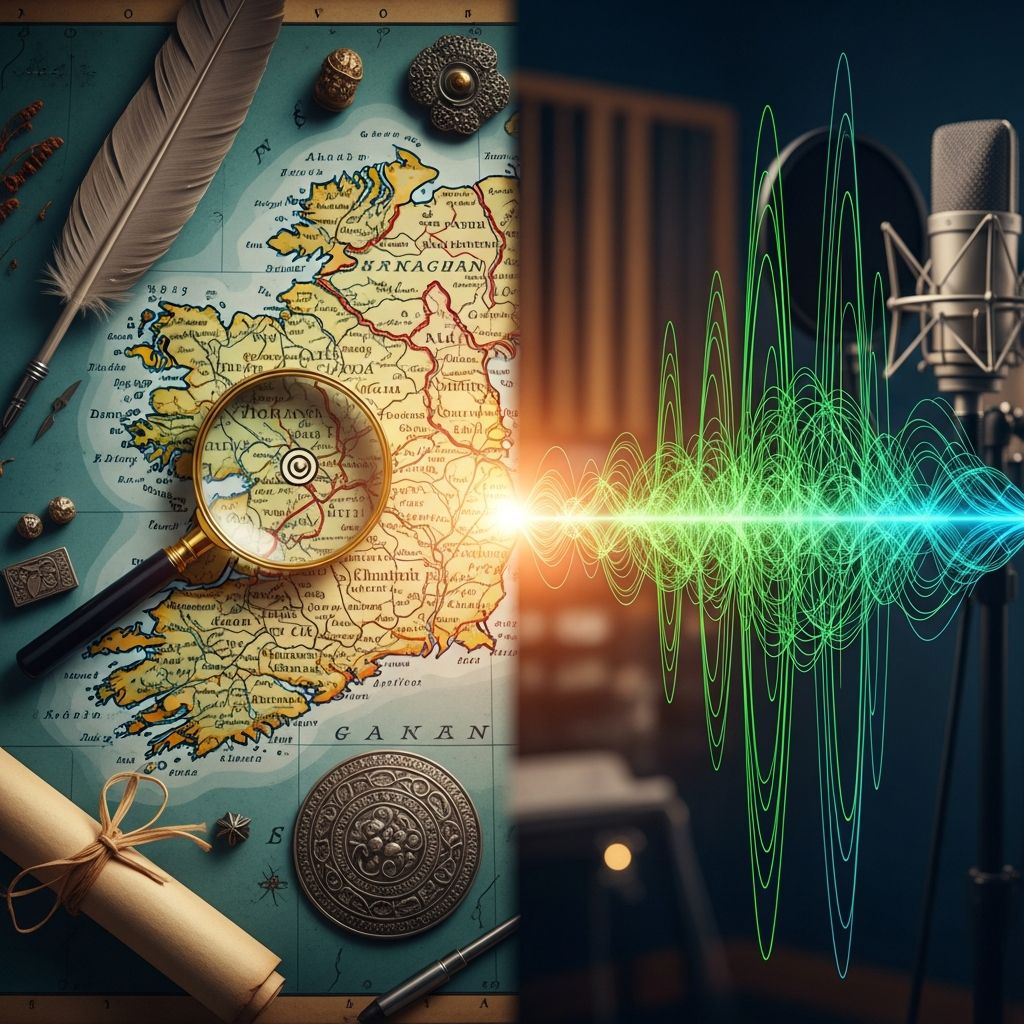
The Irish brogue stands as one of the most recognizable accents in the English-speaking world, characterized by its melodic rhythm, rolling r’s, and distinctive vowel qualities. This accent, deeply intertwined with Ireland’s cultural heritage, has evolved over centuries, blending native Gaelic influences with English phonetics. Far more than a mere way of speaking, the brogue encapsulates regional identities, historical migrations, and social dynamics within Ireland and its diaspora.
Historical Foundations of the Brogue
The term “brogue” itself carries historical weight, possibly deriving from the Irish word bróg, meaning shoe. This etymology suggests a connection to rural Irish folk, who wore sturdy brogues while speaking their native tongues. During the 16th and 17th centuries, as English imposition grew under British rule, Gaelic speakers adopted English vocabulary while retaining phonetic patterns from Irish Gaelic, birthing the brogue as a hybrid dialect.
Early records from travelers and linguists describe these speech patterns as musical and rapid, often misunderstood by outsiders. The Great Famine of the 1840s accelerated emigration, spreading the brogue to America, Australia, and beyond, where it mingled with local dialects, creating variants like the “Carolina Brogue” in the Outer Banks.
- Key historical milestone: Penal Laws (1695-1829) forced English use, preserving Gaelic sounds in private speech.
- Emigration waves post-1845 exported brogue traits globally.
- Linguistic studies from the 19th century, such as those by John O’ Donovan, documented rural brogues as purer forms.
Core Phonetic Elements Defining the Brogue
At its heart, the Irish brogue is defined by specific sound shifts that set it apart from standard English. Linguists classify it as a rhotic accent, where the ‘r’ sound is pronounced strongly in all positions, often with a retroflex quality—curling the tongue back for a vibrant roll.
| Sound Feature | Standard English | Irish Brogue Example | Phonetic Description |
|---|---|---|---|
| Rhotic R | Car (silent r) | Carrr | Tongue curls back, trilled or tapped. |
| Vowel Rounding | Love (ʌ) | Lohve (oʊ) | Schwa becomes more rounded, lips purse slightly. |
| Th Substitution | Thirty-three | Tirtee-tree | Voiceless th → t, voiced th → d. |
| Diphthong Shift | Now (naʊ) | Nee-ow | Extended glide, higher starting point. |
These features create a lilt, with rising intonation on questions and a sing-song cadence in statements. The oral posture plays a crucial role: tension at the back of the tongue elevates the sound, giving it brightness.
Regional Variations Across Ireland
Ireland’s compact size belies its linguistic diversity, with brogues varying dramatically by province. The Ulster brogue in the north features a sharper, more clipped delivery influenced by Scots, while Munster in the south boasts a softer, more flowing rhythm with prominent burrs.
- Dublin Accent: Urban, less rhotic, with slang-heavy vocabulary; often called “Dublinese.”
- Cork Brogue: Sing-songy, with elongated vowels like “boy-yoh” for boy.
- Galway/Connemara: Strongest Gaelic residue, uvular r’s mimicking Scottish burrs.
- Donegal: Harsh consonants, rapid pace, bordering Scots-Gaelic traits.
These differences reflect microclimates of language contact: western Gaeltacht areas preserve purer forms, while eastern urban centers show Anglicization.
The Brogue Versus Other Celtic Accents
Distinguishing the brogue from similar accents clarifies its uniqueness. A Scottish burr emphasizes uvular r-trilling, often guttural, whereas the brogue’s r is alveolar and melodic. Welsh accents prioritize consonant mutations absent in Irish speech.
| Accent | Key Trait | Similarity to Brogue | Difference |
|---|---|---|---|
| Irish Brogue | Rhotic roll, vowel lilt | – | Melodic, Gaelic vowels |
| Scottish Burr | Uvular r-trill | R-pronunciation | Guttural, less vowel shift |
| Welsh English | Soft consonants | Rhoticity | Mutation patterns |
| Carolina Brogue | Retained Scots-Irish r’s | Heritage link | American vowel merger |
Sources note the brogue’s occasional overlap with West Country English, but its Celtic substrate remains dominant.
Cultural Significance and Media Portrayal
The brogue transcends linguistics, symbolizing Irish resilience and charm. In literature, authors like James Joyce captured its essence in Ulysses, using phonetic spelling to evoke Dublin speech. Film icons like Barry Fitzgerald and Maureen O’Hara popularized it in Hollywood’s golden age.
Modern media continues this: actors train rigorously for authenticity, as seen in The Banshees of Inisherin. However, stereotypes persist—exaggerated lilts for comic effect—prompting debates on caricature versus celebration.
- Positive portrayals: Angela’s Ashes (Frank McCourt narration).
- Criticisms: Overly thick accents in U.S. sitcoms.
- Global spread: Irish pubs worldwide feature brogue banter.
Learning and Mastering the Brogue
For language enthusiasts, adopting a brogue involves focused practice. Start with oral posture: retract the tongue slightly for baseline tension. Drill phrases like “Either ya come home or ya don’t,” emphasizing retroflex r’s and rounded schwas.
- Listen to native speakers from varied regions via podcasts or YouTube tutorials.
- Record and compare your speech to models.
- Practice minimal pairs: “thirty” vs. “tirtee,” “love” vs. “lohve.”
- Incorporate slang: “grand” for good, “craic” for fun.
- Immerse in Gaeltacht areas for live feedback.
Accent coaches stress consistency over perfection, noting the brogue’s forgiving melody aids learners.
Modern Evolution and Global Diaspora
Today, urbanization and media homogenize accents, yet rural brogues endure. Diaspora communities in New York, Boston, and Sydney maintain heritage variants, blending with host languages. Linguists predict stabilization rather than extinction, bolstered by cultural revival movements.
Digital platforms amplify preservation: TikTok creators showcase regional brogues, while AI voice tools experiment with synthesis. Challenges include generational shifts, where youth favor neutral English for employability.
Frequently Asked Questions (FAQs)
Is a brogue the same as an Irish accent?
Yes, “brogue” commonly refers to any Irish accent, though it often implies rural or strong varieties distinct from urban Dublin speech.
What’s the difference between a brogue and a burr?
A brogue encompasses full Irish/Scottish dialect traits, while a burr specifically denotes r-trilling, more Scottish than Irish.
Can anyone learn an authentic Irish brogue?
With practice focusing on phonetics and rhythm, yes—many actors master it convincingly.
How has the brogue influenced American English?
Irish immigrants introduced rhoticity and lilts, evident in regional U.S. dialects like the Carolina Brogue.
Are there female and male differences in brogue speech?
Women often exhibit higher pitch and softer consonants, while men emphasize r-rolls, but overlaps exist regionally.
References
- Difference between a brogue and a burr? — LibraryThing Forums. 2006. https://www.librarything.com/topic/28191
- How to Do an Irish Accent aka Brogue | Accent Training — Howcast (YouTube). Accessed 2026. https://www.youtube.com/watch?v=nAFfM8Qmz-A
- The Carolina Brogue: Outer Banks Vocabulary — The Language & Life Project (YouTube). Accessed 2026. https://www.youtube.com/watch?v=jgi9wYsR5fo

Medha Deb is an editor with a master's degree in Applied Linguistics from the University of Hyderabad. She believes that her qualification has helped her develop a deep understanding of language and its application in various contexts. Medha specializes in the areas of beauty, health, sports, and wellness and is committed to ensuring that the content on the website is…