
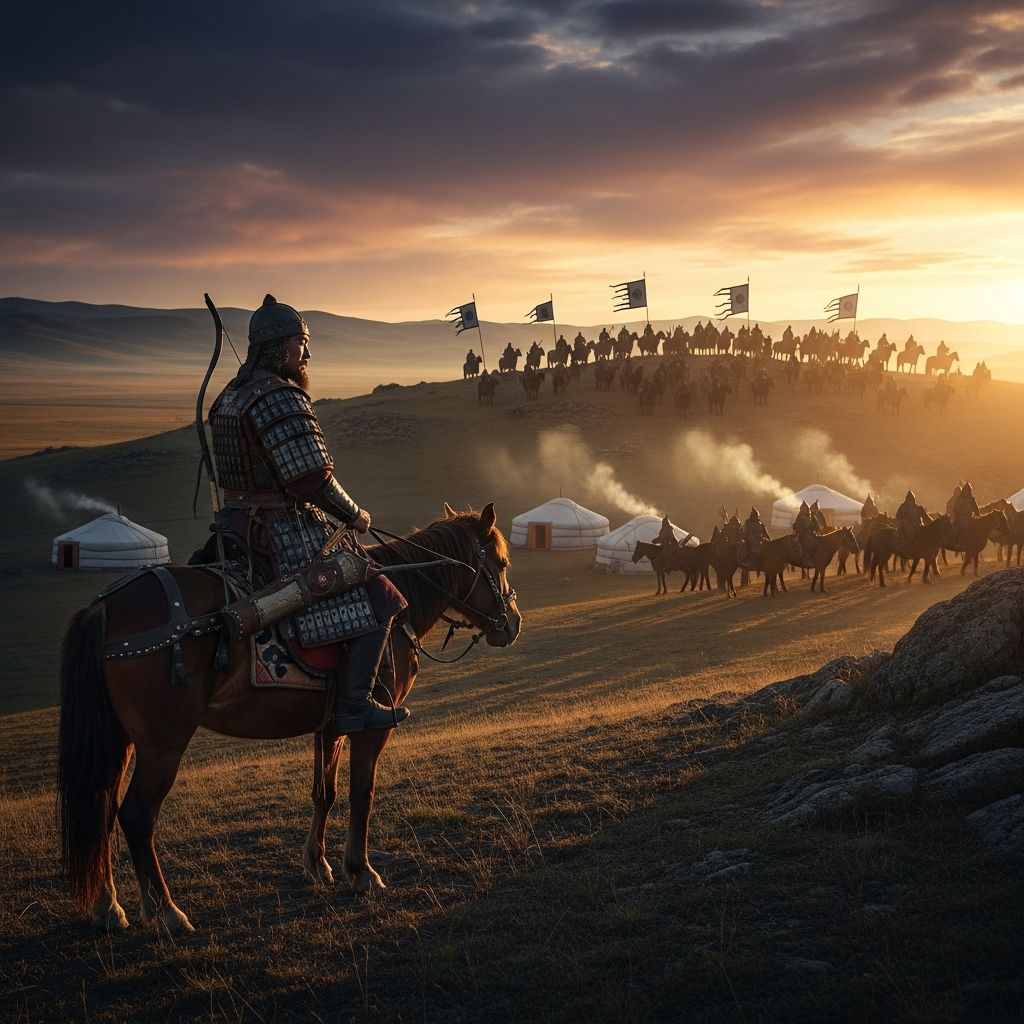
The Mongol conquests, spanning the 13th and 14th centuries, marked one of the most transformative periods in world history, birthing the largest contiguous land empire from the steppes of Mongolia to the edges of Europe and the Pacific. Driven by a unique blend of environmental fortune, strategic brilliance, and unyielding ambition, these campaigns under Genghis Khan and his successors reshaped trade, culture, and power dynamics across Eurasia.
The Steppe World: Cradle of Warrior Nomads
Mongol society emerged from the harsh, windswept grasslands of the Mongolian Plateau, where pastoral nomads herded sheep, horses, yaks, and camels between seasonal pastures. These tribes, fragmented and often feuding, were led by khans who forged temporary alliances for raids against settled neighbors like the Chinese Jin and Xia dynasties.
Life on the steppe demanded resilience. Families moved in gers—portable felt tents—following the herds that sustained them. Horses were central, providing mobility, milk, meat, and warfare prowess. Young boys learned to ride and shoot composite bows from infancy, crafting warriors unmatched in speed and precision.
- Herding economy: Reliant on livestock for food, clothing, and transport, nomads traded hides, horses, and furs for grain, metal tools, and luxuries from China.
- Tribal rivalries: Constant skirmishes over grazing lands honed combat skills but prevented unity until a singular leader arose.
- Adaptability: Nomads’ seasonal migrations built logistical expertise essential for large-scale invasions.
This environment bred a culture of survival through conquest, where raiding was not just plunder but a way of life.
Climate’s Hidden Role in Empire Building
A pivotal factor in the Mongols’ rise was a 15-year period of unusually wet and warm weather from 1211 to 1225, transforming the steppes into fertile pastures. Abundant grass fueled explosive horse population growth, swelling Mongol herds from thousands to millions.
Mild winters reduced livestock losses, allowing tribes to amass wealth and manpower. Historians link this climatic window directly to military expansion: more horses meant faster armies, better archery units, and sustained campaigns into warmer seasons when grazing supported vast herds.
| Climate Factor | Impact on Mongols | Historical Period |
|---|---|---|
| Increased precipitation | Lush grasslands for horse breeding | 1211–1225 |
| Milder winters | Higher survival rates for herds | Early 13th century |
| Warm summers | Extended grazing seasons | 1210s–1220s |
Without this ecological boon, the logistical backbone of Mongol cavalry—grass-foraging ponies—might never have supported empire-scale operations.
Trade Disruptions: Economic Sparks of War
Mongols depended on overland trade with China for essentials like grain, silk, iron weapons, and luxury goods. The Jin and Xia dynasties, seeking to curb nomad influence, imposed embargoes and reduced trade quotas, sparking crisis.
Faced with shortages, Mongols escalated from raids to full invasions. Capturing trade routes promised not just revenge but control over lucrative Silk Road networks, flooding steppe economies with wealth.
- Jin dynasty policies restricted Mongol access to markets in North China.
- Xia dynasty in Northwest China similarly limited exchanges, exacerbating hunger.
- Mongol response: Targeted strikes evolved into systematic conquests by 1209.
These disruptions unified fractious tribes under calls for retaliation, channeling economic desperation into coordinated aggression.
Genghis Khan: The Unifier and Visionary
Born Temüjin around 1162, Genghis Khan rose from orphaned outcast to supreme khan in 1206, proclaimed by a grand kurultai council. His early life—marked by betrayal, captivity, and clan wars—instilled ruthless pragmatism.
Genghis revolutionized warfare through meritocracy: promotions based on skill, not birth; equal loot shares to bind loyalty; and integration of conquered engineers for siege tech like catapults.
His vision transcended steppe raids, aiming for universal rule. By 1227, campaigns had toppled the Jin (with son Ögedei finishing in 1234) and Xia, opening paths to Khwarezm, Rus’, and beyond.
Military Innovations That Conquered Continents
Mongol armies excelled through mobility and deception. Each warrior managed 3-5 horses, rotating for non-stop travel at 100 miles per day. Composite bows outranged foes, firing accurately from horseback.
Tactics included feigned retreats to lure enemies into ambushes, psychological terror via massacres to induce surrenders, and naval adaptations later under Kublai.
- Cavalry dominance: Light and heavy horse archers overwhelmed infantry.
- Intelligence networks: Spies and yam relay stations ensured rapid communication.
- Siege adoption: Chinese and Persian engineers built trebuchets for walled cities.
These methods dismantled the Khwarezm Empire in 1219–1221, slaughtering millions but securing Central Asia.
Expansions Under Successors: From China to Europe
Genghis’s death in 1227 did not halt momentum. Ögedei (r. 1229–1241) invaded Kievan Rus’, sacking Ryazan (1237) and Vladimir.
Grandson Kublai completed China’s conquest by 1279, defeating the Song and establishing the Yuan dynasty. Hulagu sacked Baghdad in 1258, ending the Abbasid Caliphate.
Yet limits emerged: failed European pushes (e.g., Battle of Ain Jalut, 1260) due to terrain, supply lines, and unified resistance.
Pax Mongolica: Empire’s Golden Legacy
The conquests ushered Pax Mongolica, a century of relative peace facilitating Silk Road revival. Safe passage for merchants spread technologies (gunpowder, printing), ideas (Buddhism, Islam), and plagues (Black Death).
Empire administration via ulus divisions and paper currency standardized trade from Pacific to Mediterranean.
Human Cost and Enduring Impact
Estimates suggest 40 million deaths from warfare, famine, and disease—11% of global population. Cities like Samarkand and Baghdad were razed, yet reconstruction followed.
The Mongols’ legacy endures in genetic footprints (16 million men descend from Genghis), Eurasian connectivity, and modern state boundaries.
Frequently Asked Questions
What sparked the Mongol conquests primarily?
A mix of favorable climate for horse breeding, trade embargoes by Chinese dynasties, and Genghis Khan’s unifying leadership propelled the expansions.
How large was the Mongol Empire at its peak?
By 1260, it spanned 9 million square miles, from Korea to Hungary, the largest contiguous land empire ever.
Did the Mongols use advanced technology?
They adopted siege engines from conquered peoples and leveraged superior horse archery, but core strength was tactical innovation.
Why did Mongol expansions stop?
Overextension, civil wars post-Ögedei, climatic shifts, and defeats like Ain Jalut halted further gains.
What was Pax Mongolica?
A period of enforced peace enabling vast trade and cultural exchange across Eurasia.
References
- Mongol Empire — Wikipedia. 2026-04-01. https://en.wikipedia.org/wiki/Mongol_Empire
- Mongol invasions and conquests — Wikipedia. 2026-04-01. https://en.wikipedia.org/wiki/Mongol_invasions_and_conquests
- The Mongol Conquests — Asia for Educators, Columbia University. N/A. https://afe.easia.columbia.edu/mongols/conquests/conquests.htm
- Expansion of the Mongol Empire (c. 1200s) — Smith College. N/A. https://www.science.smith.edu/climatelit/expansion-of-the-mongol-empire-c-1200s/
- Written in the Stars: Secrets of the Mongol Empire — OER Project. N/A. https://www.oerproject.com/OER-Materials/OER-Media/HTML-Articles/Origins/Unit6/Written-in-the-Stars-Secrets-of-the-Mongol-Empire
- Genghis Khan: The Mongol Warlord Who Almost Conquered The World — History Extra (BBC History). N/A. https://www.historyextra.com/period/medieval/genghis-khan-mongol-warlord-conquered-world-china-medieval/
- Written in the Stars: Secrets of the Mongol Empire — Khan Academy. N/A. https://www.khanacademy.org/humanities/world-history-project-ap/xb41992e0ff5e0f09:unit-2-networks-of-exchange/xb41992e0ff5e0f09:2-1the-mongol-empire/a/article-written-in-the-stars-secrets-of-the-mongol-empire-ap

- Integrated M.A. in Applied Linguistics, University of Hyderabad
- 5+ years in editorial, instructional, SEO, and research-based writing
Sneha is a relationships and lifestyle writer with a strong foundation in applied linguistics and certified training in relationship coaching. She brings over five years of writing experience to theskillvault, crafting thoughtful, research-driven content that empowers readers to build healthier relationships, boost emotional well-being, and embrace holistic living. Her writing and insights reflect the belief that beauty, happiness, and wellness…