
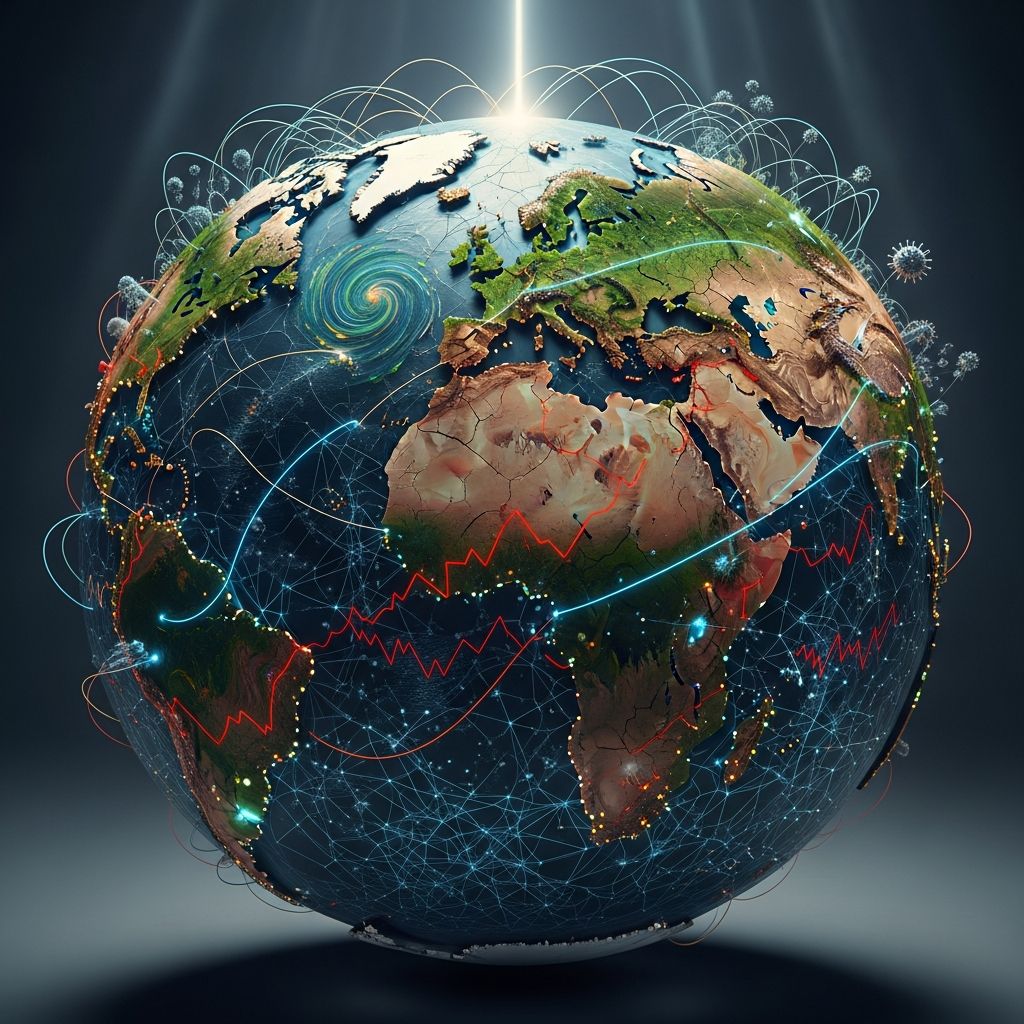
Some global challenges threaten not only millions of lives today, but also humanity’s long-term potential. Understanding which problems are most pressing – and why – can help direct talent, funding, and political will where they matter most.
This article offers a fresh synthesis of current thinking about high-stakes global problems, drawing on recent research in risk analysis, global health, international security, and environmental science. It emphasizes both scale (how many beings are affected), neglectedness (how few resources are currently devoted), and tractability (how much progress seems possible).
How to Judge What Makes a Problem “Pressing”
Different moral and political worldviews prioritize different issues, but several practical criteria are widely used in global priorities research and risk assessment:
- Scale: The expected number of lives or beings affected, or the size of the economic, social, or environmental impact.
- Probability: The likelihood of severe harms in the coming decades, especially from low-probability but extremely high-impact events.
- Neglectedness: Whether the problem is underfunded or overlooked relative to its importance, leaving unusually good opportunities for impact.
- Tractability: The extent to which additional resources, research, or policy change seem able to reduce the risk or suffering.
- Long-term effects: How much the issue could shape the future trajectory of civilization – including existential and global catastrophic risks.
Major institutions – from the United Nations to the World Economic Forum – use related lenses in their own global risk and issue reports.
Transformative AI and the Future of Power
Rapid advances in artificial intelligence could bring enormous benefits, but they also create novel risks, especially if highly capable systems are not aligned with human values or are deployed recklessly.
Why advanced AI could be unusually high-stakes
- Systemic impact: AI can influence finance, critical infrastructure, defense systems, and information ecosystems simultaneously, magnifying both benefits and errors.
- Power concentration: A small number of actors controlling powerful AI systems could gain outsized political, economic, or military leverage.
- Autonomy and misalignment: If future systems learn goals that diverge from human intentions, they could pursue strategies that are dangerous at scale.
- Arms races: Geopolitical rivalries can incentivize speed over safety, as highlighted in multiple 2025 risk assessments.
Key fronts for reducing AI-related risks
- Technical safety research: Robustness, interpretability, alignment, and monitoring of large-scale models.
- Governance and standards: National regulations, international norms, and industry standards for high-risk AI development and deployment.
- Institutional design: Ensuring that organizations developing advanced systems have strong safety cultures, independent oversight, and clear accountability.
- Managing misinformation and polarization: Limiting AI-accelerated disinformation that can undermine democratic institutions and international cooperation.
Engineered Pandemics and Biosecurity
COVID-19 revealed how disruptive pandemics can be even when caused by naturally occurring pathogens. Advances in biotechnology, while highly beneficial for medicine, also increase the feasibility of creating or modifying biological agents.
Why engineered pandemics are a special concern
- High fatality potential: Engineered pathogens might combine features like high transmissibility and high mortality.
- Global connectedness: Dense travel networks allow pathogens to spread worldwide in weeks, as documented in WHO pandemic reports.
- Dual-use tools: Techniques in synthetic biology and gene editing can be used for both lifesaving treatments and dangerous agents.
Promising strategies for bio-risk reduction
- Strengthening laboratory biosafety and biosecurity standards across research institutions and industry.
- Improving surveillance and early detection, including genomic monitoring of unusual outbreaks.
- Developing platform technologies – such as rapid vaccine platforms – that can be quickly adapted to new threats.
- Building international governance and norms for responsible biotechnology research and publication.
Great Power Conflict and Nuclear Risk
Armed conflict remains a leading short-term global risk, and tensions among major powers increase the chance of escalation, accidents, or miscalculation.
Why interstate conflict is resurging as a top risk
- Increased geopolitical rivalry: Analyses of the international system describe a more fragmented order with rising geoeconomic confrontation and sanctions.
- New technologies: Cyber operations, autonomous weapons, and AI-enabled decision systems add new pathways for escalation.
- Nuclear arsenals: Nine states possess nuclear weapons; doctrines and modernization programs raise long-term concerns about deterrence stability.
Reducing the probability and impact of great power war
- Supporting arms control, transparency, and crisis hotlines between rivals.
- Improving governance of dual-use technologies that could rapidly change military balances, such as AI and cyber capabilities.
- Backing multilateral diplomacy and institutions that help manage disputes and coordinate responses to shared threats.
Climate Change and Environmental Destabilization
Anthropogenic climate change is already driving extreme weather, sea-level rise, food system stress, and displacement. Even under optimistic mitigation pathways, societies must adapt to significant warming.
Key dimensions of the climate problem
- Human impacts: Climate-related extremes contribute to heat stress, crop failures, and increased mortality, especially in low-income and conflict-affected regions.
- Feedback loops: Melting permafrost, forest dieback, and other processes risk amplifying warming in ways that are hard to reverse.
- Interactions with conflict and migration: Climate shocks can exacerbate political instability and humanitarian crises.
Priority levers for action
- Accelerating decarbonization through clean energy deployment, efficiency, and industrial innovation.
- Investing in adaptation – resilient infrastructure, early warning systems, and climate-resilient agriculture.
- Supporting climate finance for vulnerable countries, as emphasized in UN development and climate agendas.
Global Health and Poverty in Low-Income Countries
Even apart from catastrophic risks, preventable disease and extreme poverty cause immense, ongoing harm. In many low-income settings, relatively modest funding can avert large numbers of deaths and improve quality of life.
Major health and development gaps
- Infectious diseases: Conditions like malaria, tuberculosis, HIV/AIDS, and neglected tropical diseases remain major killers despite cost-effective interventions.
- Health systems: Weak primary care, shortages of health workers, and limited diagnostic capacity constrain long-term progress.
- Economic vulnerability: Conflict, price shocks, and climate-related disasters can rapidly push households back into extreme poverty.
High-leverage opportunities
- Scaling proven interventions such as insecticide-treated bed nets, childhood vaccinations, and basic maternal health services.
- Investing in health systems strengthening, including data infrastructure and community health workforces.
- Supporting evidence-based development programs that improve income, education, and institutional capacity.
Animal Welfare: Factory Farming and Wild Animal Suffering
Ethical concern for non-human animals greatly expands the scale of global moral problems. Industrial animal agriculture directly involves trillions of animals each year, many in conditions that cause intense and prolonged suffering.
Why animal issues may be highly “scaled” but neglected
- Sheer numbers: Global livestock production involves tens of billions of land animals annually and vast numbers of farmed fish.
- Limited protections: Animal welfare laws are weak or poorly enforced in many jurisdictions.
- Invisible suffering: Most people rarely see the conditions inside intensive farming systems.
Beyond farmed animals, there is a vast, largely unquantified amount of potential suffering among wild animals – from disease, hunger, and environmental stresses – raising complex questions about if and how humans can help without causing unintended harms.
Comparing These Problems: A Snapshot
| Problem Area | Primary Risk Type | Key Time Horizon | Why It’s Highly Pressing |
|---|---|---|---|
| Transformative AI & power concentration | Existential / systemic | Next 10–30 years | Could reshape institutions, economies, and security; large upside and downside. |
| Engineered pandemics & biosecurity | Catastrophic / existential | Ongoing, with rising capability | Biotech is advancing quickly; engineered pathogens could exceed natural ones. |
| Great power conflict & nuclear risk | Catastrophic / geopolitical | High near-term salience | Conflict remains a top global risk in major surveys and analyses. |
| Climate change | Systemic / environmental | Decades to centuries | Transforms physical and social systems, with compounding effects. |
| Global health & extreme poverty | Ongoing humanitarian | Immediate to long-term | Millions of deaths annually from preventable causes; highly cost-effective interventions exist. |
| Animal suffering | Ethical / welfare | Ongoing, large-scale | Impacts enormous numbers of sentient beings; comparatively under-addressed. |
How Individuals and Institutions Can Contribute
No single person can solve these challenges, but thoughtful choices about careers, funding, and advocacy can significantly shift outcomes over time.
Career paths with unusually large leverage
- Policy and governance on AI, biosecurity, climate, and conflict prevention.
- Technical research in AI safety, epidemiology, vaccine platforms, or clean energy.
- Field implementation in global health, poverty reduction, or humanitarian response.
- Movement-building and communication to improve public understanding of high-stakes risks.
Philanthropy and funding choices
- Supporting evidence-driven organizations working in highly neglected but tractable areas.
- Combining near-term impact (e.g., health and poverty) with long-term risk reduction (e.g., AI and biosecurity).
Frequently Asked Questions (FAQs)
Q: Why focus so much on low-probability global catastrophes?
Even if some events are unlikely in any given year, the expected harm can be enormous if the downside includes billions of deaths or permanent damage to civilization. Risk analyses by major organizations increasingly emphasize these low-probability, high-impact scenarios, especially for conflict, emerging technologies, and climate tipping points.
Q: How do these priorities relate to the UN Sustainable Development Goals?
Many near-term concerns – such as health, poverty, climate, and strong institutions – are directly encoded in the Sustainable Development Goals. Work on catastrophic and existential risk is complementary: it aims to protect the long-term future so that progress on those goals is not derailed by disasters that could have been prevented.
Q: Aren’t global health and poverty already getting a lot of attention?
Compared to some other causes, global health and poverty do attract substantial funding. However, the scale of need remains very large, and independent evaluations have repeatedly found that the most effective interventions in these areas can save or improve lives at remarkably low cost. This makes them strong candidates for anyone prioritizing measurable, near-term impact.
Q: How can someone without a technical background help with AI or biosecurity?
These fields need more than technical experts. Policy specialists, lawyers, communicators, operations professionals, social scientists, and grantmakers all play crucial roles in shaping incentives, building institutions, and coordinating international action. Many impactful roles focus on governance, regulation, and institutional design rather than hands-on lab or engineering work.
Q: What if different moral views disagree about animals, future people, or global equity?
Different ethical frameworks do weigh these issues differently. However, there is broad overlap on many practical priorities: reducing pandemic risk, avoiding great power war, improving global health systems, and mitigating severe climate change all look important across most worldviews. People can also choose a portfolio of efforts that reflects both their moral views and their comparative advantages.
References
- Global Risks 2025: A World of Growing Divisions — World Economic Forum. 2025-01-15. https://www.weforum.org/publications/global-risks-report-2025/in-full/global-risks-2025-a-world-of-growing-divisions-c943fe3ba0/
- World Health Report: Preparedness and Response to Health Emergencies — World Health Organization. 2022-12-01. https://www.who.int/publications
- The Top Risks of 2025 — Eurasia Group. 2025-01-08. https://www.eurasiagroup.net/issues/top-risks-2025
- The Top 10 Crises the World Can’t Ignore in 2025 — International Rescue Committee. 2024-12-10. https://www.rescue.org/article/top-10-crises-world-cant-ignore-2025
- What Worries the World – July 2024 — Ipsos. 2024-07-24. https://www.ipsos.com/en-us/what-worries-world
- Global Issues — United Nations. 2024-06-01. https://www.un.org/en/global-issues
- 5 Global Issues to Watch in 2025 — United Nations Foundation. 2024-12-05. https://unfoundation.org/blog/post/5-global-issues-to-watch-in-2025/

- Integrated M.A. in Applied Linguistics, University of Hyderabad
- 5+ years in editorial, instructional, SEO, and research-based writing
Sneha is a relationships and lifestyle writer with a strong foundation in applied linguistics and certified training in relationship coaching. She brings over five years of writing experience to theskillvault, crafting thoughtful, research-driven content that empowers readers to build healthier relationships, boost emotional well-being, and embrace holistic living. Her writing and insights reflect the belief that beauty, happiness, and wellness…