
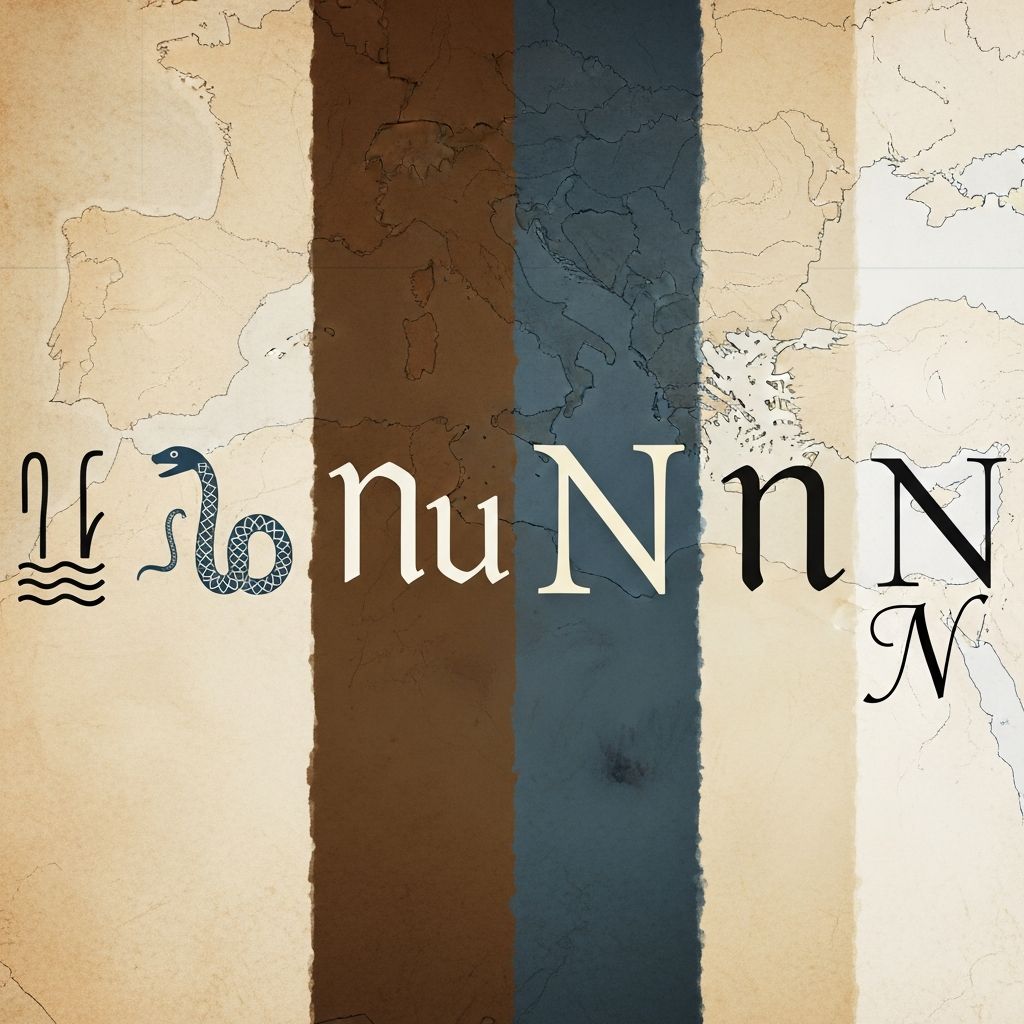
Understanding the Origins of the Letter N
The letter N occupies the fourteenth position in the modern English alphabet and serves as a fundamental building block of written communication across numerous languages. Yet the story behind this seemingly simple character stretches back thousands of years, involving multiple civilizations, linguistic transformations, and cultural exchanges. Understanding where the letter N came from requires us to journey through ancient Egypt, Phoenicia, Greece, Rome, and beyond, examining how different societies adapted and refined this symbol to suit their linguistic and practical needs.
The path from primitive pictographic representation to the standardized letter we recognize today demonstrates the profound interconnectedness of human writing systems. Each civilization that encountered or developed the letter N contributed unique modifications, reflecting their own languages, writing conventions, and artistic preferences. This evolutionary process reveals how alphabets are not static creations but rather living systems that adapt and transform across centuries and continents.
The Pictographic Beginnings in Ancient Egypt
The origins of the letter N trace back to ancient Egypt, where the symbol likely began as a pictographic representation of a snake. This hieroglyphic depiction served a dual purpose: it functioned both as a visual representation of the creature and as a phonetic marker in Egyptian writing. The Egyptian word for “snake” was “djet,” which created an association between the symbol and its sound value in the developing writing system.
In the Egyptian hieroglyphic system, one of the most frequently used signs represented the serpent, and this image became instrumental in the evolution of alphabetic writing. The snake was chosen not arbitrarily but deliberately, as the initial sound of the Egyptian word for serpent aligned with the phonetic value that would eventually become the sound of the letter N in later alphabets. This principle of using objects whose names began with desired sounds formed a crucial foundation for alphabetic development.
The hieroglyphic snake symbol demonstrated an important principle in writing system evolution: the rebus principle, where a symbol’s meaning gradually becomes less important than its sound value. As writing systems became more sophisticated and phonetically oriented, the visual resemblance to an actual snake became less critical, and the symbol’s primary function transformed into representing a specific consonantal sound.
Adaptation by Semitic Peoples and the Fish Connection
Around 1500 BCE, Semitic-speaking peoples working in Egypt and the surrounding regions adapted existing hieroglyphic symbols to create their own writing systems. This marked a revolutionary moment in linguistic history, as it represented one of the first major developments toward true alphabetic writing. Some scholars theorize that Semitic scribes deliberately selected the serpent hieroglyph to represent their language’s consonantal sound, creating a bridge between Egyptian hieroglyphics and Semitic script.
However, the Semitic peoples brought their own interpretation to the symbol. In Semitic languages, the character became known as “nun,” which actually means “fish” rather than “snake.” This naming convention suggests an alternative or parallel theory about the letter’s origins—that the Semitic peoples may have connected the symbol to a hieroglyph representing water ripples or fish, both of which produce sounds phonetically similar to the modern ‘n’ sound.
The dual etymology—connecting the letter to both serpents and fish—reveals the complexity of how different cultures interpreted and adapted the same symbols. Both interpretations involved aquatic or slithering creatures, and both supported the same phonetic value. This flexibility demonstrates that ancient peoples were pragmatic in their approach to writing systems, sometimes preserving inherited symbols while reinterpreting their meanings to align with their own linguistic needs.
The Phonetic Characteristics and Stability of the N Sound
Throughout the history of the letter N, one remarkable feature remained constant: the sound it represented. Linguists and historians have observed that the dental nasal sound represented by N is among the most stable consonantal sounds across different languages and time periods. This stability stems from the phonetic properties of nasal consonants, which are among the least liable to change in spoken language.
The letter N typically represents a dental nasal sound, produced by placing the tongue against the alveolar ridge (just behind the upper teeth) and allowing air to escape through the nose. This articulation is relatively simple and efficient, making it a common sound in human languages. The consistency of this sound across languages and epochs suggests that once the letter-to-sound correspondence was established, there was little linguistic pressure to modify it.
In most phonetic contexts, the N maintains its standard dental nasal pronunciation. However, in specific linguistic environments, the sound undergoes what linguists call assimilation. Before velar consonants such as K, hard C, hard G, Q, and X, the N shifts to a velar nasal sound, as heard in words like “ink,” “angle,” and “relinquish.” This contextual variation represents a natural phonological adaptation rather than a fundamental change in the letter’s identity, and it occurs similarly across many languages that use the Latin alphabet.
Evolution Through the Phoenician and Greek Periods
By approximately 1000 BCE, Phoenician and Canaanite civilizations had refined the earlier Semitic forms of the letter into a more standardized linear shape. This linearization represented a significant departure from the pictographic origins, as the symbol became increasingly geometric and abstract. The Phoenicians, master merchants and navigators, spread their alphabet throughout the Mediterranean, and with it came their version of the letter N.
The Phoenician form of the letter bore greater resemblance to the abstract character we recognize today, stripped of its earlier pictorial qualities. This transformation reflected the Phoenicians’ practical approach to writing—they needed a system that was rapid to execute and easy to distinguish at a glance. The simplified, linear forms they developed became the prototype for numerous subsequent alphabets.
When the ancient Greeks adopted the Phoenician alphabet around the 8th century BCE, they inherited the letter N but made subtle yet significant modifications. The Greeks renamed it “nu” (Ν), transforming the Semitic word “nun” to reflect their own linguistic patterns. More importantly, they adjusted the letter’s orientation to align with their left-to-right writing direction, standardizing the upright strokes to equal length and creating a more symmetrical appearance.
The Greek contribution to the letter N’s development was primarily one of refinement and systematization. The Greeks were meticulous about their alphabet, and they standardized letterforms across different regions and writing contexts. By the time of the Ionic alphabet, which developed in certain Greek city-states, the letter N had achieved a relatively consistent visual form that would remain recognizable through subsequent transformations.
The Roman Standardization and Latin Inheritance
The Romans encountered the Greek alphabet when they came into contact with Greek colonies and later through the Etruscan civilization, which sat between Greek and Roman territories. The Etruscans had adopted and adapted the Greek alphabet for their own language, and the Romans subsequently borrowed from the Etruscan version. In this process, the letter N remained largely unchanged, demonstrating the power of established orthographic conventions.
The Roman version of the letter N proved to be virtually indistinguishable from its Greek predecessor, which speaks to the letter’s already-refined state. The Romans, known for their practical and organized approach to governance and standardization, simply incorporated the letter into their Latin alphabet without major alterations. This conservative approach reflected both the letter’s functional adequacy and the Romans’ general respect for the Greek writing tradition from which they had borrowed.
Latin’s adoption and preservation of the letter N ensured its survival and transmission to modern European languages. As the Roman Empire expanded and Latin became the lingua franca of administration, commerce, and learning, the letter N traveled throughout Europe and beyond. The form that Rome inherited from Greece, with minor or nonexistent modifications, became the template for the capital N that appears in English and most modern European languages.
Medieval and Early Modern Transformations
During the medieval period, writing conventions underwent significant changes as different scripts emerged to serve various purposes. The development of new writing hands, particularly during the early medieval period, introduced the lowercase or minuscule form of the letter n. The Carolingian hand, which emerged during the reign of Charlemagne and became influential throughout medieval Europe, played a crucial role in establishing the rounded minuscule forms that would characterize medieval manuscripts.
The rounded minuscule n developed as a practical adaptation for rapid handwriting and efficient space usage. Medieval scribes discovered that creating rounded, connected letterforms allowed them to write more quickly while maintaining legibility. The minuscule n essentially represents a hastily rendered capital N, with the sharp angles replaced by curves and the overall form compressed to fit within narrower line spacing.
The transition from capital to minuscule forms reflected broader changes in literacy, technology, and communication practices. As paper became more widely available and writing became increasingly common, the need for faster, more efficient writing methods intensified. The minuscule alphabet emerged as the practical solution, allowing monks, clerks, and scribes to produce texts more rapidly without sacrificing too much legibility.
The Printed and Digital Age
The invention of movable type printing technology in the 15th century by Johannes Gutenberg and others created new standardization pressures on letter forms. Printers needed to decide exactly what each letter should look like, and they drew inspiration from both handwritten manuscripts and classical inscriptions. The printed lowercase n closely resembles its handwritten counterpart, maintaining the rounded form established during the medieval period while adding consistency and uniformity through mechanical reproduction.
Printing technology essentially froze letter forms, or at least made them more uniform and deliberate. Printers created specific metal or wood type blocks for each letter, and these forms became templates that subsequent generations of printers copied or slightly modified. The letter N in printed texts maintained considerable consistency across different regions and printers, as publishers followed established conventions to ensure readability and professional appearance.
In the modern digital age, the letter N continues to evolve, albeit subtly. Different typefaces and fonts present varying interpretations of the letter, from minimalist sans-serif designs to elaborate serif forms. Yet despite these stylistic variations, the fundamental recognition and function of the letter N remains constant across contexts, demonstrating the remarkable stability of this ancient symbol.
Comparative Forms Across Writing Systems
| Writing System | Time Period | Form Name | Approximate Form | Key Characteristics |
|---|---|---|---|---|
| Egyptian Hieroglyphic | Ancient Egypt | Snake sign | Pictorial serpent | Pictographic, represents actual snake |
| Semitic/Hebrew | ~1500-1000 BCE | Nun | Angular linear form | Simplified, named “fish,” purely linear |
| Phoenician | ~1000 BCE | Nun | Geometric angular form | Highly standardized, narrow proportions |
| Greek | ~800 BCE | Nu | Two parallel vertical strokes | Symmetrical, equal-height strokes |
| Etruscan | ~700-500 BCE | N | Four-stroke character | Resembled Latin M slightly, precursor to Roman form |
| Latin/Roman | ~500 BCE onward | N | Two angled strokes with diagonal | Closely resembles modern capital N |
| Carolingian | ~800-1200 CE | n (minuscule) | Rounded form | Curved, connected, space-efficient |
| Modern Printed | 15th century onward | N/n | Capital and lowercase forms | Standardized, consistent, typeface-dependent |
The Letter N in Linguistic Theory and Application
Linguists recognize the letter N as performing multiple functions across different languages. While its primary function remains representing the nasal consonant sound, different languages employ N in various ways, from simple phonetic representation to more complex orthographic roles. In English, N appears frequently both at word beginnings, middles, and endings, and it combines with other letters to create digraphs and specific phonetic values.
The letter N also appears in numerous grammatical and morphological contexts. In English, the prefix “un-” uses N to indicate negation or reversal, while suffixes like “-ness” incorporate N as part of their structure. These applications demonstrate that the letter N has evolved beyond its original phonetic function to become embedded in the grammatical structures of modern languages.
The consistency of the N sound across languages presents advantages for language learners and multilingual speakers. Unlike some letters whose pronunciation varies significantly across different languages, N typically maintains a recognizable and relatively consistent sound value. This consistency facilitates cross-linguistic understanding and makes N a reliable element in alphabetic communication.
Cultural and Historical Significance
Beyond its practical linguistic function, the letter N carries cultural and historical significance as a symbol of human writing development. The evolution of N mirrors broader trends in human civilization, including increasing complexity, specialization, and standardization. The journey from pictographic representation to abstract symbol parallels humanity’s transition from pictorial thinking to abstract symbolic thought.
The letter N’s presence in multiple alphabets and writing systems underscores the interconnectedness of human cultures and the transmission of knowledge and technology across civilizations. The Phoenicians, Greeks, Romans, and medieval European scribes all contributed to shaping this letter, each civilization adding its own mark while preserving the essential identity established by predecessors. This process of cultural transmission demonstrates how alphabets themselves become vessels of cultural exchange and continuity.
Historical inscriptions and manuscripts preserve evidence of the letter N’s visual development, providing archaeologists and linguists with concrete data about past writing practices. By studying variations in how the letter was rendered in different periods and regions, scholars can reconstruct historical development and understand broader patterns of cultural and linguistic change.
Frequently Asked Questions About the Letter N
Q: Why did the Semitic peoples call the letter “nun” when it originally came from the Egyptian snake hieroglyph?
A: The Semitic naming likely reflects their reinterpretation of the symbol’s meaning. While Egyptians associated the sign with snakes, Semitic speakers may have connected it to fish or water-related concepts, possibly because similar symbols appeared in water-related hieroglyphics. Alternatively, “nun” may have been chosen because it began with the ‘n’ sound, following the principle of using objects whose names started with the desired phonetic value.
Q: How did the letter N change from pictographic to abstract?
A: This transformation occurred gradually as writing systems became more phonetically oriented. Early pictographic forms gave way to simplified linear representations during the Phoenician period, approximately 1000 BCE. This linearization served practical purposes, making the letter faster to write and easier to distinguish. By the time the Greeks refined the letter, it had become purely geometric, with all remaining resemblance to actual snakes or fish completely gone.
Q: Is the sound of the letter N the same across all languages?
A: The letter N generally represents the same dental nasal consonant sound across most languages that use the Latin alphabet. However, its pronunciation can vary slightly depending on surrounding sounds and language-specific phonological rules. For example, before certain consonants like ‘k’ or ‘g,’ the N sound may shift slightly, but the fundamental nasal quality remains constant. This consistency makes N one of the most stable letters phonetically.
Q: What role did the Etruscans play in the development of the letter N?
A: The Etruscans served as intermediaries between Greek and Roman civilizations. They adapted the Greek alphabet for their own language and passed a modified version to the Romans. Although the Etruscans made four-stroke versions of certain letters, the letter N changed relatively little in their adaptation. This minimal modification demonstrates that the letter had already reached a stable, refined form by this point in history.
Q: Why did medieval scribes develop a rounded lowercase ‘n’ different from the capital N?
A: Medieval scribes developed rounded lowercase forms primarily for practical efficiency. Rounded, connected letterforms could be written more quickly than angular capital forms, and they used less vertical space, allowing more text to fit on a single page. These advantages were significant for monks and scribes who produced manuscripts by hand. The lowercase n essentially became a fast, space-efficient version of the capital N.
References
- N | History, Etymology, & Pronunciation — Britannica. Accessed April 2026. https://www.britannica.com/topic/N-letter
- N, n – Students — Britannica Kids. Accessed April 2026. https://kids.britannica.com/students/article/N-n/276010
- N (letter) — Wiktionary. Accessed April 2026. https://www.wiktionary.org/wiki/N
- The Historical and Cultural Significance of the Letter ‘N’ in Different Languages and Societies — Aithor Academic Essays. Accessed April 2026. https://aithor.com/essay-examples/the-historical-and-cultural-significance-of-the-letter-n-in-different-languages-and-societies

Medha Deb is an editor with a master's degree in Applied Linguistics from the University of Hyderabad. She believes that her qualification has helped her develop a deep understanding of language and its application in various contexts. Medha specializes in the areas of beauty, health, sports, and wellness and is committed to ensuring that the content on the website is…