
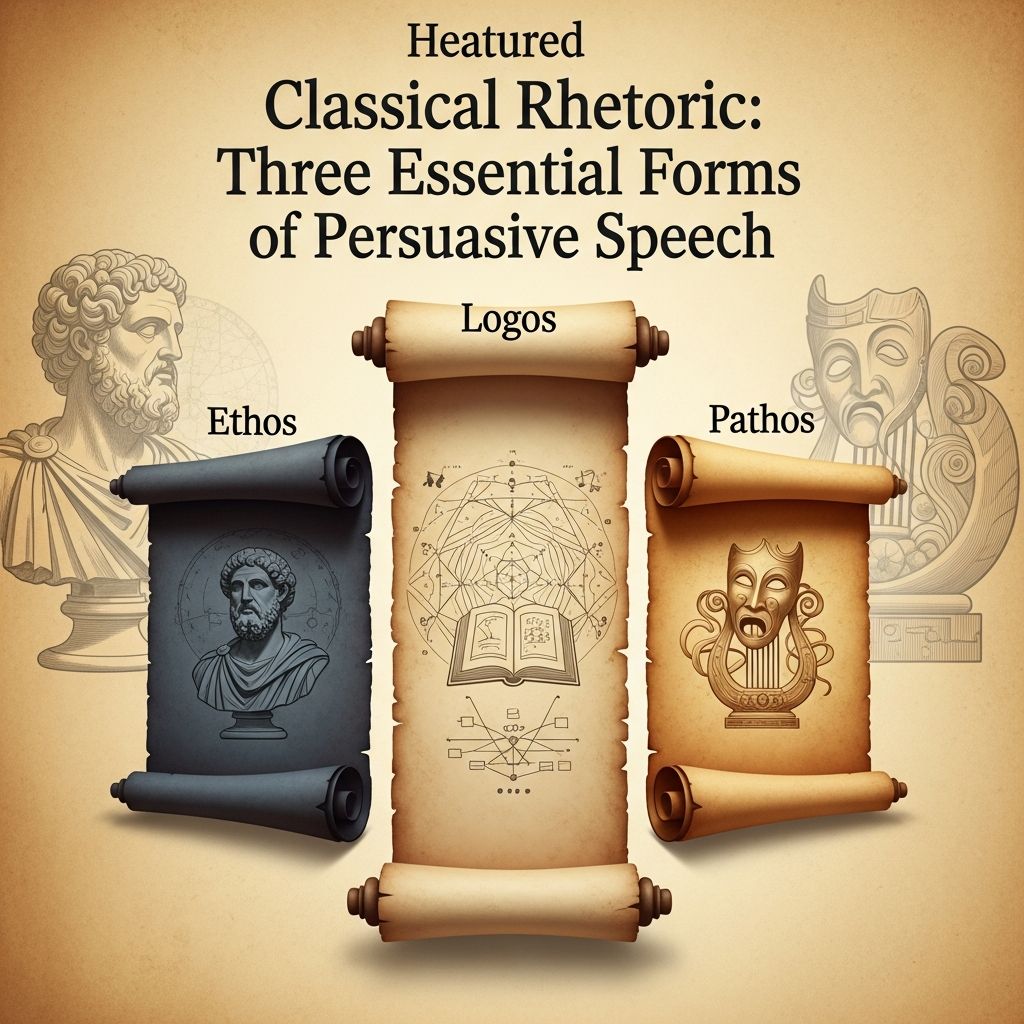
Introduction to the Classical Structure of Rhetoric
The art of persuasion has been systematically studied and refined since ancient times. Aristotle, one of history’s greatest philosophers, recognized that effective communication operates within distinct frameworks, each with specific purposes and audiences. Rather than treating all persuasive speech as identical, Aristotle identified fundamental categories that speakers and writers instinctively employ when seeking to influence others. These categories form the backbone of rhetorical education and continue to shape how we understand persuasion today.
By understanding these distinct categories, communicators gain valuable insight into which strategies work best in different situations. A politician speaking to voters operates under different constraints and opportunities than an attorney presenting evidence in court, or a speaker delivering a eulogy at a funeral. Recognizing these distinctions allows speakers to adapt their approach, select appropriate evidence, and frame arguments in ways that resonate most powerfully with their specific audience and context.
The Temporal Framework of Classical Rhetoric
One of Aristotle’s most elegant insights was recognizing that different rhetorical situations focus on different time periods. This temporal orientation shapes everything about how a speaker constructs their argument and what evidence they emphasize. Each branch of rhetoric directs attention backward, forward, or to the present moment, creating a comprehensive framework for understanding why certain types of communication work the way they do.
This temporal distinction is not merely academic—it reflects genuine differences in how audiences evaluate arguments and make decisions. When considering what happened in the past, people apply different standards of judgment than when contemplating future possibilities or celebrating current values. Understanding these temporal dimensions helps communicators construct arguments that align with how audiences naturally think about different types of questions.
Retrospective Rhetoric: Examining Past Actions
The first major category of classical rhetoric concerns itself with evaluating events and actions that have already occurred. This form of persuasion operates in contexts where judgment and determination of facts are central to the rhetorical task. Courtrooms provide the most obvious example, but this type of rhetoric appears whenever people must reconstruct what happened, assign responsibility, or determine culpability based on past events.
In legal proceedings, attorneys must convince judges or juries that their interpretation of past events is the correct one. They present evidence, call witnesses, and construct narratives designed to establish what actually happened and who bears responsibility. The goal is not to predict the future or celebrate values, but to achieve victory in determining the truth about past occurrences. Arguments focus on justice and injustice, establishing whether actions violated proper standards and norms.
Beyond the courtroom, this retrospective approach appears whenever historical events require interpretation or when accountability for past actions needs to be established. Historians, investigators, and journalists frequently employ this rhetorical mode when they must reconstruct what happened and explain its significance. The standards of evidence, the types of arguments that prove persuasive, and the ultimate goal of achieving a verdict all distinguish this category from other rhetorical forms.
The special topics of invention—the standard arguments available to speakers in this mode—center on establishing justice or injustice. Speakers emphasize precedent, legal precedent, consistency with prior rulings, and the application of established principles to the case at hand. The temporal focus remains firmly anchored in the past, even as speakers discuss implications for the future.
Deliberative Rhetoric: Shaping Future Decisions
The second major category of classical rhetoric looks forward, urging audiences to take action or adopt policies that will shape what comes next. This forward-looking persuasion characterizes political debate, policy discussions, and any situation where people must choose between alternative courses of action. Legislators, business leaders, and community organizers frequently employ this rhetorical mode when advocating for particular decisions or opposing alternatives.
Deliberative rhetoric appears whenever a group must decide how to proceed, what policies to implement, or what actions to take. The persuasive task centers on demonstrating that one proposed course of action is superior to others because it will produce better outcomes, reduce harms, or align with shared values. Speakers emphasizing benefits, warning of dangers, and contrasting different possible futures all participate in deliberative rhetoric.
The special topics available in this rhetorical mode concern advantage and disadvantage, good and unworthy outcomes. A politician might argue that a particular tax policy will benefit working families while burdening the wealthy unfairly. An environmental advocate might contend that conservation measures today will preserve resources for future generations. In each case, the speaker seeks to persuade the audience that pursuing one course of action is preferable to alternatives by focusing on likely consequences and comparative advantages.
What distinguishes this category from retrospective rhetoric is the fundamental orientation toward the future. Rather than determining what happened or assigning blame for past actions, deliberative speech urges audiences to make choices that will produce desired future states. The temporal focus, the types of evidence that prove most persuasive, and the ultimate standard for success all differ substantially from retrospective rhetoric or the third category of classical persuasion.
Epideictic Rhetoric: Celebrating and Affirming Values
The third major category of classical rhetoric operates in the present moment, seeking to reinforce, celebrate, and affirm the values held by a community. Unlike retrospective rhetoric, which determines what happened, or deliberative rhetoric, which shapes what will happen, epideictic rhetoric affirms what matters now. This category encompasses ceremonial speaking, commemorative addresses, speeches of praise and blame, and all communication that seeks to strengthen collective identity and shared values.
Epideictic rhetoric appears whenever speakers gather to celebrate accomplishments, honor individuals, commemorate occasions, or reaffirm group identity. Funeral orations, award ceremonies, patriotic celebrations, and organizational gatherings all employ this rhetorical mode. The persuasive task is not to prove a legal point or advocate a policy, but to inspire, unify, and strengthen the audience’s commitment to shared principles and ideals.
The special topics of invention available in epideictic rhetoric center on virtue and vice, excellence and shameful conduct. A speaker delivering a tribute emphasizes the virtuous qualities possessed by the person being honored. A speaker commemorating a historical event highlights the noble principles demonstrated by those involved. The persuasive goal is to move the audience emotionally, strengthen their sense of community, and reinforce commitment to the values being celebrated.
This category differs fundamentally from the other two in its temporal focus and ultimate aim. Epideictic rhetoric neither investigates the past nor shapes the future, but rather celebrates the present. It seeks not to render judgment or influence decision-making, but to inspire, unify, and strengthen collective commitment to shared values. The success of epideictic rhetoric is measured not by verdicts rendered or policies adopted, but by the emotional resonance achieved and the strengthened sense of community among the audience.
Comparative Analysis of the Three Categories
| Rhetorical Category | Temporal Focus | Primary Purpose | Key Topics of Argument | Context and Setting |
|---|---|---|---|---|
| Retrospective (Forensic) | Past | Accuse or defend; determine guilt or innocence | Justice, injustice, culpability, evidence | Courtrooms, investigations, historical analysis |
| Deliberative (Political) | Future | Exhort or dissuade; influence decisions | Advantage, disadvantage, good outcomes, practical consequences | Legislative bodies, policy debates, organizational meetings |
| Epideictic (Ceremonial) | Present | Praise or blame; celebrate and affirm values | Virtue, vice, honor, shame, excellence | Celebrations, commemorations, award ceremonies, funeral rites |
The Integration of Multiple Rhetorical Modes
While Aristotle distinguished these three categories, skilled communicators often blend elements from multiple modes within a single address. A political speech might retrospectively remind audiences of past achievements while arguing for future policy changes grounded in shared values. A lawyer might praise the character of a witness while arguing about what actually happened and what justice demands. These overlapping applications demonstrate that the three categories represent ideal types rather than rigid compartments.
Understanding how to integrate multiple rhetorical modes enhances persuasive effectiveness. A speaker might use epideictic elements—celebrating the values the audience holds dear—to establish common ground before transitioning to deliberative arguments about policy. This rhetorical sophistication allows communicators to adapt to complex situations where multiple dimensions of persuasion simultaneously operate.
Practical Applications in Contemporary Communication
The classical framework remains remarkably relevant to modern communication challenges. Business leaders employ deliberative rhetoric when proposing organizational changes or strategic directions. Legal professionals continue to master retrospective rhetoric in courtroom settings. Community leaders use epideictic rhetoric to strengthen group identity and shared commitment during commemorative events.
In political discourse, candidates blend all three modes. They retrospectively evaluate their opponents’ records while arguing for superior future policies grounded in shared values and principles. In marketing and advertising, companies use epideictic elements to build brand identity while employing deliberative arguments about why consumers should choose their products. Understanding these underlying rhetorical structures helps communicators craft more effective messages across diverse contexts.
Digital communication has created new venues for these classical rhetorical modes. Social media activism often employs retrospective rhetoric to hold institutions accountable for past actions while simultaneously using deliberative rhetoric to advocate for policy changes. Viral videos celebrating social movements or organizational achievements employ epideictic rhetoric to strengthen collective identity and commitment among supporters.
The Persuasive Appeals Within Each Mode
Across all three categories of rhetoric, communicators employ three fundamental appeals: logical consistency, credibility and authority, and emotional resonance. Effective retrospective rhetoric builds compelling logical narratives that explain past events while establishing the speaker’s expertise and credibility as an interpreter of events. Deliberative rhetoric employs logical arguments about consequences while building the speaker’s authority on policy matters and connecting emotionally with audience concerns about the future. Epideictic rhetoric primarily emphasizes emotional connection and the speaker’s embodiment of shared values while employing logical arguments about why those values matter.
The balance among these three appeals varies across the categories. Retrospective rhetoric typically emphasizes logical consistency and factual accuracy. Deliberative rhetoric balances logical argumentation about consequences with emotional appeals about consequences that matter to audiences. Epideictic rhetoric emphasizes emotional resonance and the speaker’s credibility as an authentic representative of group values, though logical arguments about virtue and excellence also play important roles.
Mastering Rhetorical Adaptation
Skilled communicators recognize which rhetorical mode their situation demands and adapt their approach accordingly. A spokesperson responding to criticism must employ retrospective rhetoric to address past actions while potentially using deliberative rhetoric to explain future corrections and epideictic rhetoric to reaffirm organizational values. An advocate promoting social change might emphasize retrospective wrongs that demand remedy, deliberative arguments about better futures, and epideictic celebration of the values underlying the movement.
Training in these classical categories provides a mental framework for analyzing communication situations, identifying which rhetorical mode is most appropriate, and selecting arguments and appeals that align with that mode. Rather than approaching every communication challenge with identical strategies, speakers who understand these distinctions can adapt their approach to match what audiences expect and what the situation demands.
Modern Relevance of Classical Categories
Despite spanning over two thousand years, Aristotle’s framework remains central to rhetoric education and professional communication training. Law schools teach students to recognize and master forensic rhetoric. Political science and public policy programs emphasize deliberative rhetoric and decision-making contexts. Communication courses teach ceremonial speaking as an essential skill grounded in epideictic principles. This enduring relevance reflects the fact that Aristotle identified fundamental features of human communication that transcend particular historical moments.
As new communication technologies emerge and social contexts shift, these classical categories continue to provide useful frameworks for understanding persuasion. The fundamental human needs—to determine truth about the past, make wise decisions about the future, and strengthen collective identity through shared values—remain constant even as the specific contexts and media through which we communicate evolve.
Frequently Asked Questions
Q: Can a single speech incorporate all three branches of rhetoric?
A: Yes. While one branch typically dominates, skilled speakers often blend elements from multiple modes. A political candidate might retrospectively critique an opponent’s record, propose deliberative solutions, and celebrate shared values—employing all three rhetorical modes within a single address to maximize persuasive impact.
Q: Why did Aristotle emphasize temporal focus as a organizing principle?
A: Temporal orientation directly shapes what types of arguments audiences find persuasive and how they evaluate claims. People judge past actions differently than they assess future predictions or present values. By recognizing these temporal differences, Aristotle identified fundamental structures underlying different types of persuasion.
Q: How do the three branches relate to modern professional communication?
A: Retrospective rhetoric dominates legal practice and investigations; deliberative rhetoric guides policy debates and business strategy; epideictic rhetoric strengthens organizational culture and community identity. Most professionals employ multiple modes depending on their specific communication context and audience.
Q: What distinguishes epideictic rhetoric from simple celebration?
A: Epideictic rhetoric uses celebration strategically to reinforce values and strengthen collective identity. It’s not merely pleasant sentiment but intentional communication designed to unify audiences around shared principles and inspire commitment to those values in future action.
Q: Can these classical categories apply to written communication?
A: Absolutely. While Aristotle focused on oral oratory, these three categories apply equally to written persuasion. Opinion columns, legal briefs, and commemorative essays all employ the corresponding rhetorical modes and can be analyzed using this classical framework.
References
- Rhetoric — Aristotle. Original text circa 330 BCE; translated editions available through multiple publishers. https://classics.mit.edu/Aristotle/rhetoric.html
- Silva Rhetoricae: The Forest of Rhetoric — Brigham Young University Department of English. 2024. https://rhetoric.byu.edu/Branches%20of%20Oratory/Branches%20of%20Oratory.htm
- The Elements of Rhetoric — Richard Whately. 1828 (original); modern editions published by various academic presses. Foundational text on classical rhetoric branches.
- Aphorisms on Rhetoric — Jeffrey R. Wilson, Harvard University. 2024. https://wilson.fas.harvard.edu/aphorisms/rhetoric
- Aristotle on the Kinds of Rhetoric — Eugene Garver. *Philosophy and Rhetoric*, 2009. Academic analysis of Aristotelian rhetorical categories and their contemporary applications.
- Branches of Oratory — The Comm Spot. 2024. https://thecommspot.com/communication-basics/rhetoric/branches-of-oratory/

- Integrated M.A. in Applied Linguistics, University of Hyderabad
- 5+ years in editorial, instructional, SEO, and research-based writing
Sneha is a relationships and lifestyle writer with a strong foundation in applied linguistics and certified training in relationship coaching. She brings over five years of writing experience to theskillvault, crafting thoughtful, research-driven content that empowers readers to build healthier relationships, boost emotional well-being, and embrace holistic living. Her writing and insights reflect the belief that beauty, happiness, and wellness…