
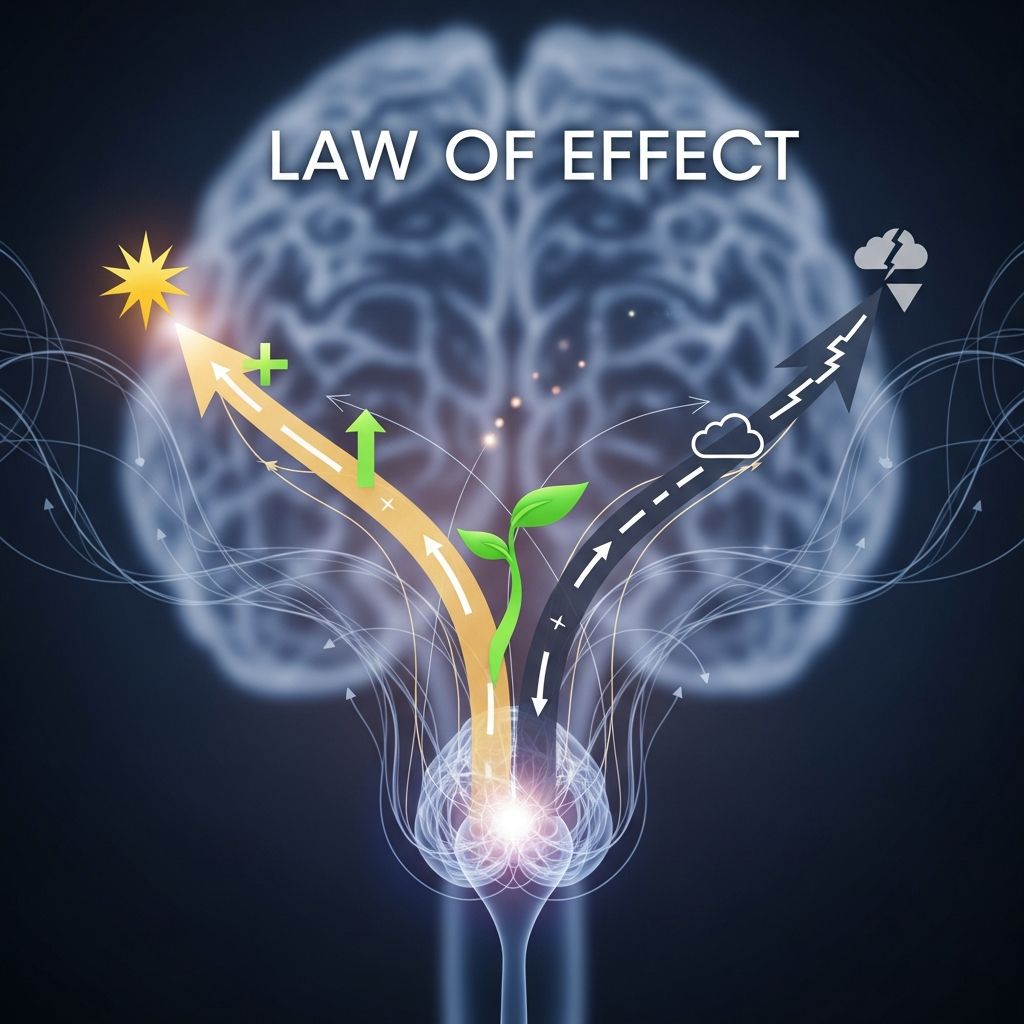
Edward Thorndike’s Law of Effect stands as a cornerstone in understanding how consequences drive learning and behavior change. This principle asserts that actions leading to rewarding results tend to recur, while those yielding discomfort diminish over time.
Origins of a Behavioral Revolution
In the late 19th and early 20th centuries, psychology shifted toward observable behaviors, distancing from introspective methods. Edward Lee Thorndike, born in 1874, emerged as a key figure at Columbia University. His work bridged animal experimentation and human learning theories, profoundly influencing B.F. Skinner’s operant conditioning.
Thorndike’s insights stemmed from dissatisfaction with prevailing associationist views. He emphasized trial-and-error learning, where outcomes directly mold response probabilities. This marked a departure from Pavlov’s stimulus-response focus, highlighting voluntary actions shaped by results.
Core Principle Explained
The Law of Effect, formalized around 1905, posits: in a given situation, responses producing satisfaction strengthen their situational connection, increasing recurrence likelihood. Conversely, discomfort weakens these bonds, reducing repetition.
Satisfaction acts as reinforcement, forging robust stimulus-response (S-R) links. Discomfort serves as a deterrent. Thorndike quantified this through repeated observations, noting efficiency gains in rewarded behaviors.
- Positive Effect: Rewarding outcomes boost behavior probability.
- Negative Effect: Unsatisfying results suppress future occurrences.
- Immediacy Matters: Closer temporal proximity between action and consequence enhances impact.
Landmark Puzzle Box Experiments
Thorndike’s genius shone in puzzle box studies with cats. Confined in wooden crates with escape mechanisms like levers or strings, cats received fish rewards upon exit. Initially frantic, they scratched and bit randomly.
With trials, escape times plummeted—from minutes to seconds—as successful actions dominated. Graphs showed learning curves: steep initial drops, flattening as mastery set in. This demonstrated gradual association strengthening, not insightful leaps.
| Trial Number | Average Escape Time (seconds) | Key Observation |
|---|---|---|
| 1-3 | 120-150 | Random trial-and-error dominant |
| 4-7 | 60-90 | Partial success patterns emerge |
| 8-12 | 20-40 | Efficient lever-pressing routine |
| 13+ | <10 | Automatic, near-instant escape |
These findings underscored consequence-driven learning, replicable across species.
Related Laws: Exercise and Readiness
Thorndike proposed companion principles. The Law of Exercise included Use (repetition strengthens S-R bonds) and Disuse (inactivity weakens them). Later revisions emphasized effect over mere practice.
The Law of Readiness added: acting per preparation yields satisfaction; opposition causes annoyance. Multiple responses to one stimulus vary in strength, with strongest prevailing.
These formed Thorndike’s connectionism, positing learning as neural bond formation.
Path to Operant Conditioning
Thorndike’s ideas inspired John Watson’s behaviorism and B.F. Skinner’s radical refinement. Skinner discarded unobservable S-R bonds, focusing on response-consequence rates in Skinner boxes.
Operant conditioning classifies reinforcements: positive (adding pleasure), negative (removing pain), alongside punishments. Schedules—fixed, variable—optimize persistence, echoing Thorndike’s satisfaction emphasis.
Transforming Education Practices
Educators apply the Law of Effect via immediate feedback and rewards. Praise for correct answers reinforces participation; consistent application builds habits.
Classroom token economies exemplify this: points for tasks exchangeable for privileges, boosting engagement. Data shows improved compliance and grades. Negative effects deter disruptions through timeouts, minimizing recurrence.
- Positive reinforcement: Stickers for homework completion.
- Shaping: Incremental rewards for complex skills.
- Extinction: Ignoring minor misbehaviors to fade them.
Applications in Therapeutic Interventions
Behavioral therapies leverage the Law for habit change. Cognitive Behavioral Therapy (CBT) uses exposure with rewards to counter phobias. Habit reversal trains competing responses, reinforced positively.
In addiction treatment, contingency management offers vouchers for clean tests, exploiting satisfaction to supplant drug rewards. Efficacy proven in clinical trials.
Hypnotherapy integrates it, pairing suggestions with reinforcing states for lasting change.
Everyday Implications for Personal Growth
Beyond labs, the principle guides self-improvement. Fitness apps reward streaks with badges, sustaining exercise. Habit trackers apply extinction by logging lapses without self-rebuke.
Parenting uses it: praising sharing strengthens prosociality. Workplace gamification—leaderboards, bonuses—drives productivity via competition-fueled satisfaction.
Critiques and Modern Evolutions
Critics note oversimplification: cognitive factors like expectations modulate effects. Neuroscience reveals dopamine’s role in reward prediction, refining Thorndike’s model.
Despite evolutions, the core endures. Contemporary studies contrast habitual (effect-driven) vs. goal-directed actions, validating its mechanisms.
Frequently Asked Questions
What is the Law of Effect in simple terms?
Behaviors followed by good outcomes repeat more; bad outcomes make them less likely.
Who discovered it and how?
Edward Thorndike via cat puzzle box experiments in the early 1900s.
How does it differ from classical conditioning?
Classical pairs stimuli involuntarily; Effect focuses on voluntary action consequences.
Is it still relevant today?
Yes, foundational to behavior therapy, education, and apps.
Can it explain human habits?
Absolutely; rewards build routines, lack thereof breaks them.
This principle illuminates behavior’s plasticity. By harnessing consequences mindfully, individuals and societies foster adaptive patterns, honoring Thorndike’s legacy.
References
- The Law of Effect: How Consequences Influence Behavior — Just Weighing. 2023. https://justweighing.com/blogs/wisdoms-many-facets/the-wisdom-of-work/the-law-of-effect-reinforcement-extinction-how-these-forces-negate-self-motivation.html
- Thorndike’s Law of Effect and Its Influence on Modern Behaviour Management — TeachHQ. 2023. https://teachhq.com/article/show/thorndikes-law-of-effect-and-its-influence-on-modern-behaviour-management
- Thorndike’s Law of Effect: Foundations and Applications in Therapy — Institute of Clinical Hypnosis. 2023. https://instituteofclinicalhypnosis.com/psychotherapy-coaching/cbt/thorndikes-law-of-effect/
- Edward Thorndike: The Law of Effect — Simply Psychology. 2023-10-15. https://www.simplypsychology.org/edward-thorndike.html
- Thorndike’s law of effect — Britannica. 2024. https://www.britannica.com/science/Thorndikes-law-of-effect
- Thorndike’s law of effect and its inconsistent description over the years — PMC (NIH). 2023. https://pmc.ncbi.nlm.nih.gov/articles/PMC12687759/

Medha Deb is an editor with a master's degree in Applied Linguistics from the University of Hyderabad. She believes that her qualification has helped her develop a deep understanding of language and its application in various contexts. Medha specializes in the areas of beauty, health, sports, and wellness and is committed to ensuring that the content on the website is…