
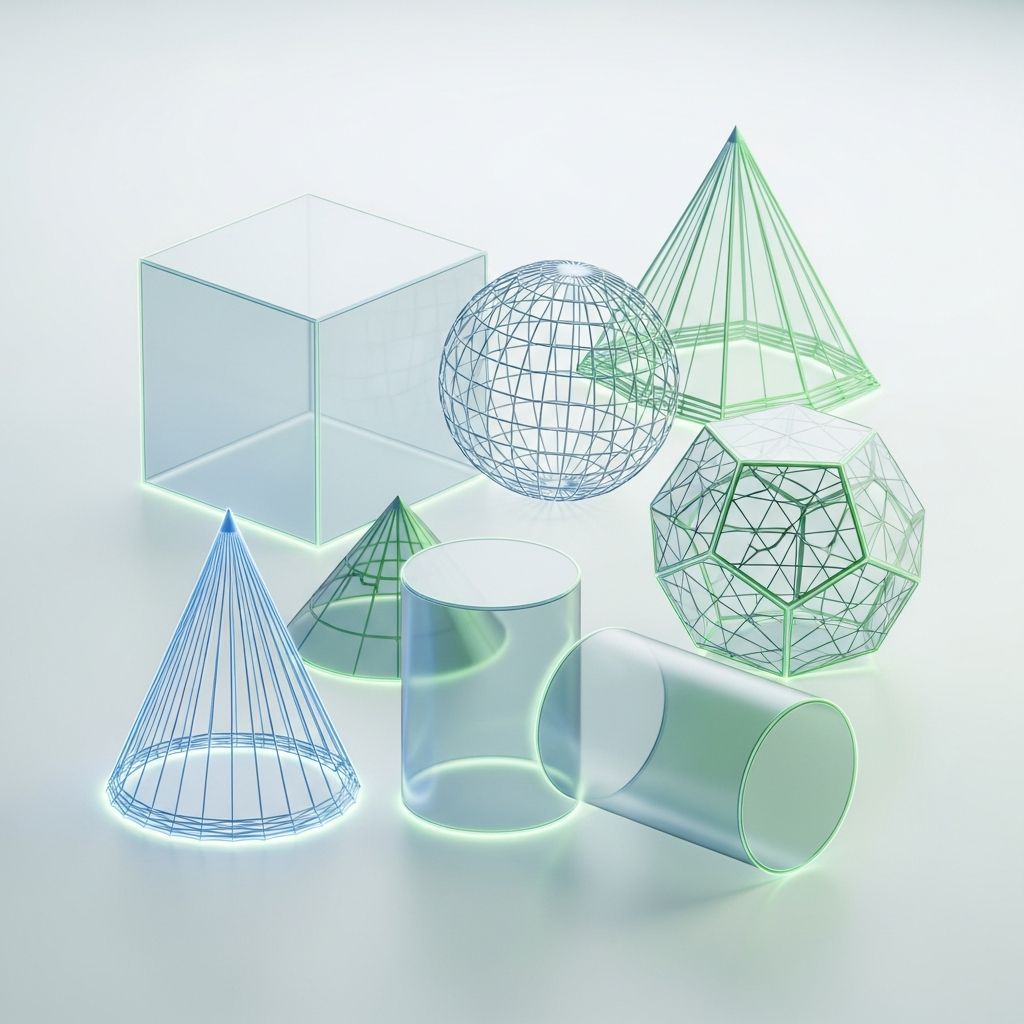
Three-dimensional geometric forms represent the foundation of spatial mathematics and are fundamental to understanding the physical world around us. Unlike two-dimensional shapes that exist on a flat plane, three-dimensional structures possess depth, width, and height, allowing them to occupy actual space. These shapes are not merely abstract mathematical concepts; they appear everywhere in nature and human-made environments, from the spherical surface of a planet to the rectangular structure of buildings.
Defining Spatial Geometric Structures
A three-dimensional shape is a solid object that can be physically held and manipulated. These forms extend across three axes simultaneously, distinguishing them from their two-dimensional counterparts. The primary characteristic that separates three-dimensional geometry from planar geometry is the addition of depth—the z-axis—which creates volume and spatial presence.
The classification of three-dimensional shapes generally falls into two major categories: polyhedra and non-polyhedra forms. This distinction determines not only how we analyze and describe the shapes but also how we calculate their surface areas and volumes.
Categories of Three-Dimensional Shapes
Angular Structures with Flat Surfaces
Polyhedra are three-dimensional shapes composed exclusively of flat polygonal surfaces. These geometric forms do not contain any curved elements, making their mathematical analysis more straightforward in many contexts. The faces of polyhedra—the flat surfaces that compose them—are always polygons such as triangles, squares, or rectangles.
Within the polyhedra category, several important subcategories emerge:
- Prisms: These shapes feature two identical and parallel polygonal bases connected by rectangular or parallelogram sides. The cross-section remains constant throughout the height of the shape.
- Pyramids: Characterized by a single polygonal base with triangular faces that converge at a single apex point. The nature of the base polygon determines the specific type of pyramid.
- Platonic Solids: These are regular polyhedra where all faces are identical regular polygons. This category includes the tetrahedron, cube, octahedron, dodecahedron, and icosahedron.
Curved and Mixed Surface Forms
In contrast to angular polyhedra, non-polyhedra shapes feature curved surfaces. These geometric forms cannot be constructed from flat polygon faces alone. The most common examples include spheres, cones, and cylinders, each with distinct properties and applications.
Essential Components of Three-Dimensional Shapes
Understanding three-dimensional geometry requires familiarity with three fundamental components that describe every solid shape:
| Component | Definition | Characteristics |
|---|---|---|
| Faces | The flat or curved surfaces that form the boundary of a shape | Can be polygonal (flat) or curved; represent the exterior of the solid |
| Edges | The straight lines formed where two faces meet | Present in polyhedra but absent in smooth curved shapes like spheres |
| Vertices | The corner points where three or more edges intersect | Also called corners; represent the geometric extremities of angular shapes |
These three properties work together to define the structural characteristics of any three-dimensional shape. By counting and analyzing faces, edges, and vertices, mathematicians can classify and distinguish between different geometric forms.
Common Polyhedra and Their Characteristics
The Cube
The cube represents the most regular and symmetrical polyhedron. This shape possesses 6 square faces, 12 edges, and 8 vertices. All faces are congruent squares, and all internal angles measure 90 degrees. Cubes appear frequently in practical applications, from dice to storage boxes to architectural designs. The regularity of the cube makes it invaluable for calculation and construction purposes.
The Rectangular Prism
Similar to the cube but without the requirement that all dimensions be equal, the rectangular prism or cuboid features 6 rectangular faces, 12 edges, and 8 vertices. While the cube is a special case where all rectangles are squares, the general rectangular prism allows for variation in dimensions. This shape is ubiquitous in everyday life—books, boxes, buildings, and furniture predominantly utilize this form for practical reasons.
Pyramidal Structures
Pyramids possess a polygonal base and triangular faces that meet at a single point called the apex. The specific classification of a pyramid depends on the shape of its base. A square pyramid has a square base with four triangular faces, while a triangular pyramid (tetrahedron) has a triangular base with three triangular faces. The properties of pyramids vary depending on their base shape, but all share the characteristic of having faces that narrow to a point.
Prism Variations
Prisms extend beyond rectangular forms. A triangular prism features two triangular bases connected by three rectangular faces. Pentagonal and hexagonal prisms follow the same principle with their respective polygonal bases. These shapes maintain consistent cross-sections throughout their length, making them geometrically predictable and useful in structural applications.
Platonic Solids
The five Platonic solids represent the only regular polyhedra possible in three-dimensional space. These shapes possess remarkable symmetry properties:
- The tetrahedron contains four equilateral triangular faces
- The octahedron contains eight equilateral triangular faces
- The dodecahedron contains twelve regular pentagonal faces
- The icosahedron contains twenty equilateral triangular faces
- The cube contains six square faces
These solids appear not only in mathematical study but also in nature, crystallography, and philosophical representations of classical elements.
Non-Polyhedra: Curved Geometric Forms
The Sphere
The sphere represents the purest expression of three-dimensional symmetry. This shape is formed by rotating a circle in three-dimensional space, creating a surface where all points remain equidistant from a central point. Notably, a sphere possesses 1 curved face, 0 edges, and 0 vertices. This absence of edges and vertices distinguishes spheres from all polyhedra. Spheres appear throughout nature: planets, stars, bubbles, and cells. In practical applications, spheres represent the optimal form for containing maximum volume with minimum surface area.
The Cylinder
Cylinders feature 2 parallel circular bases connected by a curved lateral surface. This shape contains 3 faces, 2 edges, and 0 vertices. Unlike cones, which taper to a point, cylinders maintain consistent circular cross-sections throughout their height. Cylinders are fundamental to engineering and manufacturing, appearing in pipes, tubes, containers, and mechanical components.
The Cone
A cone consists of a circular base that gradually tapers to a single point called the apex. This shape contains 2 faces, 1 edge, and 1 vertex. Cones introduce the concept of slant height—the distance from the apex to any point on the circumference of the base—which differs from the perpendicular height. Cones appear in nature as tree shapes and man-made objects such as traffic cones and ice cream cones.
The Torus
A torus represents a more complex curved form created by revolving a small circle around a larger circle in three-dimensional space. This shape resembles a doughnut or tire. The torus possesses the unusual property of having no edges, vertices, or flat faces. Unlike simpler curves, the torus creates a surface of revolution with a hole through its center, generating fascinating mathematical properties studied in advanced geometry.
Dimensional Properties and Measurements
Every three-dimensional shape occupies space defined by three perpendicular measurements: length, width, and height. These dimensions determine the volume—the amount of space the shape occupies—and surface area—the total area of all external surfaces.
For polyhedra with faces, vertices, and edges, Euler’s formula provides a fundamental relationship: the number of faces plus the number of vertices minus the number of edges always equals 2 (F + V – E = 2). This elegant mathematical principle holds true for all convex polyhedra and provides a checking mechanism for proper identification and counting of shape components.
Regular Versus Irregular Three-Dimensional Forms
Regular three-dimensional shapes have all faces that are congruent regular polygons. The cube exemplifies regularity with its six identical square faces. In contrast, irregular shapes possess faces of different sizes or shapes. A rectangular prism with different length, width, and height dimensions represents an irregular form.
This distinction matters significantly for mathematical calculations and visual recognition. Regular shapes display perfect symmetry from all viewing angles, while irregular shapes may look different depending on the perspective from which they are observed.
Three-Dimensional Nets and Construction
A two-dimensional representation of a three-dimensional shape is called a net. These unfolded patterns show how a three-dimensional shape can be laid flat while preserving the connectivity of its faces. Understanding nets aids in visualization and construction:
- A cube net consists of six connected squares that fold into a cube form
- A rectangular prism net shows six rectangles arranged to form the flat pattern
- A cylinder net displays two circles and a rectangle that connects them
- A pyramid net reveals a polygonal base surrounded by triangular faces
Nets are valuable educational tools for understanding how three-dimensional structures decompose into manageable two-dimensional components.
Real-World Applications and Examples
Three-dimensional geometric forms are not abstract mathematical curiosities; they are fundamental to our physical reality:
- Architecture: Buildings utilize rectangular prisms for efficiency and structural stability
- Natural formations: Crystals form as polyhedra, while celestial bodies approximate spheres
- Everyday objects: Dice are cubes, basketballs are spheres, traffic cones are cones, and tents are triangular prisms
- Historical monuments: The pyramids of Giza represent square pyramids, demonstrating ancient geometric understanding
- Engineering: Cylinders and prisms form the basis of pipes, beams, and structural components
Common Questions About Three-Dimensional Geometry
- What is the primary distinction between polyhedra and non-polyhedra?
- Polyhedra consist exclusively of flat polygonal faces, while non-polyhedra contain curved surfaces. This fundamental difference affects how these shapes are analyzed and measured.
- Why do spheres have no edges or vertices?
- Spheres are formed through continuous curvature in all directions. Without any flat sections or corners, they possess only a single curved surface without any points of geometric intersection.
- How do prisms differ from pyramids?
- Prisms have two congruent parallel bases connected by flat sides, maintaining consistent cross-sections. Pyramids have a single base with triangular faces converging at an apex point.
- What makes the Platonic solids special?
- Only five regular polyhedra exist where all faces are identical regular polygons and all vertices are identical. These special solids possess remarkable symmetry properties found nowhere else in geometry.
- How do nets help understand three-dimensional shapes?
- Nets provide two-dimensional representations of three-dimensional shapes, showing how flat patterns can be folded to create spatial forms. This visualization technique aids in understanding shape structure and construction.
Conclusion
Three-dimensional geometric forms provide the mathematical language for describing and understanding the spatial world. From simple cubes and spheres to complex Platonic solids and toruses, these shapes demonstrate the elegant principles underlying three-dimensional geometry. Whether encountered in natural formations, architectural designs, or mathematical study, understanding the properties, classifications, and characteristics of three-dimensional shapes enriches our comprehension of both abstract mathematics and the tangible world surrounding us.
References
- 3D Shapes — BYJU’S. Accessed February 6, 2026. https://byjus.com/maths/3d-shapes/
- 3D Geometry Shapes – Definition, Properties, Types, Formulas — Cuemath. Accessed February 6, 2026. https://www.cuemath.com/geometry/3d-shapes/
- 3D Shapes in Geometry | Definition, Properties, Types, Examples — EduSeed. Accessed February 6, 2026. https://eduseed.in/math/3d-shapes/
- 3D Shape Names – Math Steps, Examples & Questions — Third Space Learning. Accessed February 6, 2026. https://thirdspacelearning.com/us/math-resources/topic-guides/geometry/3d-shape-names/
- 3D-shapes — Math.net. Accessed February 6, 2026. https://www.math.net/3d-shapes
- Three Dimensional Shapes (3D Shapes) – Definition, Examples — SplashLearn. Accessed February 6, 2026. https://www.splashlearn.com/math-vocabulary/geometry/3-dimensional
- What Is a 3D Shape? – Types of 3D shapes — Twinkl. Accessed February 6, 2026. https://www.twinkl.com/teaching-wiki/3d-shapes
- Properties of 3D shapes facts by PlanBee — PlanBee. Accessed February 6, 2026. https://planbee.com/pages/properties-of-3d-shapes

- Integrated M.A. in Applied Linguistics, University of Hyderabad
- 5+ years in editorial, instructional, SEO, and research-based writing
Sneha is a relationships and lifestyle writer with a strong foundation in applied linguistics and certified training in relationship coaching. She brings over five years of writing experience to theskillvault, crafting thoughtful, research-driven content that empowers readers to build healthier relationships, boost emotional well-being, and embrace holistic living. Her writing and insights reflect the belief that beauty, happiness, and wellness…