
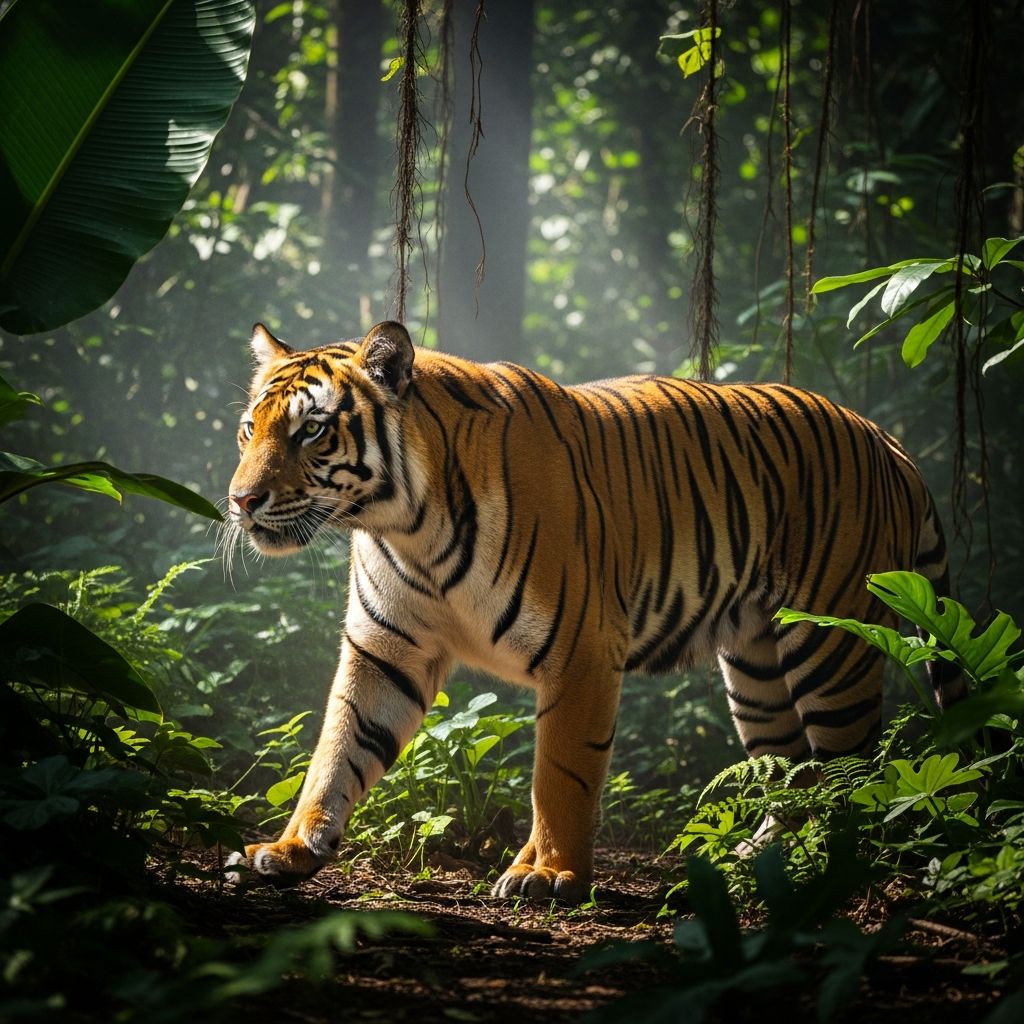
Tigers (Panthera tigris) stand as the largest members of the big cat family, renowned for their striking orange coats adorned with bold black stripes. Native exclusively to Asia, these apex predators embody raw power and stealth, thriving in diverse ecosystems from dense forests to open grasslands.
Physical Characteristics and Adaptations
The tiger’s body is a masterpiece of evolutionary design, built for ambush hunting and survival in varied terrains. Adults possess a muscular frame, broad shoulders, and exceptionally large paws equipped with retractable claws that can extend up to 10 centimeters. Their heads are massive, housing powerful jaws capable of exerting a bite force of around 1,000 pounds per square inch, sufficient to crush bone.
Orange fur patterned with vertical black stripes provides perfect camouflage among tall grasses and dappled forest light, allowing tigers to blend seamlessly with their surroundings. This disruptive coloration breaks up their outline, making them nearly invisible to prey until it’s too late. A long, thick tail aids in balance during high-speed chases, while soft, padded toe pads enable silent stalking.
Sexual dimorphism is evident: males are typically 20-30% larger than females. An average male tiger measures 2.7 to 3.3 meters from nose to tail tip and weighs 180-300 kilograms, rivaling the size of a grizzly bear. Females are smaller, around 2.5 meters long and 100-160 kilograms.
| Subspecies | Average Male Length | Average Male Weight | Habitat |
|---|---|---|---|
| Siberian (Amur) | 3 meters (10 ft) | 300 kg (660 lbs) | Russian Far East, Northeast China |
| Bengal | 2.8-3.1 meters | 220 kg (485 lbs) | India, Bangladesh, Nepal |
| Sumatran | 2.4 meters (8 ft) | 140 kg (310 lbs) | Sumatra, Indonesia |
| Malayan | 2.4 meters | 200 kg (440 lbs) | Peninsular Malaysia |
These variations reflect adaptations to local prey availability and climates; northern tigers grow larger to conserve heat in colder regions.
Diverse Habitats Across Asia
Tigers occupy a wide array of environments, from the frigid taiga of Siberia to tropical rainforests of Sumatra. They prefer areas with dense cover for ambushes, such as mangrove swamps, deciduous and evergreen forests, and riverine grasslands. In the Russian Far East, Siberian tigers navigate snowy coniferous forests, while Bengal tigers roam the lush terai grasslands and sundarbans mangroves of India.
- Temperate Forests: Siberian tigers endure harsh winters in mixed broadleaf and conifer zones, traveling up to 12 miles nightly in search of prey.
- Tropical Lowlands: Sumatran tigers inhabit dense jungles and peat swamps, where high humidity supports year-round hunting.
- Grasslands and Savannas: Bengal tigers dominate India’s open plains, using reeds for cover.
Historically, their range spanned from eastern Turkey to the Sea of Japan, but today it’s fragmented into isolated pockets covering just 5% of former territory.
Subspecies: Variations in Form and Range
Experts recognize six extant subspecies, each uniquely adapted to its locale. Though classifications vary, with some proposing only two broad groups (mainland and island tigers), the traditional six are widely accepted.
- Siberian (Amur) Tiger: The giants of the north, once roaming Korea but now confined to Russia and China. Critically low numbers due to poaching.
- Bengal Tiger: Most numerous, comprising half of wild tigers in India and neighboring countries. Versatile hunters of deer and wild boar.
- Indochinese Tiger: Elusive dwellers of Thailand, Myanmar, and Laos, facing habitat loss from agriculture.
- Malayan Tiger: Smaller but robust, in Malaysia’s peninsula forests.
- Sumatran Tiger: The smallest, island-exclusive, critically endangered by palm oil plantations.
- South China Tiger: Possibly extinct in the wild, surviving only in captivity.
Extinct subspecies like the Caspian tiger highlight human impact; last sighted in the 1970s, they once prowled Central Asia.
Hunting Strategies and Diet
As solitary apex predators, tigers rely on stealth and explosive power. They stalk prey—primarily ungulates like sambar deer, wild pigs, and gaurs—for distances up to 500 meters before launching a surprise attack. A single paw swipe can shatter a cow’s spine, and they drag kills weighing up to 1,000 kg to secluded spots.
Daily intake averages 5-7 kg of meat, but they can gorge 30-40 kg post-kill. Tigers cache uneaten portions, covering them with leaves to deter scavengers. Opportunistic feeders, they take water buffalo, monkeys, and even small elephants in groups. In prey-scarce areas, they resort to livestock, fueling human-tiger conflicts.
Social Structure and Reproduction
Tigers are mostly solitary, except mothers with cubs. Males maintain territories of 50-1000 square kilometers, marked by urine, scrapes, and roars audible over 3 km. Females’ ranges overlap multiple males’ for mating.
Gestation lasts 3.5 months, yielding 2-4 cubs. Blind at birth, cubs depend on milk for 6 months and stay with mom until age 2-3, learning survival skills. Mortality is high; only 30% reach adulthood due to infanticide by males, starvation, or injury.
Conservation Crisis: From 100,000 to Peril
A century ago, 100,000 tigers roamed Asia; now, only about 5,500 remain in the wild, a 95% decline. India holds nearly 3,000, but others teeter on extinction’s edge.
Threats include:
- Habitat Loss: Deforestation for logging and farming fragments ranges.
- Poaching: Body parts fetch high black-market prices for traditional medicine.
- Prey Depletion: Overhunting of deer and boar starves tigers.
- Human-Wildlife Conflict: Livestock raids lead to retaliatory killings.
All subspecies are endangered or critically so. Captive tigers outnumber wild ones in places like the US, complicating conservation genetics.
Global Efforts to Save the Tiger
Initiatives like WWF’s TX2 campaign aim to double wild populations by 2022, with partial success. India’s Project Tiger, launched 1973, expanded protected reserves, boosting numbers. Camera traps, anti-poaching patrols, and habitat corridors are key. Community programs incentivize coexistence via compensation for losses.
Rewilding South China tigers and genetic management in zoos offer hope. International bans on tiger trade under CITES have curbed demand.
Frequently Asked Questions (FAQs)
What is the largest tiger subspecies?
The Siberian (Amur) tiger is the largest, males reaching 300 kg and 3 meters long.
Why are tigers endangered?
Habitat destruction, poaching, and prey loss have reduced populations by 96% since 1900.
How do tigers hunt?
They use stealthy ambushes, silent padded paws, and powerful strikes to take down ungulates.
Where do most wild tigers live today?
India hosts about half of the world’s remaining 5,500 wild tigers.
Can tigers swim?
Yes, excellently; they swim rivers miles long to hunt or cross territories.
References
- Tiger — Wikipedia. 2026-04-01. https://en.wikipedia.org/wiki/Tiger
- 15 incredible tiger facts — International Fund for Animal Welfare. 2023-05-15. https://www.ifaw.org/journal/15-incredible-tiger-facts
- A guide to tigers — The Big Cat Sanctuary. 2024-02-20. https://thebigcatsanctuary.org/news/a-guide-to-tigers/
- Tigers: Endangered Species Facts — WWF Canada. 2025-01-10. https://wwf.ca/species/tigers/
- Top 10 facts about Tigers — WWF-UK. 2023-11-08. https://www.wwf.org.uk/learn/fascinating-facts/tigers
- Where Do Tigers Live? Tiger Facts — World Wildlife Fund. 2024-07-12. https://www.worldwildlife.org/resources/facts/where-do-tigers-live-and-other-tiger-facts/

Medha Deb is an editor with a master's degree in Applied Linguistics from the University of Hyderabad. She believes that her qualification has helped her develop a deep understanding of language and its application in various contexts. Medha specializes in the areas of beauty, health, sports, and wellness and is committed to ensuring that the content on the website is…