
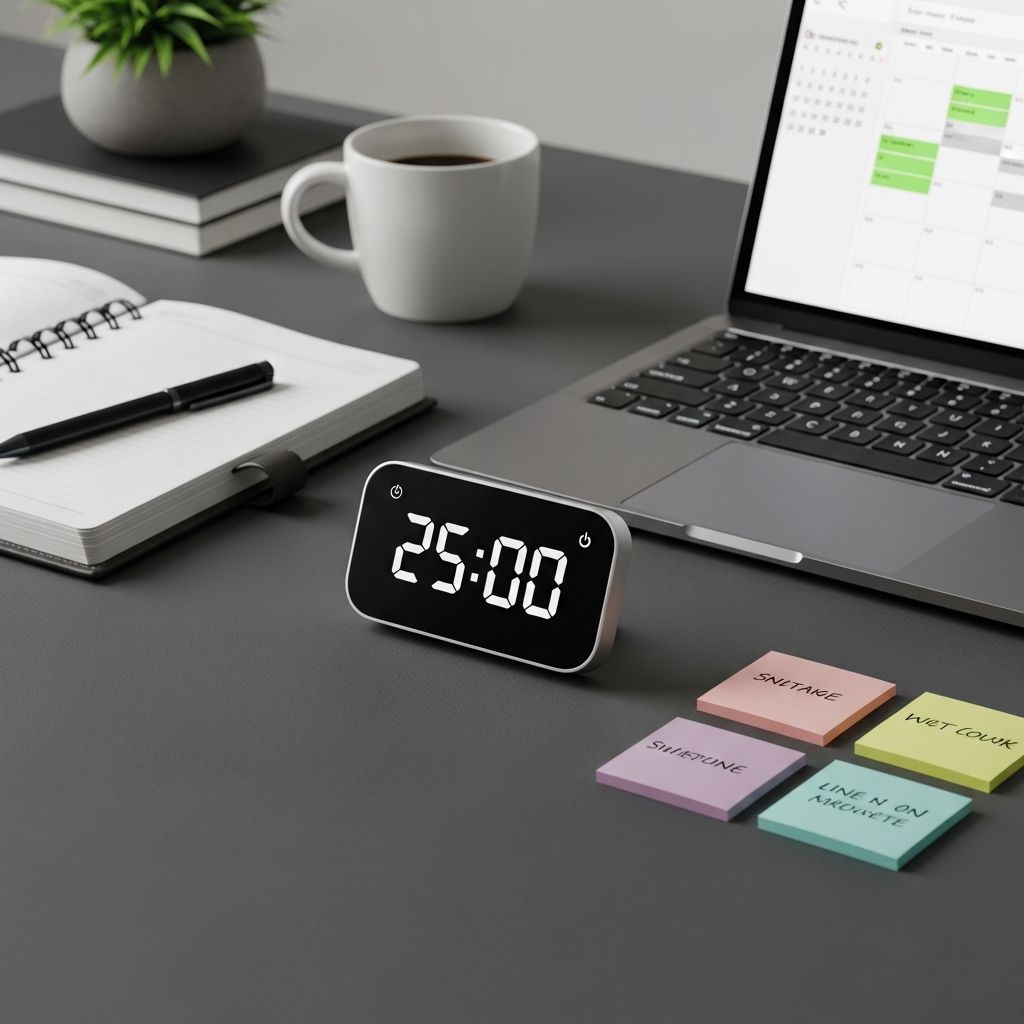
Timeboxing revolutionizes how you approach daily tasks by assigning fixed time slots to activities, creating structure amid chaos. This method, ranked the most effective productivity technique in a survey of 100 methods, counters the natural tendency of work to expand indefinitely.
Understanding the Essence of Timeboxing
At its heart, timeboxing involves pre-allocating a specific duration for each task and adhering strictly to it, regardless of completion status. This differs from open-ended to-do lists by introducing deliberate boundaries that foster urgency and completion. Originating from principles like Parkinson’s Law—where work fills available time—this technique compels efficiency.
Imagine dividing your day into discrete ‘boxes’ for emails (25 minutes), project planning (45 minutes), and breaks (10 minutes). When the timer ends, you transition, preventing any single activity from dominating your schedule.
Scientific Foundations: Why Timeboxing Delivers Results
Research underscores timeboxing’s efficacy. A Harvard Business Review analysis highlighted it as the premier productivity hack, transforming vague lists into actionable calendars. Studies show time constraints sharpen decision-making by promoting habitual strategies and narrowing focus, leading to quicker resolutions even if minor details are sidelined.
Moderate pressure from timeboxes reduces cognitive overload, making overwhelming projects digestible. A review in the International Journal of Environmental Research and Public Health noted that balanced constraints curb overthinking, enhance prioritization, and elevate performance—provided they avoid excessive stress.
Key Advantages for Daily Productivity
- Heightened Concentration: Dedicating exclusive slots signals your brain to prioritize the task, minimizing distractions and boosting deep work sessions.
- Procrastination Buster: Fixed limits create urgency, pushing you past initial resistance on dreaded tasks.
- Multitasking Reducer: Single-task focus within boxes eliminates context-switching costs, where the brain expends energy reorienting between activities.
- Burnout Prevention: Built-in breaks recharge energy, sustaining long-term output without exhaustion.
- Superior Prioritization: Forces ranking tasks by impact, ensuring high-value work gets prime slots.
Brain Science Behind the Magic
During timeboxed sessions, the prefrontal cortex ramps up distraction filtering, enabling sustained attention. This triggers eustress—a positive stress variant that motivates without overwhelming, unlike chronic distress. Pre-setting durations also spares decision fatigue, conserving mental resources for execution over endless planning.
Aligning boxes with natural energy peaks—deep tasks for mornings, routine ones for afternoons—optimizes performance. Low energy mismatching leads to errors; synchronization accelerates completion.
Practical Steps to Implement Timeboxing
- List and Prioritize: Catalog tasks, then select high-focus ones, urgent duties, or perfectionist traps using methods like ‘top three urgent, easy three quick wins’.
- Allocate Slots: Estimate realistic durations—start with 25-50 minutes for focus work—factoring in breaks.
- Schedule Firmly: Block calendar slots, treating them as unbreakable appointments.
- Timer Discipline: Use a visible timer; stop at buzzer, even mid-task, to maintain momentum.
- Review and Adjust: Post-session, assess output and refine estimates for accuracy.
Advanced Variations for Tailored Efficiency
Customize timeboxing to fit your style. Hard timeboxing enforces rigid cutoffs, ideal for deadlines or email marathons, building discipline. Soft variants offer flexibility for creative pursuits, using timers as gentle nudges.
Task batting alternates short bursts (15 minutes) between disparate activities—like writing and data analysis—leveraging novelty to sustain engagement and avert fatigue.
| Variation | Best For | Duration | Key Benefit |
|---|---|---|---|
| Hard Timeboxing | Deadlines, routine tasks | Fixed, strict | Discipline, speed |
| Soft Timeboxing | Creative, complex work | Flexible end | Adaptability |
| Task Batting | Mixed cognitive loads | 15-min alternates | Fresh focus |
Overcoming Common Hurdles
Initial overestimation plagues beginners; track actual times to calibrate. Distractions? Designate a quiet zone and silence notifications. For teams, shared calendars and timers keep meetings concise. Perfectionists benefit most, as enforced stops curb endless tweaks.
Start small: timebox one daily segment, scaling as habits form. Tools like timers or apps provide real-time tracking, boosting motivation through visible progress.
Real-World Applications Across Scenarios
Professionals use it for focused sprints amid meetings; students for study blocks. Parents batch household chores, freeing evenings. In teams, it streamlines collaborations by capping discussions. A survey revealed 50% of workers productive under 5 hours daily—timeboxing bridges that gap.
Frequently Asked Questions (FAQs)
What exactly is timeboxing?
Timeboxing assigns a fixed time slot to a task in advance, working intensely until the timer ends, then moving on.
Is timeboxing suitable for creative work?
Yes, soft timeboxing provides flexibility for ideas to flow while preventing indefinite stalling.
How does it differ from Pomodoro?
Pomodoro uses fixed 25-minute intervals with breaks; timeboxing customizes durations and schedules tasks into calendars.
Can teams adopt timeboxing?
Absolutely—use shared timers for meetings to ensure agendas stay on track and discussions remain productive.
What if a task overruns its box?
Reschedule the remainder into a future slot; this prevents one task from derailing the day.
Long-Term Transformation Through Consistent Practice
Adopting timeboxing yields compounding gains: sharper focus, reclaimed hours, and reduced stress. It aligns with circadian rhythms, matching task intensity to energy levels for sustained output. Over weeks, you’ll notice faster task throughput and clearer calendars.
Research affirms its edge; integrate it via simple calendars or apps for frictionless execution. This isn’t mere scheduling—it’s reclaiming control, turning potential into achievement.
References
- How Timeboxing Can Transform Your Productivity (and How to Do It with Super Productivity) — Johannes Jo. 2023 (approx.). https://dev.to/johannesjo/how-timeboxing-can-transform-your-productivity-and-how-to-do-it-with-super-productivity-in4
- The Timeboxing Technique: A Comprehensive Guide — UseMotion Blog. 2023 (approx.). https://www.usemotion.com/blog/timeboxing-technique.html
- Timeboxing: The goal-oriented time management technique — Asana Resources. 2023 (approx.). https://asana.com/resources/what-is-timeboxing
- Timeboxing: What Is It and How to Use It — Clockify. 2023 (approx.). https://clockify.me/timeboxing
- How Timeboxing Works and Why It Will Make You More Productive — Harvard Business Review (Marc Zao-Sanders). 2018-12-01. https://hbr.org/2018/12/how-timeboxing-works-and-why-it-will-make-you-more-productive

- Integrated M.A. in Applied Linguistics, University of Hyderabad
- 5+ years in editorial, instructional, SEO, and research-based writing
Sneha is a relationships and lifestyle writer with a strong foundation in applied linguistics and certified training in relationship coaching. She brings over five years of writing experience to theskillvault, crafting thoughtful, research-driven content that empowers readers to build healthier relationships, boost emotional well-being, and embrace holistic living. Her writing and insights reflect the belief that beauty, happiness, and wellness…