
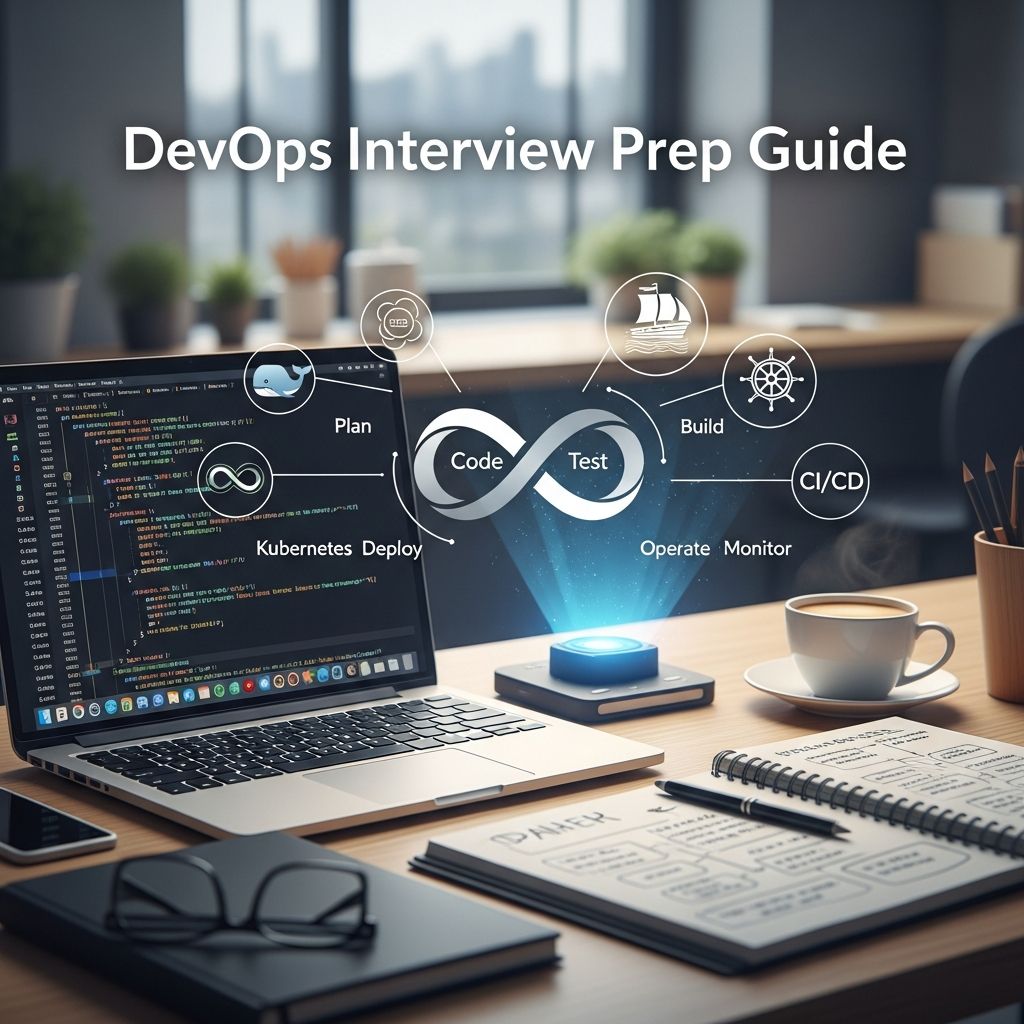
Landing a DevOps role demands a blend of technical prowess, cultural alignment, and problem-solving under pressure. This guide equips you with curated questions, detailed responses, and preparation tips drawn from industry standards to help you excel.
Core DevOps Principles and Lifecycle
Interviews often start with foundational knowledge to gauge your understanding of DevOps philosophy. DevOps bridges development and operations through automation, collaboration, and continuous improvement, accelerating software delivery while maintaining stability.
The typical DevOps lifecycle encompasses planning, coding, building, testing, releasing, deploying, operating, and monitoring—forming an infinite loop of feedback and iteration. Expect questions like:
- Describe the DevOps lifecycle and its stages.
- Sample Response: It begins with planning requirements, moves to coding in version control, automated building via CI tools, rigorous testing, release packaging, deployment to environments, operational monitoring, and feedback loops for refinement.
- What distinguishes DevOps from Agile?
- Sample Response: Agile focuses on iterative development; DevOps extends this by integrating operations for end-to-end automation and deployment speed.
CI/CD Pipelines: Building and Deploying at Scale
CI/CD is the heartbeat of DevOps, enabling frequent, reliable releases. Continuous Integration merges code changes frequently with automated tests, while Continuous Delivery/Deployment automates releases to production.
Popular tools include Jenkins for orchestration, GitHub Actions for YAML-based workflows, GitLab CI/CD for integrated pipelines, and CircleCI for cloud-native speed.
Key CI/CD Interview Questions
| Question | Key Points in Answer | Tools Mentioned |
|---|---|---|
| Walk through setting up a CI/CD pipeline from scratch. | Assess workflows, select source control (Git), integrate build tools, add testing stages, implement deployment strategies like blue-green, monitor with alerts. | Jenkins, GitHub Actions |
| What is Pipeline-as-Code? | Defining pipelines in version-controlled files (e.g., Jenkinsfile or .gitlab-ci.yml) for reproducibility and collaboration. | GitLab CI, Jenkins |
| Explain blue-green and canary deployments. | Blue-green: Two identical environments for zero-downtime switches. Canary: Gradual rollout to subset of users for risk mitigation. | Kubernetes, AWS |
To design a scalable pipeline, incorporate autoscaling agents, dependency caching, environment-specific workflows, and approval gates.
Infrastructure as Code (IaC) Mastery
IaC treats infrastructure provisioning as software, using declarative code for consistency and repeatability. Tools like Terraform define resources in HCL files, generate execution plans, provision via ‘apply’, manage state files, and integrate with version control.
- How does Terraform work?
- Sample Response: Write config files, run ‘plan’ for previews, ‘apply’ for changes, track state for drift detection, version everything in Git.
- What are IaC benefits?
- Sample Response: Versioning, testing, reproducibility, reduced manual errors, easier scaling.
Containerization and Orchestration Essentials
Containers package applications with dependencies for portability, orchestrated by Kubernetes for scaling and resilience. Docker builds images; Kubernetes manages pods, services, deployments, and auto-scaling.
- Compare Docker and Kubernetes.
- Sample Response: Docker containerizes apps; Kubernetes orchestrates clusters, handling scheduling, load balancing, and self-healing.
- Describe a Kubernetes deployment.
- Sample Response: YAML manifests define replicas, pods, services; kubectl apply rolls out with rolling updates and rollbacks.
Monitoring, Logging, and Observability
DevOps thrives on visibility. Key KPIs include build success rate, build/deploy time, deployment frequency, change failure rate, and mean time to recovery.
Tools: Prometheus for metrics, Grafana for dashboards, ELK Stack (Elasticsearch, Logstash, Kibana) for logs, CloudWatch for AWS-native monitoring.
- How do you ensure high availability?
- Sample Response: Auto-scaling, health checks, multi-region failover, alerting on anomalies.
Security in DevOps (DevSecOps)
Shift-left security integrates checks early. Implement RBAC, least privilege, compliance scans, and incident response in pipelines.
- What is ‘shift left’?
- Sample Response: Moving testing/security earlier in the pipeline for faster feedback.
- Secure a CI/CD pipeline.
- Sample Response: Secrets management (Vault), signed artifacts, vulnerability scans (Trivy), access controls.
Cloud and Tool-Specific Deep Dives
Cloud platforms like AWS, Azure, GCP demand familiarity. Azure DevOps offers boards, repos, pipelines, artifacts for lifecycle management. GitHub Actions automates workflows triggered by events.
- Azure DevOps components?
- Sample Response: Unified platform for planning, coding, building, testing, deploying.
Behavioral and Scenario-Based Questions
Showcase soft skills with STAR (Situation, Task, Action, Result). Examples:
- Tell me about a failed deployment.
- Sample Response: Situation: Pipeline error in prod. Task: Rollback fast. Action: Used blue-green, fixed config. Result: 5-min recovery, added pre-prod gates.
- How do you collaborate with developers?
- Sample Response: Pair programming, shared repos, joint retrospectives, embedding in standups.
Advanced System Design Challenges
Design a global app: Multi-cloud Kubernetes clusters, service mesh (Istio), CDN, database sharding, chaos engineering for resilience.
Preparation Strategies for Success
Research company stack (e.g., if AWS-heavy, master EC2, Lambda). Practice on LeetCode for coding, build personal projects (GitHub repo with pipeline). Ask insightful questions: ‘What’s your deployment frequency?’ or ‘Current observability challenges?’.
Entry-level: Focus on basics, Linux commands, scripting (Bash/Python). Senior: Architecture, cost optimization, GitOps.
Frequently Asked Questions
What are top DevOps KPIs?
Deployment frequency, lead time for changes, mean time to recovery, change failure rate.
Best tools for beginners?
Docker, Jenkins, Terraform, Git for version control.
How to handle production incidents?
Triage with SLOs, rollback if needed, post-mortem for root cause.
Difference between CI and CD?
CI builds/tests merges; CD automates releases.
What is GitOps?
Declarative infrastructure via Git as single source of truth, automated by tools like ArgoCD.
References
- 40 Interview Questions to Ask a DevOps Engineer — BrightHire. 2024. https://brighthire.com/interview-questions/devops-engineer/
- DevOps Engineer Interview Questions and Answers — The Interview Guys. 2024. https://blog.theinterviewguys.com/devops-engineer-interview-questions-and-answers/
- Top 50 Popular DevOps Interview Questions — Roadmap.sh. 2024. https://roadmap.sh/questions/devops
- DevOps Interview Questions & Answers: The Ultimate Guide for 2025 — Dev.to. 2024. https://dev.to/sameerimtiaz/devops-interview-questions-answers-the-ultimate-guide-for-2025-48lm
- Entry-Level DevOps Interview Questions — University of Kentucky. 2024-08-04. https://pigmancareers.uky.edu/blog/2024/08/04/entry-level-devops-interview-questions-with-answers/
- Mastering the Art of DevOps Interview Questions — TriCom. 2024. https://tricomts.com/resources/mastering-the-art-of-devops-interview-questions-a-comprehensive-guide

- Integrated M.A. in Applied Linguistics, University of Hyderabad
- 5+ years in editorial, instructional, SEO, and research-based writing
Sneha is a relationships and lifestyle writer with a strong foundation in applied linguistics and certified training in relationship coaching. She brings over five years of writing experience to theskillvault, crafting thoughtful, research-driven content that empowers readers to build healthier relationships, boost emotional well-being, and embrace holistic living. Her writing and insights reflect the belief that beauty, happiness, and wellness…