
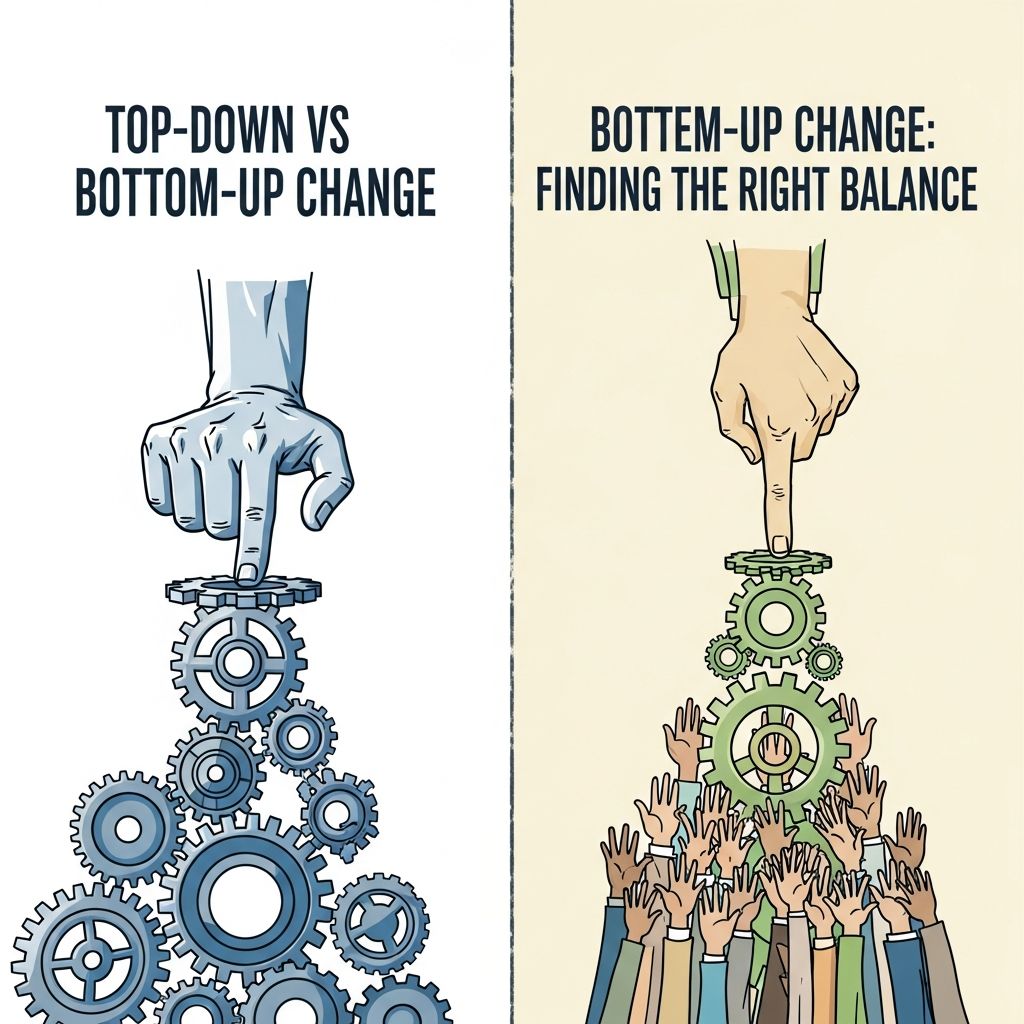
Organizations rarely stand still. Market disruption, new technologies, regulatory shifts, and evolving customer expectations all require leaders to guide people through continuous change. A central question in this process is whether change should be driven from the top down, from the bottom up, or through a deliberate combination of both.
This article explores how each approach works, the advantages and risks, and how leaders can design a blended strategy that delivers fast, sustainable, and human-centered transformation.
Understanding Top-Down and Bottom-Up Change
Although every change initiative is unique, most strategies cluster around two core patterns: leadership-driven and employee-driven change.
What is Top-Down Change?
Top-down change management occurs when senior leaders define the vision, goals, and roadmap, then cascade direction through the hierarchy for implementation. Decisions on what will change, when, and how are largely made at executive or senior management level.
Typical characteristics include:
- Strategic vision and objectives are set by executives.
- Change plans and timelines are designed centrally.
- Communication flows primarily downward (announcements, town halls, memos).
- Employees are tasked with execution rather than co-design.
What is Bottom-Up Change?
Bottom-up change management emphasizes participation, feedback, and initiative from employees across the organization. While leaders still provide direction, people closest to the work shape solutions and influence decisions.
Common features include:
- Employees contribute ideas, pain points, and improvement suggestions.
- Teams co-create processes, tools, and workflows.
- Feedback loops are built into design, testing, and rollout.
- Change champions and informal leaders play a visible role.
Core Differences Between the Two Approaches
The two approaches differ in who initiates change, how decisions are made, and how information flows.
| Dimension | Top-Down Change | Bottom-Up Change |
|---|---|---|
| Primary driver | Executives and senior leaders | Employees and teams, guided by leadership |
| Decision-making | Centralized, few decision-makers | Distributed, many contributors |
| Speed of initial decisions | Typically fast | Typically slower due to consultation |
| Employee involvement | Lower during design; higher in execution | High throughout design and implementation |
| Risk of resistance | Higher if change feels imposed | Lower if people feel ownership |
| Adaptability during rollout | Can be rigid unless leaders seek feedback | More adaptive, continuous adjustments |
Strengths of Top-Down Change
Top-down processing can be particularly valuable in high-stakes or time-pressured situations.
- Clarity of direction: Executives can articulate a unified vision and a small number of strategic priorities, which helps teams align their efforts.
- Speed of decision-making: Fewer stakeholders making decisions means critical moves—such as entering a new market or responding to regulatory change—can happen quickly.
- Strong accountability: When leaders own the decisions, it is clear who is responsible for outcomes, budgets, and timelines.
- Consistent standards: Top-down design can ensure policies, compliance, and brand standards are applied uniformly across business units or regions.
Risks and Limitations of Top-Down Change
Despite these strengths, a purely top-down approach carries significant risks if used in isolation.
- Limited insight into daily realities: Leaders may miss process nuances, technical constraints, or customer issues that frontline staff understand well, leading to designs that look good on paper but fail in practice.
- Resistance and low engagement: Research in organizational behavior consistently links lack of involvement with higher resistance to change and lower commitment. Employees are more likely to push back if they feel change is “done to” them rather than “with” them.
- Communication bottlenecks: When information flows mainly one way, issues surface late, and myths or rumors can spread faster than official updates.
- Rigid plans: Highly centralized decision-making can struggle to adapt once rollout begins, especially if plans are detailed and fixed early.
Strengths of Bottom-Up Change
Bottom-up approaches tap into the knowledge, creativity, and motivation of people who perform the work every day.
- Deeper understanding of work and customers: Employees at the front line see process failures, workarounds, and unmet customer needs long before executives do, making their input essential for realistic solutions.
- Higher engagement and ownership: Studies in participative management show that involvement in decisions tends to increase motivation, job satisfaction, and acceptance of change. When people help design the change, they are more invested in making it succeed.
- More innovation: Diverse perspectives across departments and roles often generate novel, practical improvements that leadership alone might overlook.
- Continuous improvement culture: Encouraging ideas from all levels helps organizations move beyond “one big transformation” toward ongoing, incremental change.
Challenges of Bottom-Up Change
Left unmanaged, bottom-up efforts can become fragmented, slow, or misaligned with strategy.
- Slower decision cycles: Gathering input, running workshops, and building consensus takes time and facilitation effort—an issue when deadlines are tight.
- Risk of misalignment: Local optimizations (for a team or function) may conflict with enterprise-wide objectives if leadership doesn’t provide clear strategic guardrails.
- Higher coordination costs: Effective bottom-up change requires robust communication channels, feedback mechanisms, and governance to integrate ideas into a coherent direction.
- Uneven participation: Without intentional design, some groups may participate actively while others remain passive, skewing input.
When Top-Down Change Makes Sense
Although participatory approaches are powerful, certain situations call for a predominantly top-down strategy.
- Crisis response: During emergencies (e.g., cybersecurity breaches, major compliance issues), organizations need rapid, decisive action. Centralized decision-making helps contain risk and provide clear direction quickly.
- Non-negotiable compliance or safety changes: When regulations, legal rulings, or safety standards change, leaders must often issue directives that leave limited room for debate.
- Organization-wide repositioning: Major shifts in strategy—exiting markets, redefining the business model, or large-scale restructuring—typically originate at the top.
- Early-stage vision setting: Defining the overall “why” and “where we are going” is usually a leadership responsibility, even if teams later shape the “how.”
When Bottom-Up Change is Especially Valuable
In most non-crisis scenarios, organizations benefit from emphasizing bottom-up processing, with leaders framing the direction and boundaries.
- System and process implementations: Enterprise technology projects, such as ERP or workflow automation, are more successful when future users contribute to requirements, design, and testing. This improves usability and adoption.
- Customer experience improvements: Frontline employees see customer frustrations and opportunities daily; their insights are crucial for redesigning journeys and touchpoints.
- Innovation and product development: Bottom-up idea generation can surface new offerings, features, or process improvements that increase competitiveness.
- Culture and engagement initiatives: Efforts to strengthen collaboration, inclusion, or leadership behaviors must reflect real employee experiences to be credible and effective.
Designing a Hybrid Approach to Change
In practice, the most effective change programs combine the strengths of both approaches: strategic clarity from the top and authentic involvement from the bottom.
Key Design Principles
- Lead with purpose and constraints: Executives articulate the vision, business case, and non-negotiables (e.g., regulatory requirements, deadlines). This establishes a clear frame for employee-driven innovation.
- Create structured participation channels: Use mechanisms such as design workshops, pilot teams, digital suggestion platforms, or cross-functional working groups to gather input systematically rather than informally.
- Establish governance for alignment: A change steering group or governance board can review proposals from teams, ensuring they align with strategy, budget, and risk appetite.
- Iterate rather than announce once: Treat the change plan as a living roadmap. Gather feedback, adjust timelines or processes, and communicate updates transparently.
- Invest in change capabilities: Provide training and coaching in basic change skills—such as communication, stakeholder engagement, and experimentation—so that managers and employees can participate effectively.
Practical Tactics to Blend Top-Down and Bottom-Up
Leaders can operationalize a hybrid approach with simple but powerful practices:
- Vision from the top, solutions from the bottom: Leaders define outcomes (e.g., “reduce cycle time by 20%”) and invite teams to propose how to achieve them.
- Pilots and prototypes: Instead of rolling out a new process to everyone at once, test with a few volunteer teams, then refine and scale based on their input.
- Change champions network: Identify employees across functions who are respected by peers, train them in change methods, and involve them in communication and feedback-gathering.
- Transparent decision logs: When leadership accepts, adapts, or declines bottom-up suggestions, explain why. This builds trust and keeps expectations realistic.
- Shared metrics: Track a mix of business outcomes (e.g., productivity, error rates) and people measures (e.g., engagement, adoption) so both leaders and teams can see progress.
Leadership Behaviors that Enable Effective Change
Successful change is influenced as much by leadership behavior as by methodology. The most effective leaders:
- Listen actively: They seek out honest perspectives from different levels, including dissenting voices, and genuinely use that input.
- Communicate consistently: They explain the rationale for change, repeat key messages, and adapt the narrative for different audiences.
- Model the change: They adopt new processes, tools, or behaviors themselves, signaling that change is not optional or superficial.
- Empower local decisions: Within defined boundaries, they give teams authority to adapt implementation to local contexts.
- Recognize contributions: They highlight teams and individuals who contribute ideas, solve problems, and help others adapt.
Measuring Whether Change is Sticking
Declaring a change “complete” at go-live is a common mistake. Sustainable change requires tracking outcomes and behavior over time.
- Adoption and usage: Monitor how many people are using new systems or processes as intended (e.g., system logins, process compliance rates).
- Business impact: Track performance metrics tied to the original objectives (e.g., cost, quality, customer satisfaction, cycle time).
- Employee sentiment: Use surveys, focus groups, and 1:1s to understand how people feel about the change, where they are struggling, and what support they need.
- Issue resolution speed: Measure how quickly implementation issues or defects are identified and addressed, which reflects both governance and feedback mechanisms.
Frequently Asked Questions (FAQs)
Q1. Is bottom-up change always better than top-down change?
No. Bottom-up approaches generally build more engagement and better fit with day-to-day work, but in crises or highly regulated situations, a stronger top-down stance may be essential. The most effective strategies blend clear leadership direction with meaningful employee involvement.
Q2. How can leaders reduce resistance to top-down decisions?
Leaders can reduce resistance by clearly explaining the reasons for change, being transparent about constraints, involving employees in how decisions are implemented, and responding visibly to input where possible. Even when the “what” is non-negotiable, there is often room for participation in the “how.”
Q3. What are simple ways to start bottom-up change in a traditional hierarchy?
Start small by running improvement workshops with frontline teams, creating a digital feedback channel with commitments to respond, or launching pilots where volunteers test new processes. Use early successes to demonstrate value and gradually expand participation mechanisms.
Q4. How do we avoid bottom-up change becoming fragmented?
Establish clear strategic priorities, define decision rights, and create a governance group to review and integrate ideas. Communicate which types of decisions are local versus enterprise-wide, and align bottom-up proposals with shared metrics and objectives.
Q5. What role does middle management play in change?
Middle managers translate strategy into local action. They are critical connectors between top-down direction and bottom-up input: they contextualize messages, support teams through transition, surface risks upward, and enable experimentation within their areas.
References
- Top-Down vs. Bottom-Up Change Management: Which is Better? — Panorama Consulting Group. 2023-03-15. https://www.panorama-consulting.com/top-down-vs-bottom-up-change-management-which-is-better/
- Top-Down vs. Bottom-Up Management: Definition and Difference — Indeed Editorial Team. 2023-08-18. https://www.indeed.com/career-advice/career-development/top-down-vs-bottom-up
- Top-Down vs. Bottom-Up Management — Touro University Worldwide. 2022-11-10. https://www.tuw.edu/business/top-down-bottom-up-management/
- Top-Down Approach vs. Bottom-Up Approach — Asana. 2025-01-05. https://asana.com/resources/top-down-approach
- Bottom-Up vs. Top-Down Management Styles — edX. 2023-06-21. https://www.edx.org/resources/what-does-it-mean-to-manage-bottom-up-vs-top-down

- Integrated M.A. in Applied Linguistics, University of Hyderabad
- 5+ years in editorial, instructional, SEO, and research-based writing
Sneha is a relationships and lifestyle writer with a strong foundation in applied linguistics and certified training in relationship coaching. She brings over five years of writing experience to theskillvault, crafting thoughtful, research-driven content that empowers readers to build healthier relationships, boost emotional well-being, and embrace holistic living. Her writing and insights reflect the belief that beauty, happiness, and wellness…