
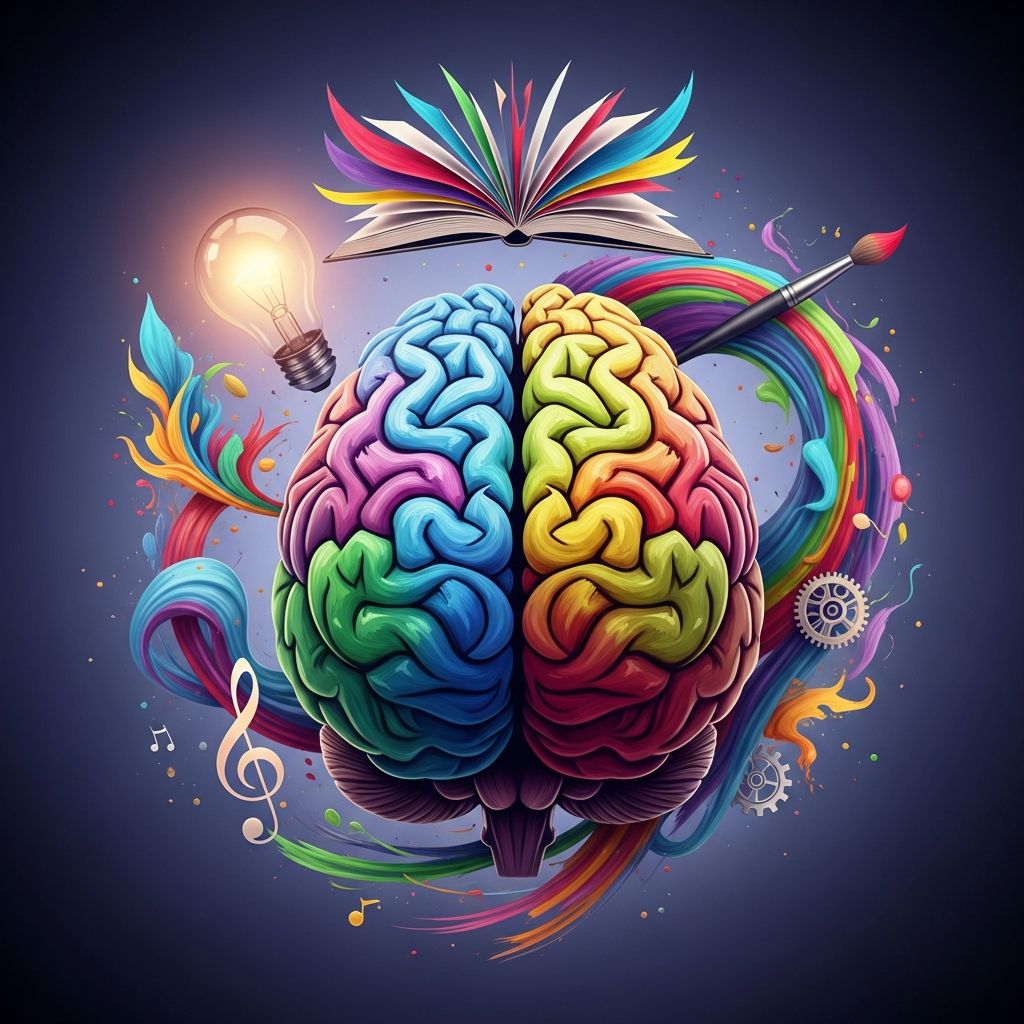
Creativity drives innovation across fields, from art to science, and stems from distinct cognitive and behavioral patterns in highly creative individuals. These people exhibit unique ways of thinking, feeling, and acting that set them apart, enabling them to generate novel ideas and solutions consistently.
The Neurological Foundations of Creativity
Research reveals that creative brains operate differently, engaging multiple networks simultaneously for enhanced idea generation. Creative individuals show greater flexibility in activating brain regions that typically do not collaborate, allowing for fluid thought processes amid challenges. This neurological wiring supports both divergent thinking—producing many ideas—and convergent thinking—refining them into viable outcomes.
Studies highlight how the imagination network, salience network for motivation, and executive attention network interact dynamically during creative tasks. Initially, immersive flow states dominate with high imagination activity, followed by focused refinement as executive functions engage. Such cognitive agility distinguishes creative minds, fostering originality without rigidity.
Embracing Inner Worlds Through Daydreaming and Solitude
Highly creative people frequently immerse themselves in daydreaming, detaching from immediate surroundings to explore mental landscapes. This mental wandering fuels unconventional connections and fresh perspectives, serving as a key habit for idea incubation.
- Daydreaming allows assimilation of new information into existing knowledge, aiding pattern recognition.
- Solitude provides essential space for deep reflection, where individuals process emotions and insights without external distractions.
Personal creative spaces, like studios or quiet nooks, amplify this by offering environments tailored for uninterrupted focus. These sanctuaries enable thriving in personal worlds, blending discipline with imaginative freedom.
Passion as the Driving Force
Deep passion propels creative pursuits, often sparked by profound experiences or relationships. It acts as emotional fuel, balanced with practical strategies to sustain long-term efforts. Creative individuals channel this energy realistically, combining visionary dreaming with diligent action.
Followed intrinsically, passions lead to sustained motivation, even amid doubts about viability. This heartfelt commitment overrides external negativity, keeping creators aligned with their core drives.
Openness: Gateway to New Experiences
The strongest predictor of creative achievement is openness to experience, encompassing intellectual curiosity, aesthetic appreciation, and emotional depth. This trait encourages exploration of diverse ideas, arts, and emotions, enhancing integrative complexity—the ability to link disparate information.
| Aspect of Openness | Impact on Creativity |
|---|---|
| Intellectual | Drives truth-seeking and idea engagement |
| Aesthetic | Fosters fantasy immersion and beauty absorption |
| Affective | Explores human emotions profoundly |
Practical steps like trying new mediums, routes, or social groups cultivate this openness, yielding higher-quality creative output beyond mere intellect.
Flexibility and Originality in Thinking
Creative minds excel in fluency—generating abundant ideas—and flexibility—shifting approaches fluidly. They produce unusual solutions, viewing situations from multiple angles objectively, which enriches problem-solving.
- Originality involves unconventional uses of concepts or objects.
- Flexibility counters mental fixedness, promoting diverse idea types.
This adaptability extends to self-assessment; creators may drastically reevaluate their work overnight, guided by intuition over rigid logic. Such shifts reflect emotional sensitivity and rapid idea evolution.
Discipline Paired with Playfulness
Contrary to stereotypes, highly creative people demonstrate self-discipline and persistence, developing and refining ideas persistently. They balance playful exploration—treating ideas as intellectual games—with rigorous execution.
Humor emerges spontaneously from conceptual twists, lightening the creative process. This playfulness coexists with determination, enabling risk-taking and nonconformity without personalizing failures.
Sensitivity and Emotional Depth
Heightened sensitivity to nuances, problems, and emotions characterizes creative individuals. They notice overlooked details, derive inspiration from surroundings, and make feeling-based decisions, with emotions shifting dynamically.
This emotional fuel supports deep dives into philosophical questions on purpose and legacy. Loving and observant, they express beauty through art and spread positivity.
Ambiverted Social Dynamics
Often ambiverts, creative people navigate introversion and extroversion adeptly, enjoying solitude yet collaborating effectively. Their nonconformist streak fosters rebellion against conventions, paired with skepticism toward accepted norms.
Tolerance for ambiguity thrives in uncertainty, extracting patterns from chaos. Self-confidence and a sense of mission enable independent work.
Observational Sharpness and Memory
Exceptional memory and recall draw from vast life experiences for creative synthesis. Keen observers, they people-watch and absorb subtle environmental cues, transforming observations into inspiration.
Awareness of imperfections drives improvement without personal attachment, cutting through distractions to core issues.
Cultivating Creativity: Practical Strategies
To nurture these traits, integrate habits like mindful play, intuitive trust, and deliberate mind-wandering. Embrace paradoxes—mindfulness with wandering, solitude with collaboration—for fuller self-expression.
Above-average intelligence aids analysis, but curiosity and persistence matter more. Skepticism sharpens critical evaluation, while adaptability keeps minds agile across interests.
Frequently Asked Questions (FAQs)
Can anyone develop creative traits?
Yes, habits like openness, daydreaming, and disciplined practice can enhance creativity, though innate wiring influences baseline potential.
Why do creative people need solitude?
Solitude fosters flow states for idea generation, allowing networks to engage freely without interruption.
How does passion sustain creativity?
It provides emotional motivation, balanced with realistic strategies for long-term achievement.
Is nonconformity essential for creativity?
It enables risk-taking and original thinking, viewing failures as growth opportunities.
What role does sensitivity play?
It heightens awareness of details and emotions, fueling intuitive and original ideas.
These traits interconnect, forming a mindset where imagination meets execution. By adopting them, individuals unlock innovative potential in daily life.
References
- Traits of Highly Creative People — Susan Elizabeth Jones. 2023-05-15. https://www.susanejones.com/post/traits-of-highly-creative-people
- Characteristics of the Creative Individual — Andy Eklund. 2022-11-10. https://andyeklund.com/characteristics-of-the-creative-individual/
- Ten Habits of Highly Creative People — Greater Good Science Center, UC Berkeley. 2024-03-22. https://greatergood.berkeley.edu/article/item/ten_habits_of_highly_creative_people
- 10 Characteristics Of Highly Creative People — SongTown. 2023-08-07. https://songtown.com/on-songwriting/10-characteristics-of-highly-creative-people/

Medha Deb is an editor with a master's degree in Applied Linguistics from the University of Hyderabad. She believes that her qualification has helped her develop a deep understanding of language and its application in various contexts. Medha specializes in the areas of beauty, health, sports, and wellness and is committed to ensuring that the content on the website is…