
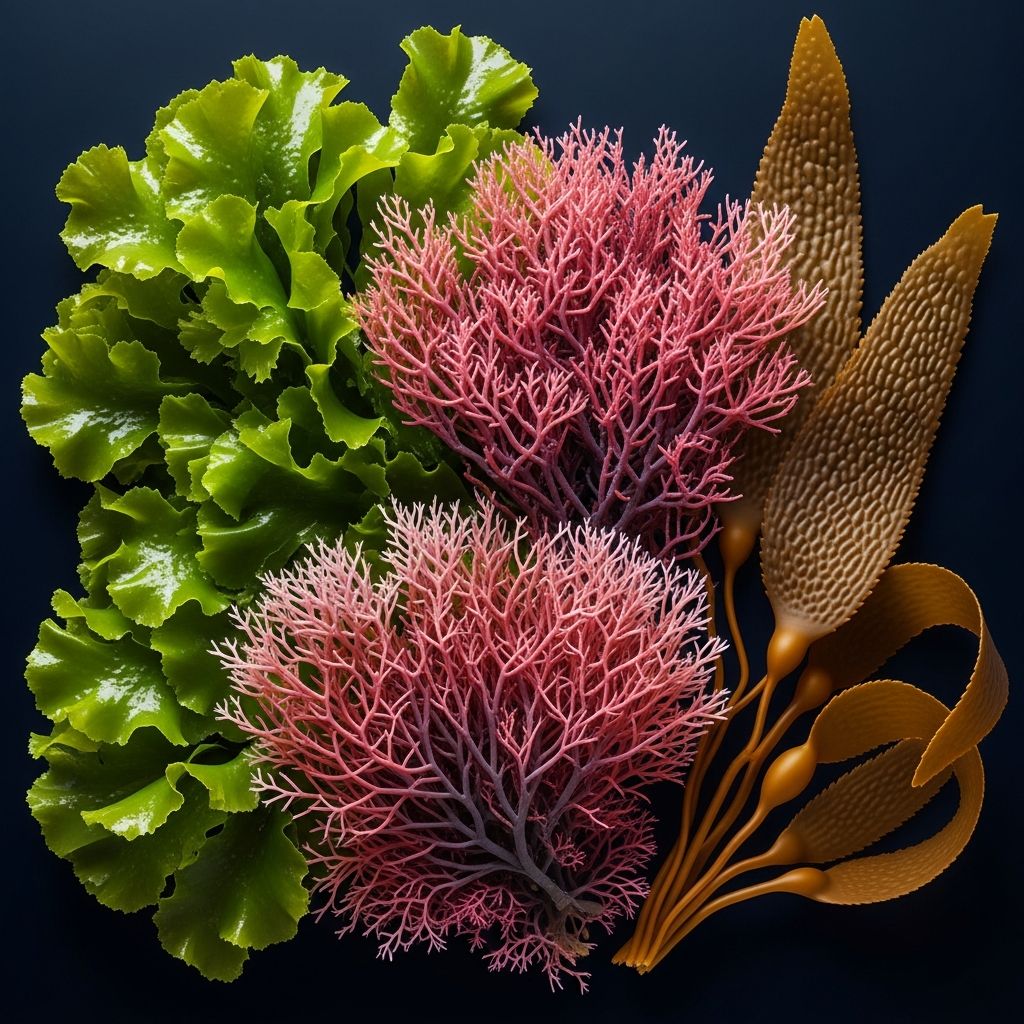
Algae represent a vast and varied group of photosynthetic organisms that thrive in aquatic and moist environments worldwide. Unlike plants, they lack true roots, stems, and leaves, yet they play pivotal roles in oxygen production, food chains, and even industrial applications. This article examines the primary classifications of algae, highlighting their biological features, preferred habitats, and contributions to ecosystems and society.
Understanding Algae: Foundations and Classifications
Algae encompass a polyphyletic assembly of organisms capable of photosynthesis, ranging from single-celled microbes to large multicellular forms. They inhabit oceans, freshwater bodies, soils, and even extreme environments like hot springs. Classification hinges on pigmentation, cell structure, and reproductive methods. Major groups include those with chlorophyll a and b (green algae), fucoxanthin-dominant (brown algae), phycoerythrins (red algae), and silica-shelled (diatoms).
Primary algae trace their chloroplasts directly from ancient cyanobacteria, forming the Archaeplastida clade, which includes green and red lineages leading to land plants. Secondary algae, like brown forms, acquired plastids through endosymbiosis of other algae. Habitats vary: planktonic forms drift in water columns, benthic types cling to substrates, and some are epiphytic or parasitic.
Green Algae: Versatile Pioneers of Photosynthesis
Green algae, or Chlorophyta, dominate freshwater ecosystems and moist terrestrial spots. Their bright hue stems from abundant chlorophyll a and b, mirroring land plants and suggesting an evolutionary link. These organisms store energy as starch and appear in unicellular, colonial, or filamentous forms.
Common in ponds, rivers, and on damp rocks, green algae like Chlamydomonas swim via flagella, while Spirogyra forms slimy mats in streams. In aquariums, species such as Pithophora (cotton algae) create fluffy, branched structures resembling horsehair, often marked by dark akinetes—resting spores for survival.
- Unicellular forms: Free-floating or motile, essential for primary production in waters.
- Colonial types: Aggregate into spheres or plates, like Volvox, showcasing early multicellularity.
- Filamentous varieties: Cladophora and its relatives form dense, coarse mats on substrates.
Ecologically, they oxygenate waters and serve as food for zooplankton. Some, like charophytes, bridge algae and plants with complex reproductive structures protecting embryos.
Brown Algae: Giants of the Coastal Seas
Brown algae (Phaeophyceae) exclusively inhabit marine realms, particularly cold, nutrient-rich waters. Their olive-brown tones arise from fucoxanthin masking chlorophyll c. These are the largest and most structurally complex algae, with kelps reaching 50 meters.
Found attached to rocky shores or floating in sargassum rafts, they form underwater forests supporting diverse marine life. Holdfasts anchor them, stipes provide support, and blades host gas-filled bladders for buoyancy. Reproduction involves alternation of generations, with motile spores.
| Feature | Description | Examples |
|---|---|---|
| Habitat | Cold marine coasts, kelp forests | Kelp (Macrocystis), Sargassum |
| Structure | Multicellular, differentiated tissues | Holdfast, stipe, blade, pneumocysts |
| Uses | Food (nori-like), fertilizers, alginates | Food thickeners, biofuels |
Brown algae stabilize sediments, shelter fish, and supply iodine-rich foods. They face threats from warming oceans disrupting their habitats.
Red Algae: Ancient Masters of Deep Waters
Red algae (Rhodophyta), among the oldest eukaryotes, flourish in marine depths thanks to phycoerythrin absorbing blue light. Over 6,000 species exist, mostly multicellular, with cell walls rich in agar and carrageenan.
They attach via crusty bases to rocks or other algae, thriving from intertidal zones to 200+ meters deep. Non-motile, they rely on currents for dispersal. Pit connections between cells are unique structural features.
- Coralline reds: Calcify reefs, mimicking coral.
- Agarophytes: Yield gelling agents for labs and food.
- Deep-sea forms: Dominate light-scarce profundities.
Red algae underpin fisheries, cosmetics, and biotechnology, while supporting coral ecosystems vital for biodiversity.
Microscopic Powerhouses: Diatoms and Dinoflagellates
Diatoms and dinoflagellates, key phytoplankton, drive global primary production. Diatoms (Bacillariophyta) boast silica frustules—ornate glass shells—in radial or pennate shapes. Planktonic or benthic, they store oil for motility and dominate spring blooms.
Dinoflagellates, often armored with cellulose plates, feature two flagella for spinning motion. Some bioluminesce or photosynthesize symbiotically in corals. Harmful types cause red tides, producing toxins.
| Type | Key Traits | Impacts |
|---|---|---|
| Diatoms | Silica walls, golden-brown pigment | Oxygen (50% global), shellfish toxins |
| Dinoflagellates | Flagella, grooves; some toxic | Red tides, paralytic poisons |
These microalgae fuel ocean food webs but spark harmful algal blooms (HABs) affecting health and economies.
Cyanobacteria: The Blue-Green Enigma
Cyanobacteria, or blue-green algae, are prokaryotes not true algae, yet photosynthetic bacteria pivotal in evolution. They fixed Earth’s early oxygen and form stromatolites. Found in fresh and salt waters, they produce phycocyanin for blue-green hues.
In aquaria, they manifest as slimy plaques from nutrient imbalances, thriving on ammonia or low nitrates. Akinetes and heterocysts aid survival and nitrogen fixation.
- Planktonic: Bloom in eutrophic lakes, releasing hepatotoxins.
- Filamentous: Mats in moist soils or tanks.
- Symbiotic: Partner with plants like ferns.
Beneficial for fertilizers, they pose risks via HABs monitored by agencies like CDC.
Aquarium Algae: Identification and Management
Hobbyists encounter nuisance algae like green spot (GSA) on glass—small, adherent dots in balanced tanks—and black brush (BBA), tufted clumps in high-flow areas. Green beard algae forms decorative yet invasive threads. Causes include silicates, poor lighting, or imbalances; solutions involve water changes, algae eaters, and nutrient control.
Ecological and Human Significance of Algae
Algae generate 50-80% of Earth’s oxygen, base aquatic food webs, and sequester carbon. HABs from cyanobacteria, diatoms, and dinoflagellates threaten waters, tracked by CDC. Uses span biofuels from diatoms, pharmaceuticals from reds, and nutraceuticals from greens.
Climate change amplifies blooms and shifts distributions, underscoring conservation needs.
Frequently Asked Questions (FAQs)
What distinguishes true algae from cyanobacteria?
True algae are eukaryotes with nuclei; cyanobacteria are prokaryotic bacteria despite similar appearances and photosynthesis.
Which algae cause harmful blooms?
Cyanobacteria, dinoflagellates, and diatoms primarily cause HABs toxic to humans and wildlife.
Are all green algae related to land plants?
Charophyte green algae share a common ancestor with embryophytes, marked by similar reproductive protections.
How can I control algae in my aquarium?
Balance light, nutrients, and flow; use manual removal, competitors like otocinclus, and test for silicates/ammonia.
What are practical uses of brown algae?
They provide alginates for food/textiles, iodine sources, and habitat for fisheries.
References
- The Three Main Types of Algae and Their Surprising Uses — AlgenAir. 2023-05-15. https://algenair.com/blogs/news/the-three-main-types-of-algae-and-their-surprising-uses
- Types of Harmful Algal Blooms — Centers for Disease Control and Prevention (CDC). 2024-02-12. https://www.cdc.gov/harmful-algal-blooms/about/types-of-harmful-algal-blooms.html
- How to Identify Different Algae Types — SePRO Corporation. 2023-08-20. https://sepro.com/aquatics/algae-corner/algae-corner-how-to-identify-different-algae-types/
- Algae — Wikipedia (informational, primary sources referenced). 2026-04-01. https://en.wikipedia.org/wiki/Algae

Medha Deb is an editor with a master's degree in Applied Linguistics from the University of Hyderabad. She believes that her qualification has helped her develop a deep understanding of language and its application in various contexts. Medha specializes in the areas of beauty, health, sports, and wellness and is committed to ensuring that the content on the website is…